
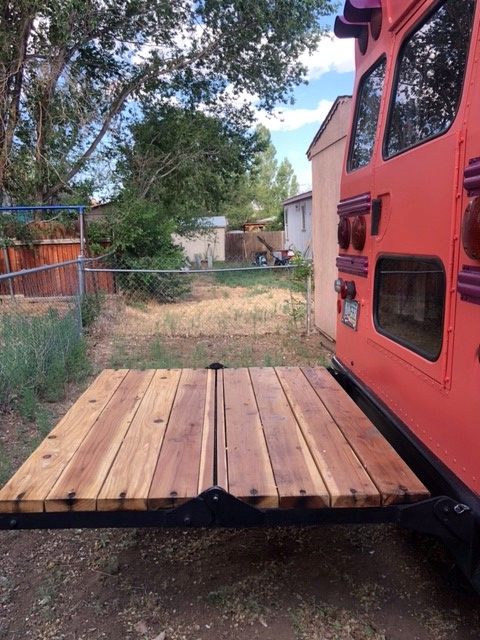
When I first started looking at buses for conversion, I kept seeing the same advice everywhere — buy a school bus, buy a school bus, buy a school bus. And yeah, school buses are great. They’re cheap, they’re everywhere, and parts are easy to find. But somewhere along the way I stumbled across a church bus listing on Facebook Marketplace and it honestly changed how I thought about the whole process.
Church buses are one of the most underrated platforms for bus conversion. They’re typically built on light-duty commercial chassis like the Ford E-450 or Chevy Express 4500, they come with dramatically lower mileage than school buses (often 40,000 to 80,000 miles), and they’ve usually been garaged and well-maintained their entire lives. The trade-offs are real though — most run gas engines instead of diesel, they sit on lighter-duty chassis with lower GVWRs, and finding them takes more effort than finding a yellow school bus at auction. For couples and solo builders who want a smaller, well-cared-for platform without the stigma of a yellow bus, a church bus conversion can be a genuinely smart move. But you need to understand what you’re getting into before you write the check.
This guide covers everything I’ve dug into about church bus conversions — what makes them different from school buses, where to find them, what they cost, what to watch out for, and whether they’re actually a good choice for your build.
What’s the difference between a church bus and a school bus?
This is the first question most people ask, and the answer is more nuanced than you’d think. On the surface, a church bus and a school bus both carry passengers and both have rows of seats. But that’s about where the similarities end.
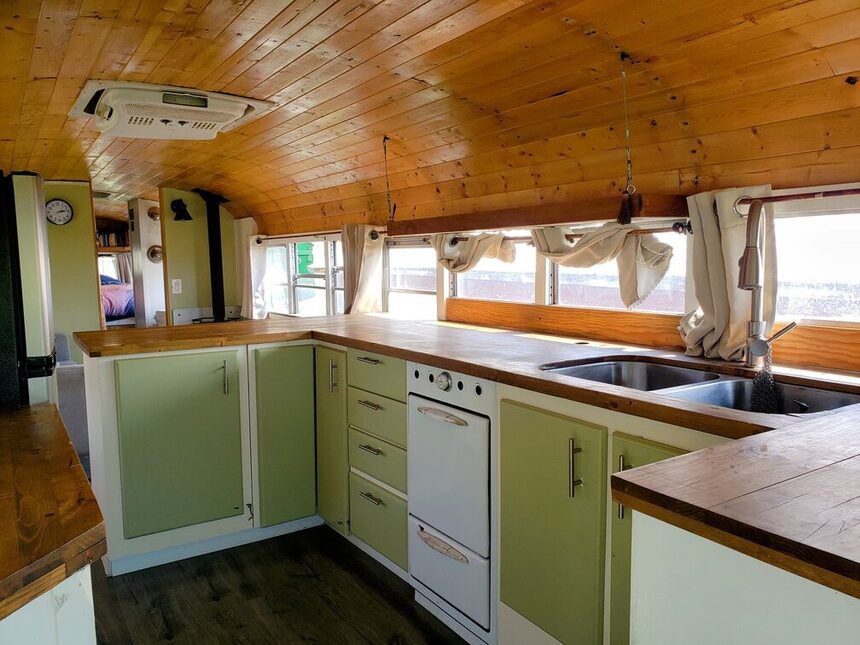
School buses are built to federal standards — FMVSS (Federal Motor Vehicle Safety Standards) specifically for school buses. These are things like the rollover protection requirements, body joint strength, fuel system integrity, and that distinctive yellow paint. School buses are built to take a beating. They haul kids twice a day, 180 days a year, over rough roads, in every kind of weather. The bodies are heavy-gauge steel bolted to purpose-built chassis from companies like Blue Bird, Thomas, and IC Bus. Most full-size school buses are Type C (conventional, with the “dog nose” hood) or Type D (flat front, transit style), riding on medium-duty chassis with diesel engines. (See our guide on Blue Bird Buses: The Complete Conversion Guide for more on this.)
Church buses are a different animal. They’re classified as commercial passenger vehicles, not school buses. That means they don’t have to meet the same federal school bus safety standards. Most church buses you’ll find are either Type A bodies (think short bus shape) built on a cutaway van chassis, or they’re basically modified shuttle buses. The chassis underneath is usually something like a Ford E-450, Chevy Express 4500 (also called the GMC Savana 4500), or occasionally a Freightliner S2 or International. (See our guide on Is a Short Bus or Full-Size Bus Better for a Conversion? for more on this.)
The body is built by a secondary manufacturer — companies like Starcraft, Glaval, ElDorado National, or Champion — who takes the bare chassis from Ford or Chevy, cuts the cab behind the front seats, and builds the passenger body onto the frame. So you end up with a Ford cab and dashboard up front, and a custom bus body behind it.
I found this distinction matters a lot for conversions. A school bus body is integrated and purpose-built. A church bus body is essentially an aftermarket addition to a commercial van or truck chassis. That has pros and cons I’ll get into below.
How the bodies differ
School buses have that signature flat-panel steel body with the squared-off windows. The ceiling height inside a standard full-size school bus is about 6 feet, sometimes a touch less. The walls are thick steel with structural ribs running vertically.
Church buses, especially the ones built on van cutaway chassis, can actually have more interior headroom than a short school bus. I’ve seen listings for church buses with 6’2″ to 6’6″ ceiling heights. Some of the nicer shuttle-style church buses were built with standing passengers in mind, not just seated, so the roof sits higher. That extra headroom is a real selling point for conversion. If you’re 6 feet tall and you’ve ever stood inside a short school bus, you know what I’m talking about.
The windows are different too. Church buses usually have larger, tinted passenger windows that are more residential-looking. Some builders actually keep these windows because they don’t scream “I live in a bus” the way school bus emergency windows do.
The seating situation
School bus seats are those awful green bench seats bolted to steel frames welded to floor tracks. They’re designed to be cheap, durable, and replaceable. Removing them is one of the first steps in any school bus conversion and it’s not a fun afternoon — those bolts are usually rusted tight and the floor tracks leave holes you need to fill.
Church bus seating varies a lot. Some have the same style bench seats as school buses. But many church buses, especially ones used for senior transport or longer trips, have individual reclining seats with armrests — more like what you’d see on a charter bus. Some even have cloth or vinyl captain’s chairs. The mounting hardware tends to be easier to remove because the bodies weren’t built to the same tank-like specs.
Are church buses good for conversion?
Short answer — yes, with caveats. I spent a lot of time going back and forth on this one because the answer really depends on what kind of build you’re doing.
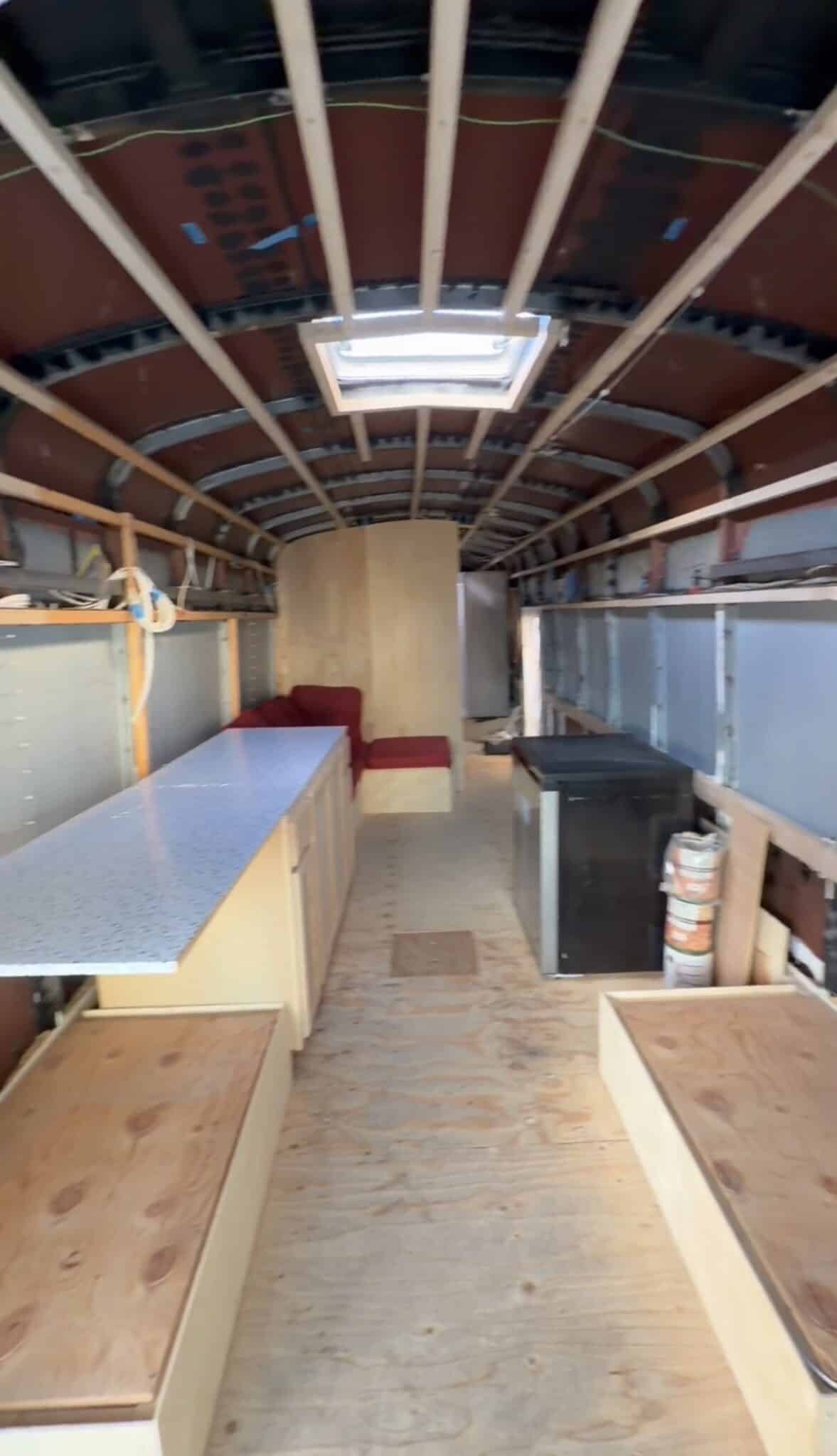
The advantages are legit
The biggest advantage of a church bus is the mileage situation. School buses get driven hard. A typical retired school bus has 150,000 to 250,000 miles on it. Some have way more. Church buses? I’ve seen them come to market with 30,000 to 80,000 miles. That’s not a typo. A bus that’s been driven to church on Sunday morning, maybe a Wednesday evening Bible study, and the occasional group trip — that’s just not putting on miles the way a daily school route does.
And it’s not just the mileage. Church buses are typically garaged. Not sitting in an open bus yard getting pounded by sun, rain, and snow like school buses. I was talking to a seller once who had a 2009 Ford E-450 church bus with 47,000 miles, and this thing had been parked inside a metal building its entire life. The paint still looked good. No rust anywhere on the undercarriage. The tires were old in years but barely worn. Compare that to a 2009 school bus with 190,000 miles that’s been sitting in an open lot since it was retired, and there’s just no comparison.
The maintenance records are often better too. Churches tend to use a single local mechanic or dealership and keep meticulous records because they’re spending congregation money and someone on the board wants receipts. I found a complete maintenance binder in the glovebox of one church bus I looked at — every oil change, every brake job, every tire rotation, documented with dates and mileage. Try getting that from a school district auction.
Another advantage people don’t talk about enough — no yellow paint to deal with. School bus yellow isn’t just cosmetic, it’s legally meaningful. Many states require you to remove all school bus markings, repaint the bus, and remove the stop sign arm and flashers before you can re-title it. With a church bus, the exterior is usually white or some neutral color. Slap your own paint scheme on it or leave it white. Nobody cares.
Now the disadvantages
Alright here’s where I have to be honest, because church buses are not a slam dunk.
The biggest issue is the engine. Most church buses on light-duty chassis run gasoline engines. We’re talking the Ford 6.8L V10 (Triton), the Ford 7.3L gas V8 (in newer ones), the Chevy/GM 6.0L Vortec V8, or even the older Ford 5.4L V8. Gas engines in a bus conversion are fine, they work, but they don’t have the longevity or the fuel economy of a diesel. A gas V10 in a loaded bus conversion is going to get you 7 to 10 MPG. A comparable diesel setup gets 10 to 14 MPG. Over 10,000 miles a year, that difference adds up fast. (See our guide on What Is the Difference Between a School Bus and a Transit Bus? for more on this.)
Gas engines also have a shorter overall lifespan. The Ford V10 is a solid engine — I’ve read accounts of them going 200,000 to 250,000 miles — but a DT466 or Cummins 5.9 in a school bus can go 300,000 to 500,000 miles before major work. When you’re building a home on wheels that you plan to live in for years, engine longevity matters.
The second issue is the chassis itself. A Ford E-450 or Chevy 4500 cutaway is a light-duty commercial chassis. The GVWR on an E-450 is typically 14,050 to 14,500 lbs. A Chevy Express 4500 sits around 14,200 lbs. That sounds like a lot until you start adding up the weight of your build.
I went down this rabbit hole one night trying to calculate what a typical church bus conversion would weigh. The bus itself, empty with no seats, might weigh 8,500 to 10,000 lbs depending on length and options. That leaves you maybe 4,000 to 5,500 lbs for your entire build, your water, your passengers, and your stuff. Granite countertops? Forget it. Tile shower? Probably not. Full 50-gallon fresh water tank, 30-gallon gray, 20-gallon black? That’s 800 lbs of water alone. You can see how fast that GVWR limit becomes a real constraint.
Compare that to a full-size school bus on a medium-duty chassis. An International CE or a Blue Bird with a DT466 might have a GVWR of 25,500 to 33,000 lbs. The math is just completely different.
And the third issue, the one that bit me when I was looking — parts and body repairs. The bus body on a church bus is made by a different company than the chassis. So if you need body panels, window seals, or structural components for the passenger compartment, you’re not going to Ford. You’re going to Starcraft or ElDorado or whoever built the body. And some of these body manufacturers are small operations. Some have gone out of business entirely. Getting replacement parts for a 2006 Glaval body on a Ford E-450 chassis can be an adventure. The mechanical parts — engine, transmission, brakes, suspension — those are all Ford or Chevy and easy to source. But anything specific to the bus body conversion can be tricky.
Where do you find church buses for sale?
This took me longer to figure out than I expected. Church buses don’t show up at the same government surplus auctions where school buses are sold by the dozens. They trickle onto the market one at a time, and you have to know where to look.
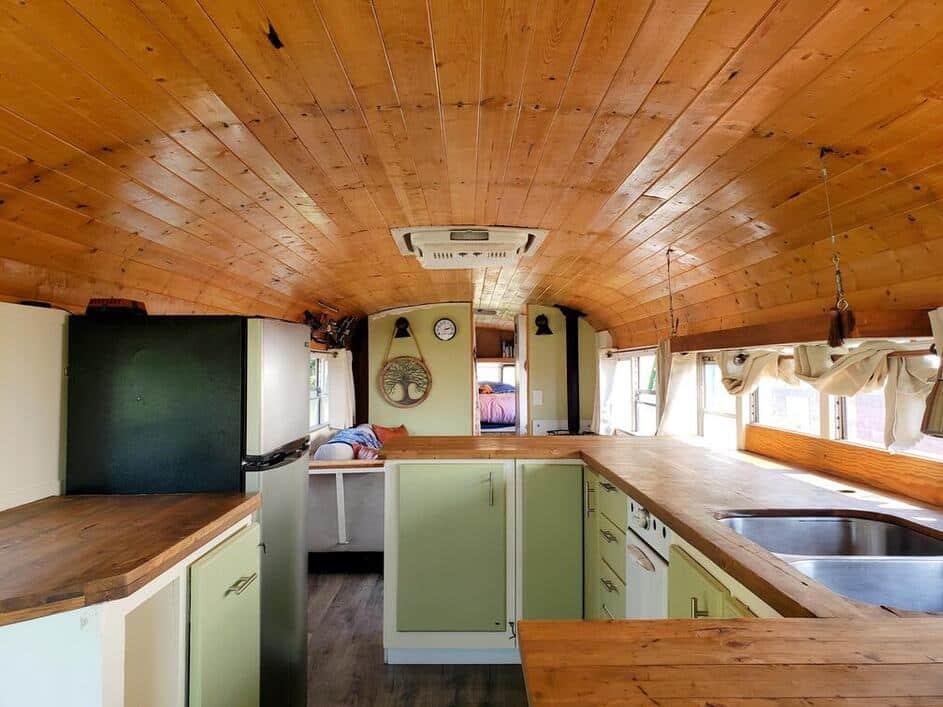
Facebook Marketplace and Craigslist
I’m putting these first because honestly, this is where I found the best deals. Churches sell their buses the same way regular people sell their cars — they post them on Facebook Marketplace or Craigslist. The listings usually say something like “church van” or “church bus” or “passenger bus” and they’ll mention that it was owned by a church, because sellers know that’s a selling point.
Set up saved searches for “church bus,” “passenger bus,” “shuttle bus,” and “activity bus” within 200 miles of wherever you are. Check daily. The good ones go fast because other converters are watching the same listings.
Church liquidation sales directly
This one takes more work but can land you the best deal. Churches upgrade their buses every 10 to 15 years, and when they do, the old bus needs to go somewhere. Some churches will park the old bus in their lot with a “For Sale” sign. Others will post on their church bulletin board or website. I’ve heard of people literally calling churches in their area and asking if they have a bus they’re looking to get rid of. You’d be surprised how often the answer is yes, and the church board is happy to sell for a reasonable price because they just want it gone.
Commercial bus dealers
There are dealers that specialize in used commercial buses — not school buses, but shuttles, church buses, and passenger vans. Companies like Las Vegas Bus Sales, Creative Bus Sales, and National Bus Sales deal in this stuff. The prices are higher than private sales because these are businesses with overhead, but the buses usually come with recent inspections and some kind of limited warranty or return policy.
Online auction sites
GovPlanet, PublicSurplus, and AuctionTime occasionally have church buses, but they’re mixed in with everything else. Set up alerts. I’ve also seen church buses pop up on Municibid, which is specifically for government and nonprofit surplus equipment. Churches aren’t government entities, but church-affiliated schools and nonprofits sometimes use Municibid to liquidate vehicles.
Pricing — what to actually expect
Here’s the range I found after looking at probably 50 or 60 listings over a few months:
Older church buses (2000 to 2008, gas engine, 60,000 to 100,000 miles) — $3,000 to $8,000 from private sellers. Anything under $5,000 with decent maintenance records is a solid deal.
Mid-range (2008 to 2015, gas engine, 40,000 to 80,000 miles) — $7,000 to $15,000. This is where most of the market sits. You’re paying a premium for lower mileage and newer chassis, but the value is there.
Newer or diesel-equipped church buses (2015+, or any year with a diesel option) — $12,000 to $25,000+. Diesel church buses are rare and command a premium. If you find one, expect to pay for it.
From dealers, add $3,000 to $5,000 on top of those ranges.
One thing I noticed — church buses hold their value a little better than school buses in the same age range. A 2006 school bus with 180,000 miles might sell for $3,000 to $5,000. A 2006 church bus with 60,000 miles in similar condition goes for $5,000 to $8,000. The lower mileage justifies the premium in most cases.
Do church buses have the same engines as school buses?
Yes and no. This is one of those questions where the answer depends entirely on the size and type of church bus you’re looking at.

Small to mid-size church buses (20 to 30 passengers)
These are the most common ones you’ll find, and they’re overwhelmingly gas-powered. The engines you’ll see:
Ford 6.8L V10 (Triton) — This is probably the single most common engine in church buses from about 2000 to 2019. It’s in the E-450 chassis that so many church bus bodies are built on. It’s a reliable engine, parts are everywhere, any mechanic can work on it. The downsides are fuel economy (8 to 10 MPG in a loaded bus) and the spark plugs — the early V10s were notorious for spark plugs seizing in the aluminum heads, or worse, blowing out entirely. If you’re looking at a V10, ask if the plugs have been replaced and with what.
Chevy/GM 6.0L Vortec V8 — Found in the Express 4500 and Savana 4500 chassis. It’s another solid, proven engine. Gas mileage is similar to the V10, maybe slightly worse since it’s a smaller engine working harder to move the same weight. But GM truck parts are cheap and available everywhere.
Ford 7.3L Gas V8 — This showed up in newer Ford chassis starting around 2020. Not to be confused with the legendary 7.3L Power Stroke diesel (totally different engine). The gas 7.3 is actually a really impressive motor for what it is — makes good power, supposedly better fuel economy than the V10, and it’s brand new so there’s no wear history to worry about. But buses with this engine are too new and expensive for most conversion budgets.
Ford 6.0L Power Stroke Diesel — Some E-450 church buses from 2003 to 2007 came with this. And I need to be straightforward here because I almost fell into this trap. The 6.0 Power Stroke has a rough reputation. Head gasket issues, EGR cooler failures, injector problems. Some people have “bulletproofed” their 6.0s and say they’re fine after that, but the bulletproofing job costs $3,000 to $5,000. If you find a 6.0 church bus, make sure the work’s been done or factor it into your price.
Larger church buses (30+ passengers)
Once you get into the bigger church buses — the ones on medium-duty chassis like a Freightliner S2 or International — you start seeing real diesel engines. Cummins ISB 6.7, International DT466, sometimes a MaxxForce. These are the same engines you’d find in medium-duty school buses, and they’re generally excellent for conversion.
But bigger church buses are much less common. Most churches didn’t need a 40-foot bus. They needed a 25-passenger shuttle for Sunday transport and the occasional field trip. So if you’re shopping for church buses, expect to find mostly gas-powered, light-duty chassis options.
I’ll be honest, when I was comparing church bus engines to school bus engines, the school bus wins on paper almost every time for the larger sizes. A full-size school bus with a DT466 or Cummins 5.9 is getting a proven, overbuilt diesel engine with massive aftermarket support and a 300,000+ mile life expectancy. A typical church bus with a Ford V10 is getting a good engine with a 200,000-mile life expectancy. Both work, but they’re in different leagues for heavy-duty conversion use.
CDL requirements for church buses
I get why people are confused about this, because the CDL rules are genuinely confusing, and they vary by state. But here’s what I found after a ton of research.
The CDL question comes down to two things: GVWR and passenger capacity.
If your bus has a GVWR over 26,001 lbs, you need a CDL. Period. Most church buses on light-duty chassis (E-450, Express 4500) have GVWRs well under that — typically 14,000 to 16,000 lbs. So you’re clear on the weight side.
The passenger endorsement question is where it gets weird. If you’re operating a vehicle designed to carry 16 or more passengers (including the driver), you technically need a passenger endorsement on your CDL. But — and this is the important part — once you convert the bus and remove the seats, it’s no longer designed to carry 16+ passengers. Once you re-title it as a motorhome or RV, the passenger capacity question goes away in most states. (See our guide on Can You Convert a Double Decker Bus Into a Home? for more on this.)
The key is re-titling. While the bus still has its original title as a commercial passenger vehicle, the CDL and passenger endorsement rules apply based on the original configuration. Once it’s re-titled as an RV or motorhome, and the seats are removed, you’re driving a motorhome, not a passenger bus.
I covered CDL rules in a lot more detail in our CDL guide, but for church buses specifically, the light-duty chassis is actually an advantage here. You’re almost certainly under the 26,001 lb threshold, which simplifies everything.
What to look for when buying a church bus for conversion
I put together a mental checklist when I was shopping, and I think it’s worth sharing because some of this stuff is specific to church buses and wouldn’t necessarily apply to school buses.

Check the GVWR first
Before you fall in love with the interior space or low mileage, look at the sticker inside the driver’s door jamb. What’s the GVWR? If it’s 14,050 lbs (common on E-450s), do the math. How much does the bus weigh empty? If the curb weight is 9,800 lbs, you’ve got 4,250 lbs for your build, your water, your gear, and you. That might be enough for a minimalist build. It’s nowhere near enough for a tile shower and hardwood floors.
I talked about this in our GVWR guide but it bears repeating here because church buses make it especially tempting to overbuild. The interior feels spacious, the mileage is low, everything seems great — and then you load it up and you’re 2,000 lbs over your GVWR. That’s not just illegal, it’s dangerous. Your brakes, tires, and suspension weren’t designed for that weight.
Inspect the body-to-chassis connection
This is church-bus-specific. Because the body was added to the chassis by a separate manufacturer, the connection points between the bus body and the frame rails are worth looking at carefully. Check for rust, cracking, or separation at the mounting bolts. Get under there with a flashlight. On a school bus, the body and chassis were engineered together. On a church bus, they were married after the fact, and the quality of that marriage varies by manufacturer.
Look at the roof
Church bus roofs are often lighter gauge than school bus roofs. Some are fiberglass or composite instead of steel. Check for leaks, soft spots, and delamination. If the bus has a roof-mounted AC unit (many do), check around the mounting base for water intrusion. I saw one bus where the roof AC had been leaking slowly for years and the wooden substructure underneath was basically pulp.
Transmission check
Most church buses on van chassis use automatic transmissions — typically the Ford 5R110W TorqShift (behind the V10) or the GM 6L90. These are good transmissions, but they were designed for truck duty, not bus duty. Ask about transmission service history. A fluid and filter change every 30,000 to 50,000 miles is ideal. If the bus has 75,000 miles and no record of transmission service, that’s something to consider.
Tires — age matters more than tread
This catches people off guard with church buses. Because the mileage is so low, the tires might still have plenty of tread. But tires age out. Rubber degrades from UV, ozone, and just sitting. A tire that’s 7 or 8 years old is at the end of its safe life regardless of how much tread is left. Check the DOT date code on the sidewall. Four digits — the first two are the week, the last two are the year. If the tires are older than 6 years, plan on replacing them. Budget $800 to $1,500 for a full set depending on size.
Church bus conversion considerations — building it out
Now we’re getting to the actual conversion part, and this is where church buses diverge from school buses in ways that matter for your build.

Floor plan constraints
A typical church bus on an E-450 chassis gives you about 18 to 24 feet of interior length, depending on the specific model. That’s comparable to a short school bus. You’re working with roughly 90 to 140 square feet of floor space. For a couple, that’s workable. For a family, it’s tight.
The good news is the interior width is usually decent — 7 to 7.5 feet wall to wall. And if you got lucky with a taller roof model, you might have 6’3″ or more of headroom, which makes the space feel bigger than it is.
The bad news is wheel well intrusions. Van-chassis buses have wheel wells that protrude into the interior space, especially over the rear axle. On a school bus, the wheel wells are contained within the body panels. On a church bus, you’ll have humps on both sides of the rear section that you have to design around. I’ve seen builders use these as the base for bench seats, storage compartments, or raised bed platforms. But they’re there and you can’t ignore them.
Weight management is everything
I can’t stress this enough. With a 14,000 to 16,000 lb GVWR and a 9,000 to 10,000 lb curb weight, you have maybe 4,000 to 6,000 lbs to work with. That forces design decisions.
Use lightweight materials. Plywood instead of hardwood. Vinyl plank instead of tile. Composites instead of granite. Aluminum framing where possible. Every pound you save in the build is a pound you can carry in water, food, or gear.
I read about one church bus build where the couple weighed every single item before it went into the bus. Every piece of lumber, every sheet of plywood, every fixture and fitting. They kept a running tally on a whiteboard. When they finished, they were 400 lbs under their GVWR, which gave them breathing room for full water tanks and supplies. That’s the kind of discipline a church bus build requires.
If you’re coming from the school bus conversion world where people are framing walls with 2x4s and laying subway tile in the shower, you need to recalibrate. That stuff works on a 33,000 lb GVWR school bus. It does not work on a 14,000 lb church bus.
Electrical and plumbing
The electrical and plumbing setup is basically the same as any small bus conversion. A 200 to 400 amp-hour lithium battery bank, 400 to 800 watts of solar, a 2000 to 3000 watt inverter, and a shore power hookup will handle most needs. Check our electrical guide for the full breakdown.
For water, a 20 to 30 gallon fresh water tank is realistic for a church bus build. You could go bigger, but remember — water weighs 8.34 lbs per gallon. A 50-gallon tank is 417 lbs of water. On a weight-constrained build, that’s significant. Our water systems guide covers tank sizing in more detail.
Insulation and climate control
Church bus bodies are usually thinner than school bus bodies, which means insulation matters even more. The walls might only give you 1 to 1.5 inches of cavity to work with. Closed-cell spray foam is the best option for thin walls because it gives you the highest R-value per inch and doubles as a vapor barrier. It’s more expensive than foam board, but in a church bus where every inch counts, it’s worth it.
The roof-mounted AC that many church buses come with is designed for cooling a bus full of seated passengers, not for climate-controlling a living space. Some converters keep the original AC and find it works reasonably well. Others remove it (saves weight and eliminates a roof penetration point) and go with a mini-split or a standard RV rooftop AC unit instead.
Church bus vs school bus for conversion — the honest comparison
Alright, this is the section where I just lay it all out, because I think people need a straight comparison to make a decision.
Where church buses win
Mileage and condition. No contest. A church bus with 50,000 miles in garaged condition is going to be in better mechanical shape than a school bus with 200,000 miles that sat in a field. The engine has more life left, the transmission has more life left, the frame is cleaner, and the body is usually in better cosmetic condition.
No school bus stigma. You don’t have to repaint it yellow, remove stop arms, or deal with the legal requirements around de-commissioning a school bus. The title is already a commercial vehicle or passenger van. Re-titling to RV is typically simpler.
Drivability. A church bus on an E-450 or Express 4500 chassis drives like a big van. Power steering, power brakes, air conditioning, a normal truck dashboard. The turning radius is tighter than a full-size school bus. It fits in more places. My neighbor has an E-450 shuttle and he takes it through drive-throughs. Try that in a 40-foot Blue Bird.
Stealth factor. A white church bus doesn’t look like a converted school bus. With the right exterior treatment, it looks like a delivery vehicle or a work van. For people who want to blend in at Walmart parking lots or urban environments, that’s a real plus.
Where school buses win
Chassis strength and GVWR. This is the big one. A full-size school bus on a medium-duty chassis gives you 25,000 to 33,000 lbs of GVWR, which means 10,000 to 15,000 lbs of build capacity. You can build whatever you want. Tile, hardwood, granite, full-size appliances, 100-gallon water tanks. A church bus just can’t compete here.
Diesel engines. Most full-size school buses come with proven diesel engines that will outlast gas engines by 100,000+ miles. And diesel mechanics are everywhere in the bus and truck world.
Cost per square foot. A full-size school bus gives you 250+ square feet for $3,000 to $8,000. A church bus gives you 90 to 140 square feet for $5,000 to $15,000. Dollar for dollar, school buses offer more space.
Build community and resources. The skoolie community is massive. There are YouTube channels, forums, Facebook groups, and detailed build documentation for every school bus model imaginable. Church bus conversions are less common, so you’ll find fewer build guides and have to figure more stuff out on your own.
Body durability. School bus bodies are built to FMVSS standards with heavy-gauge steel. Church bus bodies are lighter, built by smaller manufacturers, and may not hold up as well over decades of road use.
The verdict
I don’t think there’s a clear winner. It depends on what you’re building and how you plan to use it.
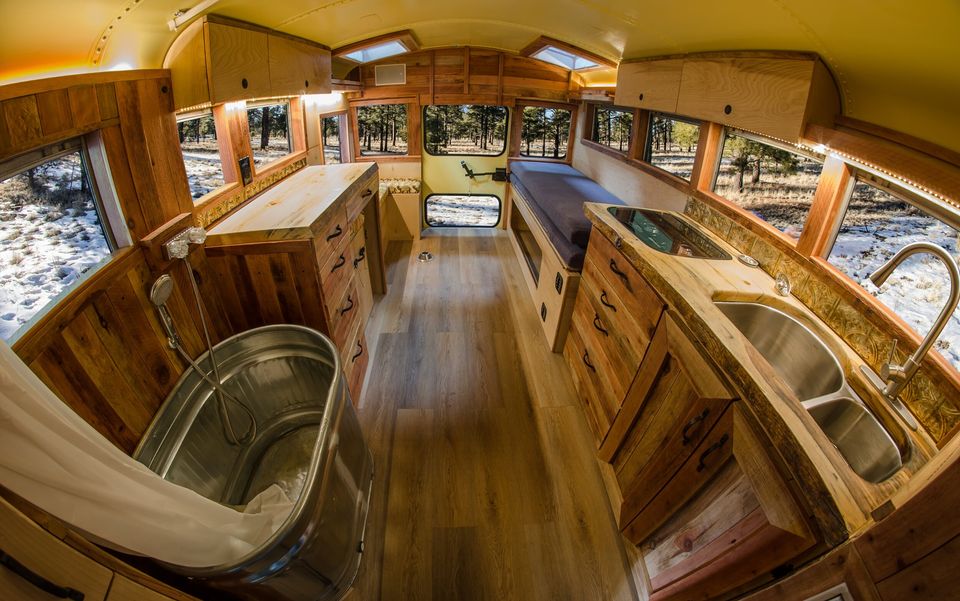
If you’re a couple building a lighter, more mobile conversion — maybe you want to travel to national parks, park in campgrounds, and don’t need a full tile bathroom — a church bus is a fantastic platform. The low mileage, good condition, and easier driving experience are legitimate advantages.
If you’re building a full-time home for a family, or you want to go heavy on the build with lots of amenities and big water tanks, a school bus is the better foundation. The GVWR headroom and diesel engine options just give you more to work with.
Common chassis you’ll find under church buses
Let me give you a quick rundown because knowing the chassis helps you evaluate the bus.
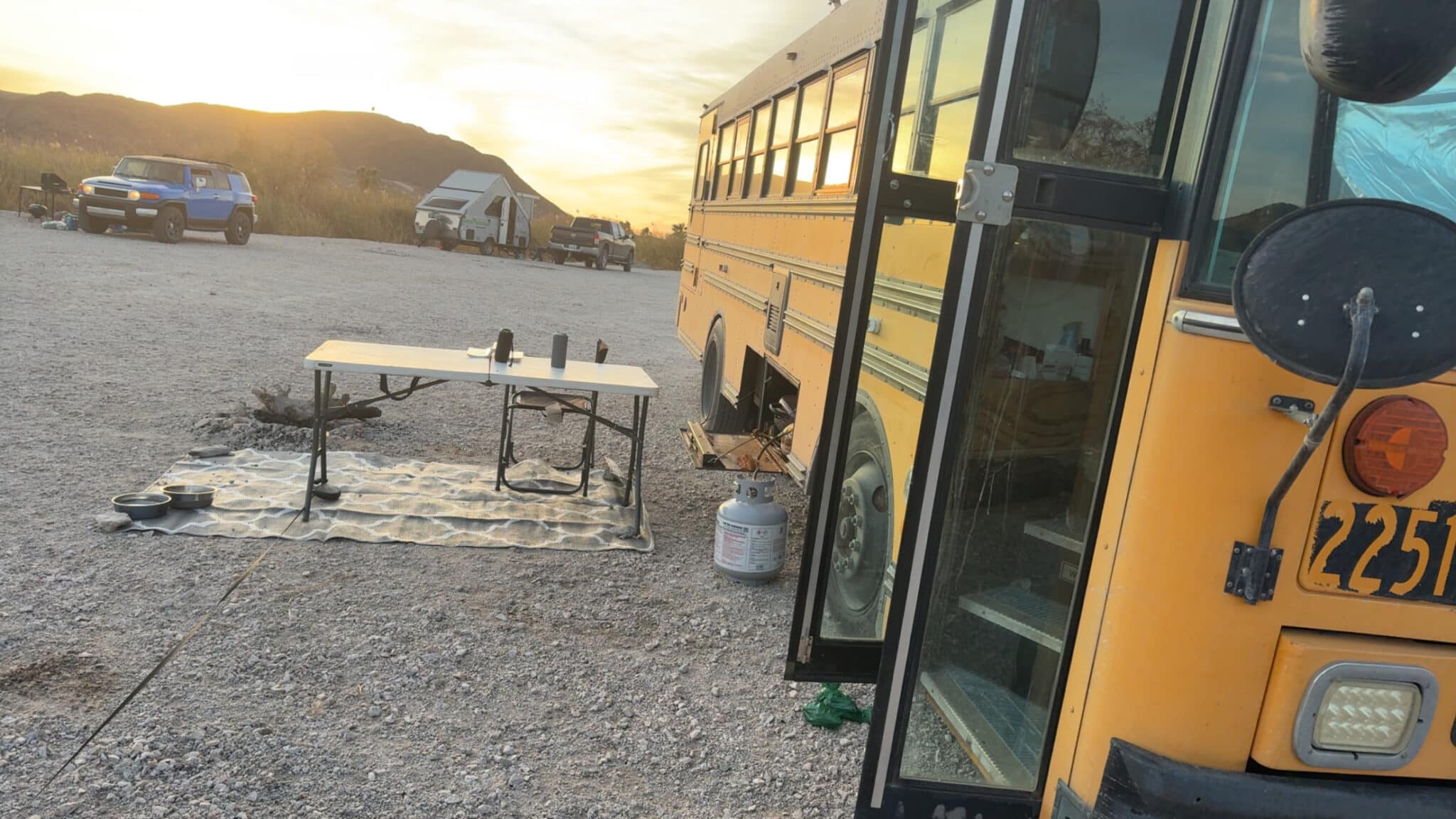
Ford E-450 — The most common church bus chassis by far. Available from the late 1990s through 2023 (Ford discontinued the E-series stripped chassis). Gas V10 or occasionally diesel (6.0 Power Stroke in mid-2000s models). GVWR 14,050 to 14,500 lbs. Solid front axle with leaf springs, rear leaf springs. Parts are dirt cheap and every Ford dealer in America can work on the drivetrain.
Chevy Express 4500 / GMC Savana 4500 — The GM equivalent. 6.0L Vortec V8 or Duramax diesel in some years. GVWR around 14,200 lbs. Independent front suspension gives a slightly smoother ride than the E-450’s solid axle. Less common than the Ford in church bus applications but still widely available.
Ford F-550 / F-650 — Some larger church buses are built on Ford’s medium-duty truck chassis. These are a step up in capability — GVWR of 19,500 lbs (F-550) to 26,000 lbs (F-650). Usually diesel, often the 6.7L Power Stroke. If you find a church bus on one of these, it’s a much more capable conversion platform, but they’re less common and more expensive.
Freightliner S2 — The commercial option. Some larger church buses (30+ passengers) use the Freightliner S2 chassis with a Cummins ISB diesel. GVWR can be 25,500 to 33,000 lbs. This is basically the same chassis some school buses use, and it’s an excellent conversion platform. But church buses on Freightliner chassis are rare and priced accordingly.
International / Navistar — Older church buses sometimes sit on International chassis with DT466 or MaxxForce engines. Same deal as the Freightliner — great chassis, rare in church bus applications.
Converting a church bus — the actual process
The conversion process for a church bus is fundamentally the same as converting any other bus, with a few differences worth noting.
Seat removal
Church bus seats are generally easier to remove than school bus seats. The mounting hardware is usually bolts into a plywood or composite floor rather than welded steel tracks. Some church buses have seats that simply unbolt with a socket wrench. I’ve heard of people removing all the seats in an afternoon, which is a far cry from the two-day battle some school bus converters go through.
Floor prep
Under the seats, you’ll usually find either plywood subflooring or a rubber mat over plywood. School buses have rubber over steel. The plywood in church buses can be an advantage (easier to work with, lighter weight) or a disadvantage (more susceptible to water damage, may need replacement if it’s soft). Check the floor carefully after removing seats. Press hard with your foot everywhere. Any soft spots need to be cut out and replaced.
Wall framing
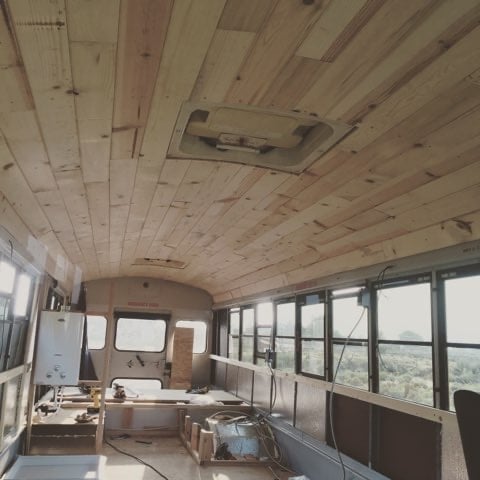
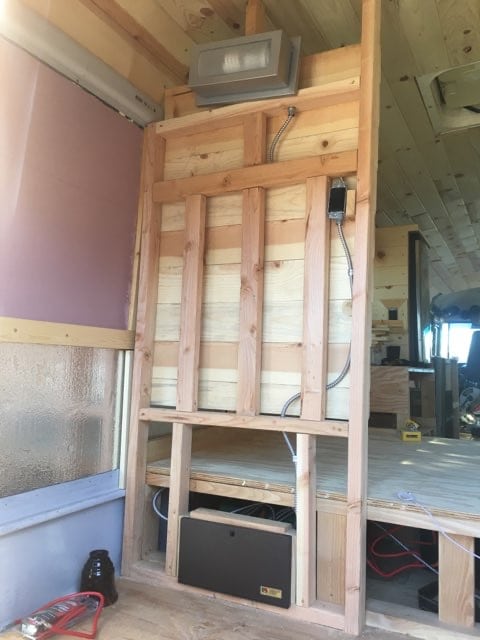
The interior walls of a church bus are usually thin composite or fiberglass panels over minimal framing. You’ll want to strip these out, inspect the structural ribs behind them, and build your own framing for insulation and interior finishing. The wall cavities are thinner than a school bus, so plan for thinner insulation — 1 inch closed-cell foam board or spray foam.
Keeping it light
I keep coming back to this because it’s the defining constraint of a church bus conversion. Every decision should run through the weight filter. When you’re choosing between two options, pick the lighter one. Every time. This isn’t just a suggestion — on a 14,000 lb GVWR chassis, being overweight isn’t something you can shrug off.
So is a church bus right for you?
After digging into all of this, here’s where I landed. Church buses are genuinely good conversion platforms for the right person. If you want a well-maintained, low-mileage vehicle that drives like a big van and doesn’t look like a school bus, a church bus deserves a serious look. The lower purchase price compared to a coach bus, combined with the better condition compared to a school bus, puts it in an interesting sweet spot. (See our guide on Coach Bus Conversions: The Complete Guide for more on this.)
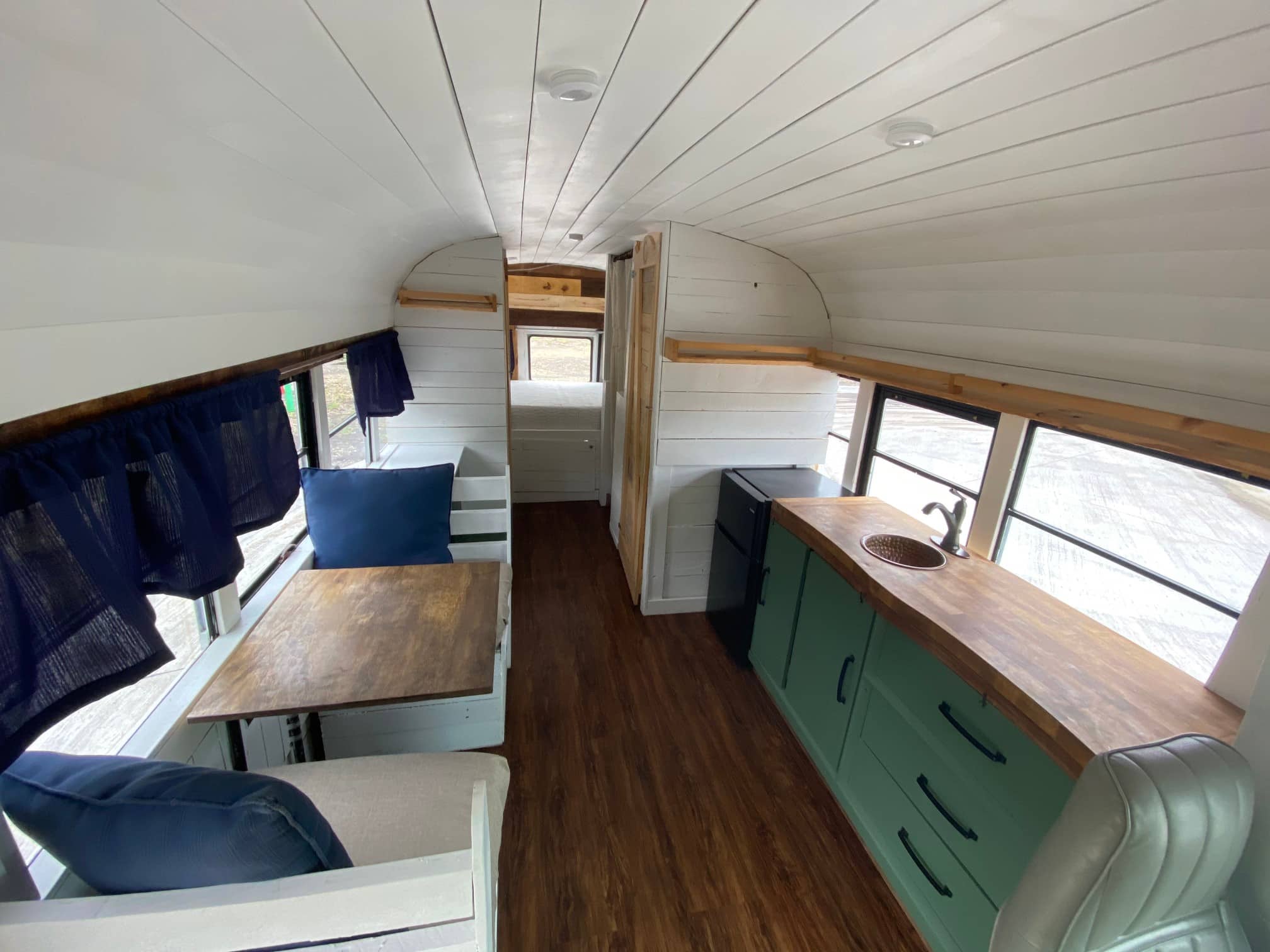
But you have to go in with your eyes open about the limitations. The GVWR ceiling is real and it will dictate your build in ways that school bus converters don’t have to think about. The gas engine means more fuel stops and a shorter engine life than diesel. And you’re working with less interior space than a full-size school bus.
For a couple doing a weekend-warrior build or a seasonal travel setup, I think a church bus makes a ton of sense. For full-time living with a family, I’d probably steer toward a full-size school bus or even a coach.
The best advice I can give is this — find one locally, go look at it in person, stand inside it, measure it, and really think about whether your build vision fits within the weight and space constraints. Don’t just fall in love with the low mileage number. That number is great, but it doesn’t change physics. Your build still has to fit within what the chassis can carry.
That’s what I found. Your situation might be different, and there’s no substitute for actually seeing these buses in person and getting a feel for the space. But at least now you know what you’re looking at and what questions to ask.
3 thoughts on “Church Bus Conversions: The Complete Guide”