
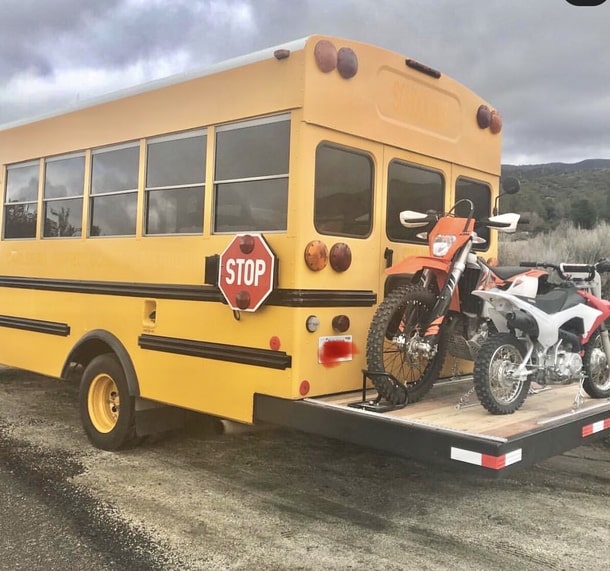
If you’re looking at buying a bus to convert into a home, one of the first forks in the road is figuring out what kind of bus you actually want. School bus? City transit bus? Something else entirely? They look different, they drive different, and they come with totally different pros and cons for a conversion. (See our guide on Can You Convert a Double Decker Bus Into a Home? for more on this.)
The short version is this: a school bus is a purpose-built vehicle designed to transport kids safely on short routes, with heavy-gauge steel construction, low purchase prices, and widely available parts. A transit bus (city bus) is designed for high-volume public transportation with low floors, wider aisles, bigger windows, and commercial-grade components that can be expensive to source and repair. For most people getting into bus conversions, school buses are the easier, cheaper, and more practical starting point. But transit buses have some genuine advantages if you know what you’re getting into.
What differences are between a normal bus and a school bus?
When I first started digging into this question, I realized “normal bus” means something different to everybody. Some people mean a city transit bus. Some mean a Greyhound-style coach. Some just mean anything that isn’t yellow. So let me break down the main categories and how they stack up against a school bus.
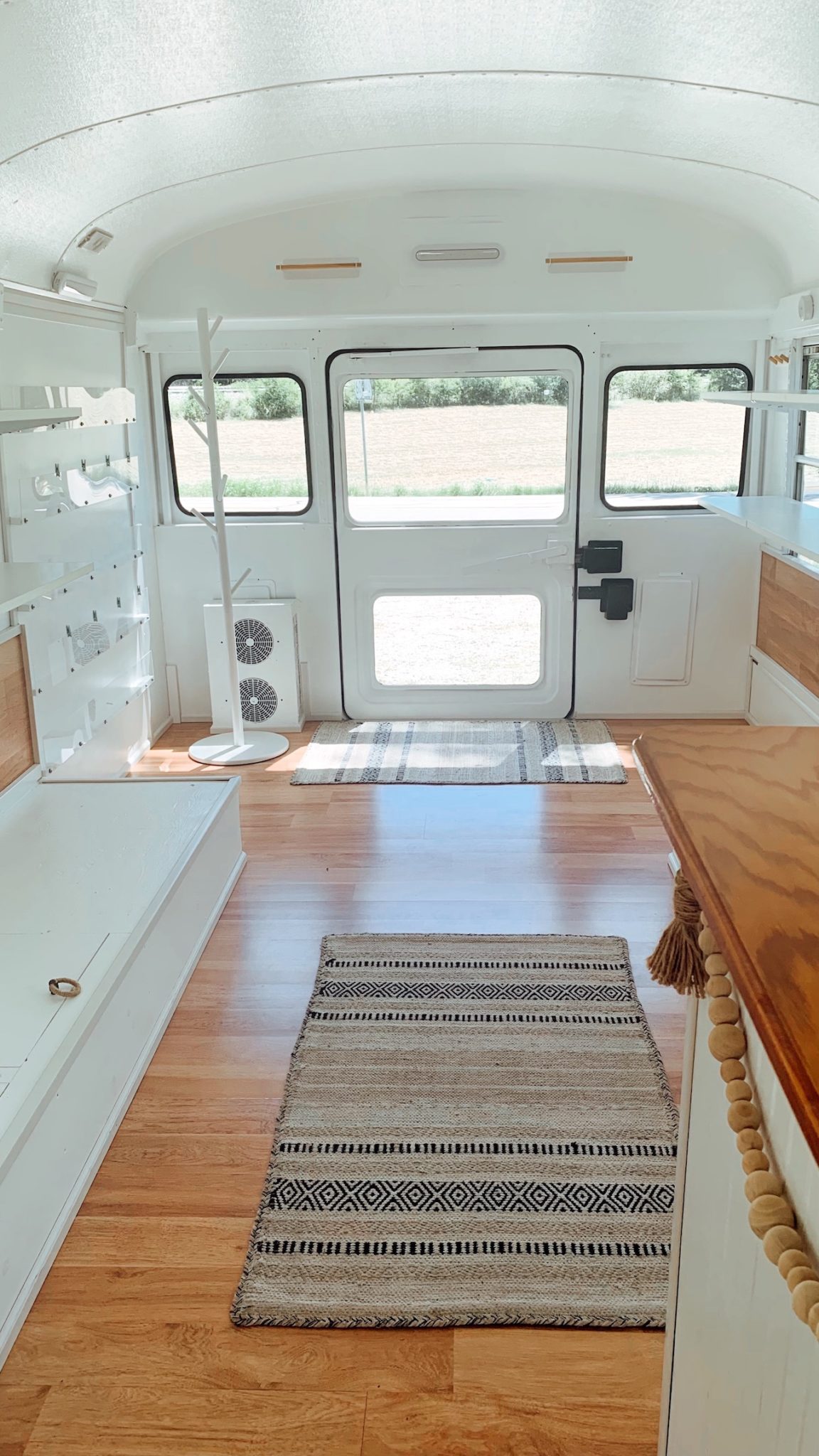
A school bus is built to a federal standard called FMVSS (Federal Motor Vehicle Safety Standards), and specifically there’s a whole set of regulations just for school buses. They have to meet rollover protection requirements, body joint strength tests, and specific emergency exit rules. What that translates to in real life is a bus built like a tank. Heavy steel frame rails, reinforced roof, body panels that are thicker than what you’d find on most commercial vehicles. I talked to a welder once who said cutting into a school bus body was noticeably harder than cutting into a transit bus panel, and that stuck with me.
Transit buses — the ones you see in cities picking up commuters — are built for a completely different job. They’re designed to load and unload passengers quickly, run all day on city streets, and rack up serious mileage. Most city transit buses have low floors (no steps at the entry), wide doors (sometimes two or three sets), and are built wider than school buses. The typical transit bus interior is about 8.5 feet wide compared to about 7.5 feet for a school bus.
Here’s where it gets interesting for conversions though. Transit buses use air suspension, which gives a smoother ride. They often have bigger engines, beefier transmissions, and they’re designed to run 12-16 hours a day. The build quality of the drivetrain is usually excellent. But the body panels? Not as robust as a school bus. Transit bus bodies are often aluminum or composite, lighter weight but more prone to corrosion at the joints and harder to weld to if you’re modifying things. (See our guide on Skoolie vs RV: Which One Should You Buy? for more on this.)
The other big difference is parts availability. School bus parts are everywhere. Every small town in America has had a school bus fleet at some point, and there are junkyards and parts suppliers that specialize in them. Transit bus parts? You’re often dealing with proprietary systems from companies like New Flyer, Gillig, or NABI, and some of those parts can only be sourced from the manufacturer or specialty dealers. I spent a whole afternoon once trying to price out a replacement air conditioning compressor for a Gillig transit bus versus a Blue Bird school bus, and the transit bus part was almost triple the cost.
Im really thinking about buying a bus, my question is would you go school, or city bus?
So this is the question that really matters, right? You’ve got a budget, you’ve got a vision, and you need to pick one.

I’d go school bus for a first build. And here’s why.
School buses are cheap. Like, really cheap. You can find running, driveable school buses at government auctions for $2,000-$5,000 all day long. A comparable transit bus in running condition? You’re probably looking at $5,000-$15,000 depending on age and condition, and that’s if you can even find one. Transit agencies don’t auction off their buses the same way school districts do. A lot of them go straight to scrapyards or get sold to transit agencies in other countries.
Then there’s the mechanical side. School buses use engines and transmissions that are shared across the trucking industry. A DT466, a Cummins 5.9, a Cat 3126 — any diesel mechanic in the country can work on these. Transit buses sometimes use engines you won’t find in anything else on the road. Some use Cummins ISL or ISB engines which are common enough, but others use Detroit Diesel units or proprietary setups that not every shop wants to touch.
The body shape matters too. School buses have flat walls and a flat ceiling, which makes building out an interior way more straightforward. Transit buses have curved walls, wheel well intrusions that eat into your floor space, and sometimes structural ribs that you have to work around. I remember watching a build video where a guy was trying to frame out a kitchen counter in a transit bus and he spent two days just dealing with the curved wall situation. In a school bus that same job would’ve taken an afternoon.
Now, here’s where I’ll give transit buses credit. If you want a wider interior, a smoother ride, and you don’t mind the extra cost and complexity, a transit bus gives you things a school bus can’t. That 8.5-foot interior width means you can do a queen bed sideways across the bus, which is really hard to pull off in a school bus without blocking the aisle. The air suspension means highway driving is genuinely more comfortable. And some transit buses have massive under-floor storage compartments that are perfect for water tanks, batteries, and gear.
But for most people, especially first-timers, the school bus is the move. Lower buy-in cost, easier to work on, easier to find parts for, and a more forgiving platform for learning on.
International school bus….what is that exactly? Is it a converted coach?
This one comes up a lot and I get why it’s confusing. “International” in the bus world doesn’t mean the bus comes from overseas or that it’s some special global version of a school bus. International is a brand name — as in International Harvester, which became Navistar, which makes IC Bus.
When somebody says they have an “International school bus,” they’re talking about a bus built on an International chassis. Usually it’s a Type C school bus (the classic dog-nose design with the hood out front) powered by an International engine — most commonly the DT466 or the T444E. These are some of the most popular engines in the skoolie community and for good reason. The DT466 especially is mechanical, not electronic, which means fewer sensors, fewer computers, fewer things to go wrong. I’ve seen DT466 engines with 300,000 miles that were still running strong. (See our guide on What’s the Difference Between Front Engine and Rear Engine Buses? for more on this.)
It’s definitely not a converted coach. A coach is a whole different animal — think Greyhound, MCI, Prevost. Those are highway cruisers built for long-distance passenger travel, with under-floor luggage bays, air ride suspension, and usually a rear-mounted diesel engine. Coaches are fantastic platforms for conversion if you’ve got the budget, but they cost significantly more to buy and maintain than a school bus. We’re talking $15,000-$40,000+ for a used coach versus $3,000-$10,000 for a school bus.
So when you see “International school bus” on a listing, just think regular school bus, built by International/IC Bus, probably with a solid engine under the hood. It’s not exotic. It’s actually one of the most common and desirable platforms for a conversion.
Related: Is a Short Bus or Full-Size Bus Better for a Conversion?
Related: Is a Propane or Electric Stove Better for a Skoolie?
What about a bus with or without a hood, or like they call the big rigs, a conventional or a COE?
Alright, so this is about the body style and it matters more than most people realize when they’re planning a conversion.
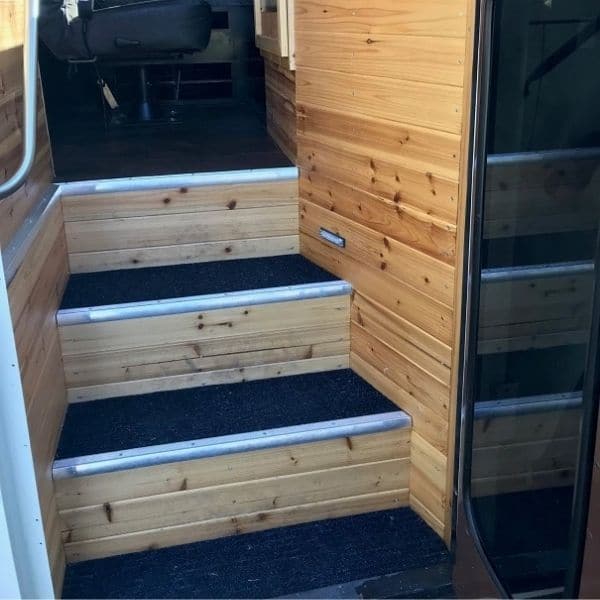
A “conventional” bus — one with a hood, or what people call a “dog nose” — is a Type C school bus. The engine sits out in front of the driver, under a hood, just like a regular truck. You can pop that hood open and you’re looking right at the engine. Oil changes, belt replacements, checking coolant — all of it is pretty accessible. This is the bus most people picture when they think of a school bus, and it’s the most common conversion platform by a wide margin.
A “cab over engine” or COE — also called a flat-nose or transit-style — is what the bus world calls a Type D. There’s no hood sticking out. The front of the bus is flat, the driver sits basically right above the front axle, and the engine is either tucked under the floor in the front or pushed all the way to the rear.
I was at a truck show a while back, one of those events where people bring all kinds of commercial vehicles, and I got to climb into both a Type C and a Type D school bus back to back. The difference in forward visibility was shocking. In the Type D, you could see straight down to the road right in front of you. In the Type C, that hood blocks your view of anything within about 6-8 feet of the front bumper. For driving in tight spaces, parking lots, campgrounds — that visibility difference is real.
But here’s the trade-off. With a conventional Type C, working on the engine is straightforward. Pop the hood, there it is. With a Type D where the engine is under the floor, you’re often working through access panels, sometimes on your back, sometimes pulling components just to reach other components. Rear-engine Type D buses are even trickier because you lose some interior space in the back for the engine compartment, and you can’t put a rear door where the engine lives.
For interior space, the Type D wins. Because there’s no hood eating into the length, you typically get more usable interior footage on the same overall bus length. A 35-foot Type D might give you 2-3 more feet of interior living space than a 35-foot Type C. And the flat nose design means the cab area transitions more smoothly into the living space — there’s no awkward doghouse (engine cover) bump in the middle of your floor.
Cost-wise, Type D buses tend to be more expensive to buy and the parts can be pricier. They’re less common on the used market, so you’ve got less to choose from. Most first-time builders end up with a Type C because they’re everywhere, they’re affordable, and every mechanic has seen one before.
If I had to sum it up, a Type C conventional is the Honda Civic of bus conversions — reliable, cheap, easy to work on, maybe not the flashiest but it gets the job done. A Type D flat-nose is more like the upgraded option, nicer ride, more space, but you’re paying for it in purchase price and maintenance complexity.
So after digging into all of this, here’s where I landed. If you’re comparing school buses to transit buses for a conversion, school buses win on practicality for about 90% of people. They’re cheaper, easier to find, easier to work with, and there’s a massive community of people who have already converted them so you’ve got endless resources and advice available. Transit buses have their advantages — wider interiors, smoother ride, under-floor storage — but you’re paying more and dealing with more complexity to get those benefits.
And whether you go conventional or flat-nose, hood or no hood, that really comes down to your priorities. Easy maintenance and lower cost? Conventional Type C. More interior space and better driving visibility? Type D flat-nose. There’s no wrong answer, just different trade-offs. The best thing you can do is go look at a few in person before you commit. Sit in the driver’s seat, walk through the interior, pop the hood or open the access panels. You’ll know pretty quick which one feels right for what you’re trying to build.