
If you’ve ever seen a double decker bus rolling through a city and thought “that would make the coolest house on wheels,” you’re not alone. It’s one of those ideas that sounds incredible on paper, but raises about a hundred practical questions the second you start digging into it.
Yes, you can absolutely convert a double decker bus into a home, and people have done it successfully. The upper deck gives you an entire second floor, which means you can have a real separation between living space and sleeping space that no standard school bus can offer. But there are serious tradeoffs. Double deckers are significantly taller (usually 13 to 14.5 feet stock height), harder to find in the US, more expensive to buy ($15,000 to $50,000+), and they come with height restrictions that will change how and where you travel. The conversion process is also more complex because you’re essentially building out two separate floors, dealing with a staircase, and reinforcing a structure that was designed for seated passengers, not a full kitchen and bathroom.
“Did you have to add extra framing to support the addition on top the bus?”
This is the structural question that matters most, and I spent a lot of time looking into it because I kept getting different answers. Here’s what I found after digging through build threads and talking to a couple of people who’d actually done it.
The upper deck of a double decker bus is already engineered to hold passengers. That’s the good news. A loaded upper deck with 40 seated passengers weighs roughly 6,000 to 7,000 pounds, so the structure can handle significant weight. But there’s a catch. Those passengers are distributed evenly across rows of seats bolted to the floor. When you start building a conversion, the weight distribution changes completely. You might have a 300-pound cast iron bathtub in one corner and a full water tank in another, and that kind of concentrated load is different from what the bus was designed for. (See our guide on Is a Short Bus or Full-Size Bus Better for a Conversion? for more on this.)
Most builders I came across did add some extra framing, but not as much as you’d think. The main areas that need reinforcement are wherever you’re putting heavy items on the upper deck — water tanks, a heavy countertop, a wood stove. A few builders welded additional cross-members under the upper floor in those specific spots. One guy I was reading about on a UK forum used steel angle iron to create additional support under his upper-deck kitchen area, and he said it took him about a weekend and maybe $200 in materials.
The lower deck is less of a concern structurally since it sits on the main chassis. That’s where most people put the heavier stuff — water tanks, batteries, the kitchen. It’s just smart weight planning. Keep the heavy things low and your center of gravity stays reasonable.
I will say, though, if you’re planning to put anything really heavy on the upper level, get an engineer to look at it. Not a buddy who welds. An actual structural engineer. It’ll cost you a few hundred bucks for a consultation and it’s worth every penny when you’re driving down the highway at 55 MPH with your bedroom directly above your head.
“Did you turn double decker into a home yourself? Who helped to design the interior?”
When I started researching double decker conversions, I noticed something interesting. Almost none of them were true solo builds. With a standard school bus, you see tons of people who gutted it and built the whole thing themselves in a driveway over six months. With double deckers, nearly every build I found had at least one person with professional fabrication or carpentry experience involved. (See our guide on Church Bus Conversions: The Complete Guide for more on this.)
That’s not because the work itself is necessarily harder. It’s because the planning is more complex. You’ve got a staircase to deal with, two separate floor plans that need to work together, plumbing and electrical that run between floors, and headroom constraints on both levels that are tighter than you’d expect. The ceiling height on each floor of a double decker is usually only about 6 feet, sometimes less. So you’re designing two compact spaces instead of one longer open space. (See our guide on What Is the Difference Between a School Bus and a Transit Bus? for more on this.)
I found a couple out of Bristol, England who did their conversion mostly themselves but hired a welder for the structural work and a plumber for the water system. They said the thing that saved them was spending three full months on the design before they ever picked up a tool. They made cardboard mockups of furniture, taped off the floor plan, and even slept in the empty bus for a few nights to figure out how they’d actually move through the space.
The interior design question is really about how you split the two floors. The most common layout I kept seeing was bedroom and lounge upstairs, kitchen and bathroom downstairs. That makes sense for a few reasons. Plumbing is simpler when your wet areas are on the lower level closer to the tanks and dump connections. And you don’t want to be hauling groceries up a narrow staircase every time you come back from the store.
Some builders flip it though and put the living space upstairs for the views. One family I read about in New Zealand has floor-to-ceiling windows on the upper deck and uses it as their main hangout space during the day. Their reasoning was that you spend more waking hours in your living room than your bedroom, so why not give those hours the better view? I thought that was a solid argument.
“how much has it restricted yall to drive being so tall”
Alright, so this is the thing that would honestly keep me up at night if I owned a double decker. Height restrictions are no joke.
A stock double decker bus sits at roughly 13 feet 6 inches to 14 feet 6 inches tall, depending on the model. For comparison, a standard school bus is around 10 feet 6 inches, and even a raised-roof skoolie tops out around 12 to 13 feet. So you’re talking about a vehicle that’s a full 2 to 4 feet taller than what most bus lifers are dealing with.
Standard interstate overpasses in the US are designed for a minimum of 14 feet of clearance. So on paper, you’re fine on major highways with most double deckers. But “on paper” and “in practice” are two very different things. Road repaving can reduce clearance by inches over the years. Older bridges in cities sometimes dip below 13 feet. Railroad overpasses in small towns can be 11 or 12 feet. And parking garages? Forget about it entirely.
I was reading about a couple who traveled in a converted Leyland Olympian through the UK and they said height became the single biggest factor in their route planning. They couldn’t take certain roads at all. They had to scout gas stations ahead of time to make sure they could fit under the canopy. Drive-throughs were completely off the table. One time they accidentally turned onto a road with a low bridge and had to reverse a double decker bus down a narrow lane for about a quarter mile because there was no place to turn around. They laughed about it later but said it was genuinely terrifying in the moment.
In the US, your best friends are trucker GPS apps that let you input your vehicle height. CoPilot and Hammer are the two I see recommended most. They route you around low bridges automatically. Some double decker owners also mount a height pole on the front — basically a piece of PVC pipe cut to their exact roof height so if it clips something, they stop before the roof does.
The other driving restriction is width and weight. Double deckers are typically 8 to 8.5 feet wide, which is similar to a full-size school bus, so that’s not too bad. But they’re heavier. A stripped double decker can weigh 20,000 to 28,000 pounds before you even start your build. Add in a full conversion with water, furniture, and all your stuff, and you might be pushing 30,000+ pounds. That affects which roads you can take, which bridges have weight limits, and what kind of fuel economy you’re looking at. Expect something in the range of 6 to 9 MPG.
So does the height restrict you? Yeah, it does. Every double decker owner I found said it changed how they travel. You plan more, you’re more careful, and some places are simply off-limits. Whether that tradeoff is worth it depends on how much you value the extra living space versus the freedom to go anywhere without thinking twice.
Related: Coach Bus Conversions: The Complete Guide
“Why not start with a double decker bus?”
I love this question because it usually comes from someone who’s looking at a standard skoolie build and thinking “why would anyone settle for one floor when you could have two?” It seems so obvious on the surface. More space, separate floors, looks incredible. Why doesn’t everyone just do this?
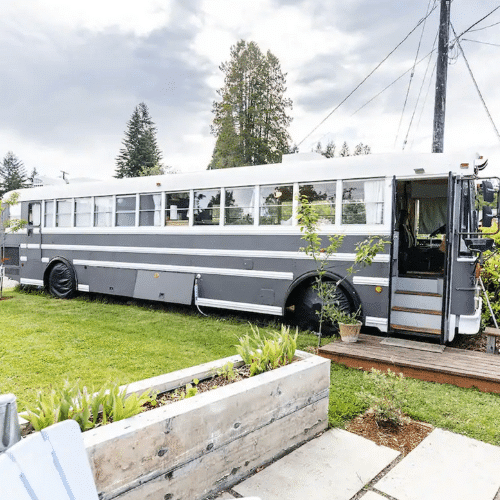
Well, there are a few really practical reasons most people don’t.
First is availability. In the US, double decker buses are genuinely hard to find. They’re not common in American public transit the way they are in the UK. Most of the ones you’ll find are either retired tour buses, decommissioned transit buses from a handful of cities that ran them, or imports. Finding one is a project in itself. You can’t just hop on GovDeals and bid on one like you can with school buses. I spent a while searching and found maybe a dozen for sale in the entire country at any given time, compared to hundreds of school buses. (See our guide on Blue Bird Buses: The Complete Conversion Guide for more on this.)
Second is cost. A retired school bus runs $3,000 to $10,000. A double decker in decent mechanical condition is more like $15,000 to $50,000, and some go higher. The engines are often different from what American diesel mechanics are used to working on, especially if it’s a UK import with a Cummins or Volvo engine setup that’s not common stateside. Parts can be harder to source and more expensive when you find them.
Third, and this is the one that gets overlooked, is that double deckers are harder to work on. The mechanical systems are more complex. The air brake systems, the suspension, the steering — all of it is built for a heavier, taller vehicle. If something breaks on the road, you might have trouble finding a shop that’s even willing to look at it. I read about one owner who broke down in rural Texas and had to have the bus flatbedded 200 miles to a shop in San Antonio that had experience with that particular chassis. That’s not a story you hear from school bus owners very often.
Fourth is the height thing we already talked about. Starting with a vehicle that limits where you can go is a tough sell for people who got into bus life specifically for the freedom to roam.
Now, all that said, for the right person, a double decker is an amazing platform. If you plan to be mostly stationary — parked on land, at a long-term site, or moving infrequently — the height restrictions matter a lot less. The extra square footage is genuinely game-changing. You can have a real two-bedroom layout. You can have a dedicated office space upstairs and a full living area downstairs. Some people have even converted the upper deck into a rental space or guest quarters.
So it’s not that double deckers are a bad idea. They’re just a very different idea from a standard skoolie, with a different set of tradeoffs. For most first-time builders, a school bus is the smarter starting point because they’re cheap, abundant, well-documented, and easy to get worked on anywhere in the country. But if you’ve got the budget, the mechanical know-how or the willingness to learn, and a realistic plan for where you’ll be driving and parking, a double decker conversion can be one of the most impressive builds out there.
There’s really no wrong answer here. It comes down to how you want to live, where you want to go, and how much complexity you’re comfortable taking on. I’d just say go in with your eyes open. Talk to people who’ve actually done it. The double decker community is smaller than the skoolie world, but the people in it are usually happy to share what they’ve learned, and they’ll be honest about both the highs and the headaches.
2m5e65
1ht91d