
When I first started looking at bus conversions, I kept running into people on forums saying things like “just get a school bus” — and I almost listened. But then I started paying attention to the shuttle bus crowd, and honestly, I think shuttle buses are one of the most underrated platforms in the conversion world. They don’t get the same hype as skoolies or the prestige of coach buses, but they sit in this sweet spot that works really well for a lot of people. (See our guide on Blue Bird Buses: The Complete Conversion Guide for more on this.)
Here’s the overview: shuttle buses are commercial passenger vehicles typically 20 to 30 feet long, built on heavy-duty chassis like the Ford E-450, Chevy Express 4500, or Freightliner, and originally used for airport transfers, hotel routes, medical transport, and corporate shuttles. They offer several real advantages over school buses — taller ceilings (often 6’3″ to 6’8″ inside), flat floors without wheel well intrusions, and a body designed for adults rather than children. Purchase prices range from $3,000 to $15,000, conversion costs run $10,000 to $30,000, and the end result is a home that’s easier to drive, easier to park, and easier to stand up straight in than most school bus builds. The trade-offs are thinner body panels, fewer online build resources, and a smaller community to lean on when you hit a snag.
What Is a Shuttle Bus?
A shuttle bus is a commercial passenger vehicle built for short-route, frequent-stop service. Think airport parking lot shuttles, hotel courtesy vehicles, nursing home transport, day camp runs, and corporate campus movers. They carry anywhere from 12 to 30 passengers, depending on length, and they were designed to be loaded and unloaded dozens of times a day. (See our guide on Is a Short Bus or Full-Size Bus Better for a Conversion? for more on this.)
What separates a shuttle bus from a school bus isn’t just the paint job. The construction philosophy is different. School buses are built to federal safety standards — FMVSS 220 for rollover protection, FMVSS 221 for body joint strength — that make them incredibly tough but also heavy. Shuttle buses don’t have to meet those same school bus-specific standards. They follow FMCSA commercial vehicle regs instead. The result is a lighter vehicle with thinner panels but one that’s still built on a heavy-duty commercial chassis.
I remember reading through a forum thread where a guy was comparing wall thickness between his shuttle bus and his buddy’s school bus conversion. The school bus walls were 16-gauge steel. The shuttle bus was 18-gauge. Doesn’t sound like a huge difference, but it affects weight, insulation, and how confidently you can weld brackets and mounts to the walls. Something to keep in mind. (See our guide on What Is the Difference Between a School Bus and a Transit Bus? for more on this.)
Most shuttle buses have a rear luggage area or wheelchair lift bay, a flat center aisle, and overhead racks or grab bars. Some have air conditioning, some don’t. Some have wheelchair lifts — those are actually a bonus because the lift cutout makes a perfect spot for a fold-down entry step or extra storage bay once you remove the lift hardware.
Shuttle Bus vs Short Bus vs Full-Size: Choosing the Right One
This is probably the most common comparison I see people trying to work through, and it makes sense because shuttle buses overlap with both short buses and small full-size rigs. The differences are real, though, and they matter for your build.
A short school bus (Type A) is built on the same kind of van chassis as many shuttle buses — Ford E-450, Chevy Express 4500 — but the body is different. School bus bodies are heavier steel with smaller windows, lower ceilings, and those signature rounded edges. A shuttle bus on the same E-450 chassis will typically have taller walls, larger windows, flat floors, and a boxier shape.
Here’s a comparison that I found helpful when I was sorting this out:
| Feature | Short School Bus (Type A) | Shuttle Bus | Full-Size School Bus (Type C) |
|---|---|---|---|
| Length | 20-25 ft | 20-30 ft | 35-40 ft |
| Interior ceiling height | 5’10” – 6’0″ | 6’3″ – 6’8″ | 6’0″ – 6’3″ |
| Interior width | ~90 in (7.5 ft) | ~90-92 in (7.5 ft) | ~90 in (7.5 ft) |
| Typical chassis | Ford E-450, Chevy 4500 | Ford E-450/F-550, Chevy 4500, Freightliner | International, Cummins-powered dedicated |
| Body construction | 16-gauge steel, federal school bus standards | 18-20 gauge steel, commercial standards | 16-gauge steel, federal school bus standards |
| Flat floor? | No — wheel wells intrude | Yes — flat throughout | Mostly flat, some wheel well humps |
| Typical purchase price | $2,000 – $8,000 | $3,000 – $15,000 | $3,000 – $12,000 |
| Conversion cost | $10,000 – $25,000 | $10,000 – $30,000 | $20,000 – $60,000 |
| Fuel economy | 10-14 MPG | 10-14 MPG | 7-10 MPG |
So when does a shuttle bus win? When interior height matters to you, when you want flat floors for easier building, and when you want something in the 24 to 30-foot range that’s not a full-size school bus. If you’re over 6 feet tall, a shuttle bus can be the difference between standing up straight and ducking every time you walk through your own home.
When does a school bus win? When you want a tougher body, more online build resources, cheaper purchase prices, and the massive skoolie community behind you. There’s something to be said for being able to post a question in a Facebook group and get twenty answers in an hour because everyone’s working with the same platform.
The full-size school bus wins on raw space. Nothing else in this price range gives you 245 to 300 square feet. But it also wins on headaches — parking, fuel costs, driving stress, and the looks you get from every campground host who’s never seen a yellow bus pull up before.
Common Shuttle Bus Models (Ford E-450, Chevy Express, Freightliner)
Not all shuttle buses are the same, and the chassis underneath makes a bigger difference than the body on top when it comes to long-term reliability and parts availability. I spent a lot of time digging into this because the chassis determines your engine, transmission, brakes, suspension, and how easy it’s going to be to find a mechanic who can work on it.

Ford E-450 / E-350
The Ford E-Series is probably the most common shuttle bus chassis out there. The E-450 with the 6.8L V10 Triton gas engine is everywhere. Airport shuttles, hotel buses, medical transport — Ford sold a staggering number of these. The E-350 is the lighter-duty version with the same engine options but a lower GVWR.
What I like about the E-450 is parts availability. It shares components with the F-Series trucks, so any parts store in the country has what you need. The V10 is thirsty — expect 8 to 12 MPG depending on how heavy your build gets — but it’s a reliable engine with a solid track record. Some E-450 shuttle buses came with the 6.0L Powerstroke diesel. That engine has a reputation, and it’s earned. The 6.0 can be bulletproofed and made reliable, but it’s a $3,000 to $5,000 job on top of your purchase price. If you’re buying an E-450 with the 6.0, factor that in.
The Ford E-Series also came with the 5.4L V8 Triton in some configurations. It’s adequate for lighter builds but struggles under the weight of a full conversion with water tanks, batteries, and all your stuff. If you’re going Ford, the V10 is the better choice for a conversion.
Chevy Express 4500 / GMC Savana
The Chevy Express 4500 (and its twin, the GMC Savana 4500) is the other workhorse of the shuttle bus world. These typically come with the 6.6L Duramax diesel paired with an Allison transmission. That’s a genuinely excellent powertrain. The Duramax is proven across millions of heavy-duty trucks, and Allison transmissions are considered some of the best in the commercial vehicle world.
I talked to a mechanic once who specializes in fleet vehicles and he said the Duramax/Allison combo in a 4500 cutaway is “overbuilt for what most people use it for.” That’s exactly what you want when you’re loading a vehicle with a home’s worth of stuff.
The downside is cost. Express 4500s with the Duramax tend to sell for more than Ford E-450s because people know the drivetrain is premium. You might pay $8,000 to $15,000 for a running shuttle bus on this platform while a comparable Ford goes for $4,000 to $10,000.
Freightliner S2C / M2
Freightliner shuttle buses are the big boys. These are true commercial chassis with Cummins ISB engines (usually the 6.7L) and Allison transmissions. They run larger — 28 to 35 feet — and have a higher GVWR, which means you’ve got more headroom on weight for a heavy build.
The Cummins/Allison combo is legendary in the bus world. The same engines power full-size school buses and medium-duty trucks, and there’s not a diesel shop in America that can’t work on them. The downside is that these are true commercial vehicles. They ride stiffer, they’re louder, and the cab is more utilitarian. They also cost more to insure because of the higher GVWR.
International / IC Bus Chassis
Some shuttle buses are built on International chassis, which puts you in the same family as many school buses. The DT466 and MaxxForce engines are common here. The DT466 is one of the most respected diesel engines in the bus world — dead simple, reliable, parts everywhere. The MaxxForce engines from about 2008 to 2013 had emissions system problems that earned them a rough reputation. If you’re looking at an International-chassis shuttle bus, check the engine year carefully.
“I recently obtained a 30 passenger shuttle bus with the 5.9 cummins and Allison 545.”
That’s a solid find. The 5.9 Cummins is one of the most beloved diesel engines in existence — not just in the bus community, but across the entire diesel world. It was used in Dodge Ram trucks, farm equipment, generators, marine applications, and of course, buses. Parts are everywhere and cheap. Any diesel mechanic can work on it with their eyes closed.
The Allison 545 transmission is a medium-duty automatic that’s been around since the late 1980s. It’s not the newest design, but it’s tough. These transmissions show up in delivery trucks, ambulances, and shuttle buses regularly. They’re hydraulic, not electronic, which means fewer sensors to fail and simpler diagnostics when something does go wrong.
A 30-passenger shuttle bus with that powertrain is probably in the 28 to 32-foot range. That’s a great size for a conversion — big enough for a full layout with a real bathroom, kitchen, bedroom, and a small living area, but not so big that you can’t park it at most campgrounds and RV parks.
One thing I’d check on that particular combo — the Allison 545 was typically paired with the 5.9 Cummins in the late ’90s to mid-2000s. Make sure you’re looking at the overall condition of the bus body and frame, not just the engine. A solid drivetrain in a rusted-out body isn’t the bargain it seems.
Pros of Shuttle Bus Conversions
I’ve been going back and forth on this topic with people in forums for a while now, and the pro list for shuttle buses is longer than most people expect. Here’s what actually matters:
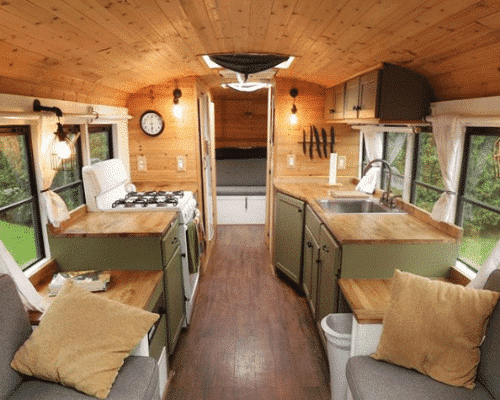
Taller ceilings without a roof raise. This is the big one. Most shuttle buses give you 6’3″ to 6’8″ of interior height right off the lot. A standard school bus gives you 6’0″ to 6’3″, and a short bus can be as low as 5’10”. If you’re tall, or even average height and don’t want to duck under ceiling fans and light fixtures, a shuttle bus saves you the $2,000 to $5,000 and multiple weekends of work that a roof raise would cost on a school bus.
Flat floors. School buses, especially short ones, have wheel well intrusions that eat into your floor space and complicate your layout. Shuttle buses typically have flat floors throughout the passenger area because the floor sits higher relative to the wheel wells. This makes building way easier. Your kitchen cabinets sit flat, your bed platform is simpler, and you don’t have to work around bumps.
Adult-sized features. Shuttle buses were built for grown adults, not kids. The entry steps are taller but fewer. The aisle is wider. The windows are bigger. The grab bars are at adult height. None of this matters once you gut the interior, but it tells you something about the overall proportions of the vehicle. Everything is just a little more generously sized than a school bus of the same length.
Easier to find low-mileage examples. School buses get driven twice a day, five days a week, nine months a year. They rack up miles. Shuttle buses, especially hotel and airport units, often sit idle between relatively short runs. I’ve seen shuttle buses with 80,000 to 120,000 miles that are 15 years old. A school bus of the same age would have 180,000 to 250,000 miles easily.
Wheelchair lift bays. Many shuttle buses come equipped with wheelchair lifts. Once you remove the lift, you’ve got a large access opening in the side of the bus that can be repurposed as an extra door, a fold-down patio step, a storage hatch, or a pass-through for loading big items during your build. Some people keep the lift frame and use it as a motorcycle or bike lift. Pretty clever.
Simpler registration. In some states, shuttle buses don’t carry the school bus classification that can complicate registration and require you to remove specific school bus equipment (lights, stop arm, etc.) before re-titling. This depends entirely on your state, so check your local DMV, but it’s one less potential hurdle.
Cons and Limitations
I’m not going to pretend shuttle buses are perfect. They’ve got real drawbacks, and if you don’t know about them going in, they’ll catch you off guard.
Thinner body panels. This is the big one on the con side. Shuttle bus body panels are typically 18 to 20-gauge steel compared to 16-gauge on a school bus. Thinner metal means less structural rigidity, more susceptibility to rust, and less confidence when you’re mounting heavy items to the walls. You can still hang cabinets and mount a TV, but you need to be smarter about spreading the load and using backing plates.
Less structural protection. School buses meet federal rollover standards (FMVSS 220) and body joint strength standards (FMVSS 221) that shuttle buses don’t. This doesn’t mean shuttle buses are unsafe — they still meet FMCSA commercial vehicle requirements — but it’s a real difference in how the body is engineered. Some people don’t care about this at all. Some people lose sleep over it. Just know what you’re working with.
Smaller community. The skoolie community is massive. Facebook groups with tens of thousands of members, thousands of YouTube build videos, detailed forums, parts swap groups. The shuttle bus conversion community is smaller by a wide margin. You’ll find help — it’s out there — but you won’t have the same depth of “someone already solved this exact problem” resources that school bus converters enjoy.
Rust is a bigger concern. Lighter-gauge panels plus the fact that many shuttle buses spent their lives in commercial duty (salt roads, airport tarmac, parking lots) means corrosion can be more advanced than you’d expect. I’ve read stories of people who bought shuttle buses that looked great on top but had serious rust underneath, especially around the lower seam where the body meets the frame. Always crawl under with a flashlight and a screwdriver before you hand over money.
Fewer windows (sometimes). Some shuttle buses, especially those used for corporate or medical transport, have fewer windows than a school bus. Less natural light means a darker interior, which affects the feel of your living space. You can always cut in more windows, but that’s added work and cost.
Parts for the body (not the chassis). The chassis underneath a shuttle bus is usually a common commercial platform with widely available parts. But the bus body sitting on top? That’s often built by a smaller manufacturer like Startrans, Glaval, ElDorado, Champion, or Turtle Top. If you need body-specific parts — window seals, entry door hardware, body trim — you might be chasing down niche suppliers.
Height Advantage (Taller Than School Buses)
“Where can I get a short school bus, or shuttle bus? Is it true that shuttle buses are taller because they are meant for grown ups?”
Yes, that’s essentially correct, and it’s one of the biggest practical advantages shuttle buses have for conversions. (See our guide on Church Bus Conversions: The Complete Guide for more on this.)
Here’s what’s going on. School buses were designed for children. The federal standards and the school district specs that manufacturers build to are optimized for small passengers. The interior ceiling height on a standard Type A short school bus is about 5’10” to 6’0″. On a Type C full-size, it’s 6’0″ to 6’3″. Those dimensions are fine when your passengers are elementary and middle schoolers, but they make for tight living quarters when you’re a full-grown adult.
Shuttle buses were designed for adults — business travelers with carry-on luggage, elderly passengers who need to walk the aisle without stooping, wheelchair users who need clearance. The result is taller walls and higher ceilings, typically 6’3″ to 6’8″ inside. Some of the taller Freightliner-chassis shuttle buses push close to 6’10” interior height.
I keep coming back to this because those extra inches make more of a difference than most people expect. When I was researching builds and watching video tours, the shuttle bus conversions just felt different. The ceiling fans had clearance. The overhead cabinets didn’t feel like they were pressing down on you. People could stretch their arms up without touching the ceiling. In a school bus conversion, especially a short bus, you see a lot of builds where the owner says something like “I’m 5’9″ and I can juuuust stand up straight.” That’s not comfortable living. That’s tolerating a limitation.
Now, where do you find these things? Shuttle buses show up in different places than school buses:
- Government surplus auctions — GovPlanet, PublicSurplus, GovDeals. Municipal transit agencies, VA hospitals, and government offices retire shuttle buses regularly.
- Fleet liquidation sales — Airport shuttle companies, hotel chains, and medical transport outfits cycle vehicles out every 5-10 years. Companies like Ritchie Bros. and IronPlanet handle these sales.
- Commercial vehicle dealers — Dealers that specialize in used commercial vehicles (not car dealerships) often have shuttle buses in their inventory.
- Facebook Marketplace and Craigslist — Private sellers, small businesses closing down, churches upgrading their fleet. Search “shuttle bus,” “passenger bus,” “church bus,” and “medical transport bus.”
- Direct from businesses — Call local hotels, airports, nursing homes, and shuttle services directly. Sometimes they’ll sell retiring vehicles before they even hit a public listing.
As for short school buses, the typical sourcing is government auctions, school district surplus sales, and private sellers. I covered that in more detail in our article on where to buy a school bus for conversion.
Floor Plans for Shuttle Buses
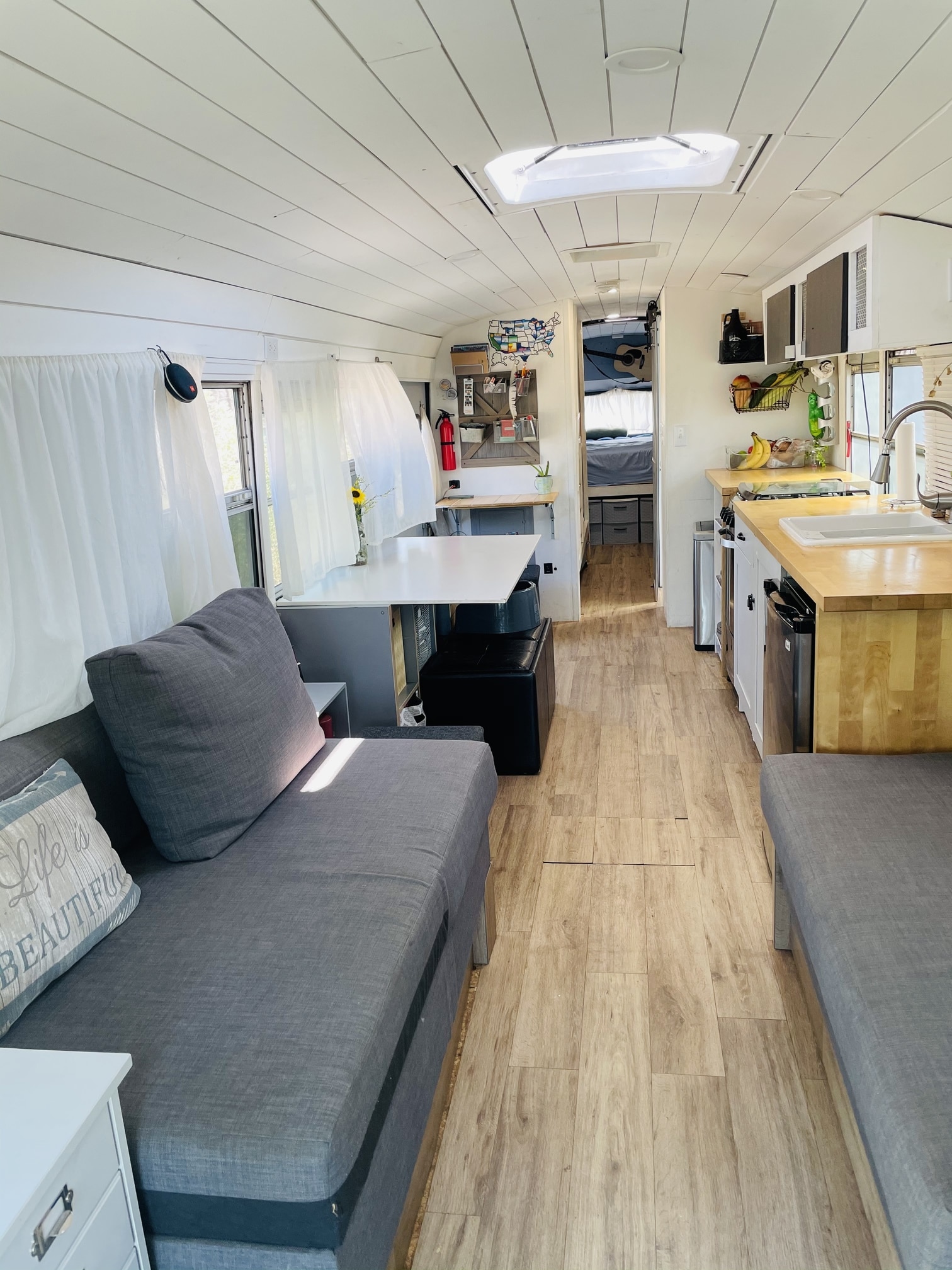
Floor planning a shuttle bus is actually more straightforward than a school bus in some ways. The flat floor, taller ceiling, and generally boxier interior shape give you cleaner geometry to work with. No wheel well bumps to design around, no curved walls to deal with.
The typical shuttle bus conversion falls into one of a few layout patterns depending on length:
20-24 Foot Shuttle Bus
This is the compact build. You’ve got roughly 12-16 feet of usable living space behind the driver’s area. Think of it like a large cargo van build with more headroom. Most people at this size go with a rear bedroom setup — a fixed bed across the back with storage underneath, a galley kitchen along one wall, and either a wet bath or no bathroom at all. A composting toilet under the bed with a curtain is a popular compromise.
I saw a build on a 22-foot Ford E-450 shuttle that really impressed me. The couple who did it used the extra ceiling height to install a raised bed platform in the rear with a full standing-height closet and pantry underneath. You couldn’t do that in a short school bus because the ceiling is too low. In the shuttle, they had about 30 inches under the bed and still 36 inches of sleeping clearance above the mattress. Smart use of the vertical space.
25-28 Foot Shuttle Bus
This is the Goldilocks zone for a lot of shuttle bus converters. You’ve got roughly 17-20 feet of living space, which is enough for a dedicated bathroom, a real kitchen, a sleeping area, and a small living space. The layouts I’ve seen at this size usually follow one of two patterns:
Rear bathroom, mid kitchen, front bedroom. The bed goes behind the driver’s area (which gives you the widest part of the bus for the bed), the kitchen runs along one wall in the middle, and a small bathroom with a shower goes in the back corner. This keeps the plumbing consolidated in the rear near the drain points.
Rear bedroom, mid bathroom, front living. The bed goes in the back, a compact bathroom sits in the middle as a divider between public and private space, and the kitchen and a small seating area fill the front. This is the more traditional RV-style layout.
29-32 Foot Shuttle Bus
At this size, you’ve got real room to work with — 20-24 feet of living space. Enough for a separate bedroom with a door, a full bathroom with a shower stall (not just a wet bath), a kitchen with real counter space, and a living area with a couch or dinette. Some people at this size even fit a small office nook or a washer/dryer combo.
The 30-foot shuttle bus is where the platform starts competing seriously with a full-size school bus for livability, while staying easier to drive and park. The main thing you give up is width — a shuttle bus is still about 7.5 feet inside compared to a school bus’s 7.5 feet. Actually, on width they’re basically the same. The shuttle bus advantage at this size is really about the ceiling height and the flat floor making the space feel more open.
One layout trick I’ve seen on longer shuttle buses — if the bus came with a wheelchair lift, and you removed it, that side bay opening can become a pass-through storage compartment accessible from outside. Some builders install a hinged door over the opening and use the space for propane tanks, shore power hookups, or a water heater that vents externally. Keeps all that stuff outside your living space.
Mechanical Considerations
The good news with shuttle buses is that the mechanical side is usually straightforward. The chassis and drivetrain are common commercial platforms, not specialty bus hardware. The bad news is that “common” doesn’t always mean “trouble-free.”
Engine choices matter. I covered the major platforms above, but let me be more specific about what to watch for. The Ford V10 is reliable but drinks fuel. The 6.0 Powerstroke needs bulletproofing. The Duramax/Allison combo is excellent but costs more to buy. The Cummins 5.9 and 6.7 are about as bulletproof as diesel engines get. The International DT466 is a workhorse. The MaxxForce engines from 2008-2013 should be approached with caution.
Brakes. Most shuttle buses run hydraulic disc brakes, not air brakes. This is actually a plus for conversion purposes because hydraulic brakes are what you find on normal trucks and cars — any shop can service them, parts are cheap, and you don’t need to understand air brake systems. Some of the larger Freightliner-chassis shuttle buses do have air brakes, though, so check before you buy. Air brakes aren’t a dealbreaker, but they add complexity and in some states they push you toward needing a CDL endorsement depending on the GVWR.
Transmission. Most shuttle buses have automatic transmissions — Allison automatics on diesel rigs, Ford or GM automatics on gas rigs. Allison transmissions in particular are rock-solid and well-known among mechanics. The Allison 1000 series in the Duramax trucks and the Allison 545/644 in medium-duty applications are both excellent. If you’re looking at a gas rig, the Ford 5R110W TorqShift behind the V10 has a good track record too.
Cooling systems. Here’s something I didn’t think about until I read a post from a guy who learned the hard way. Shuttle buses often have auxiliary rear heaters and sometimes rear AC units. When you gut the interior, you’re removing the ductwork and sometimes disconnecting hoses that were part of the cooling system loop. Make sure you properly cap or reroute any coolant lines that fed the auxiliary systems. A leaking coolant hose inside your wall cavity is a nightmare you don’t want.
Electrical. Many shuttle buses come with a high-output alternator and auxiliary battery setup to power the passenger area lights, fans, and wheelchair lift. This is free infrastructure you can repurpose. The high-output alternator is particularly useful — it can help charge your house battery bank while driving. Don’t rip it all out before you figure out what you can use.
GVWR and weight. This is critical and I can’t stress it enough. Shuttle buses have a rated Gross Vehicle Weight Rating that you cannot legally exceed. A Ford E-450 chassis has a GVWR of about 14,500 pounds. The bus body, your conversion materials, water, propane, batteries, your stuff, and your passengers all count toward that number. The empty bus already weighs 8,000 to 10,000 pounds. That leaves you maybe 4,500 to 6,500 pounds for everything else. It sounds like a lot until you start adding tile floors, granite counters, and a 100-gallon water tank. Weigh your bus on a CAT scale before you start building, do the math, and plan accordingly. I wrote a whole article on how to calculate and stay under GVWR if you want to go deeper on this.
Cost to Buy and Convert
Let me break down real numbers because I know that’s what people actually want to see.
Purchase Price
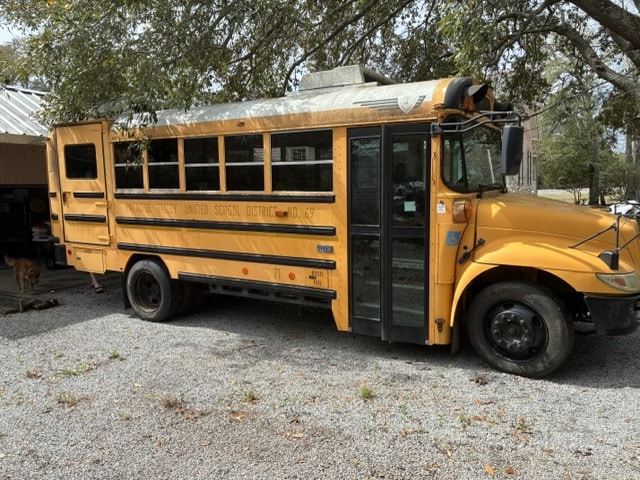
The price of a shuttle bus varies wildly based on age, mileage, condition, drivetrain, and where you’re buying.
| Source | Typical Price Range |
|---|---|
| Government surplus auction | $2,000 – $8,000 |
| Fleet liquidation | $4,000 – $12,000 |
| Private seller | $3,000 – $15,000 |
| Commercial dealer | $8,000 – $20,000 |
| Church/nonprofit liquidation | $3,000 – $10,000 |
Gas-engine shuttle buses (Ford V10, Chevy 6.0) sell for less than diesel. A 2008 Ford E-450 V10 shuttle bus with 120,000 miles might go for $4,000 to $7,000 at auction. The same vintage with a Cummins diesel might fetch $8,000 to $14,000.
I found a deal once listed on Facebook Marketplace — a 2005 Chevy Express 4500 shuttle bus with the Duramax and only 95,000 miles. A nursing home was selling it because they’d upgraded their fleet. Price was $6,500. Those kinds of deals exist if you’re patient and look in the right places. The trick is searching terms that regular bus hunters don’t use — “patient transport bus,” “courtesy shuttle,” “employee bus” — alongside the usual keywords.
Conversion Costs
Here’s a rough breakdown for a mid-range shuttle bus conversion. Not bare-bones, not luxury. Comfortable and functional.
| Category | Budget Range |
|---|---|
| Insulation | $300 – $800 |
| Framing and walls | $500 – $1,200 |
| Flooring | $300 – $800 |
| Electrical (solar, batteries, inverter) | $2,000 – $5,000 |
| Plumbing (water tank, pump, heater) | $500 – $1,500 |
| Kitchen (cabinets, stove, fridge) | $1,500 – $3,500 |
| Bathroom (toilet, shower, fixtures) | $500 – $1,500 |
| Bed/furniture | $300 – $1,000 |
| Paint/exterior | $300 – $1,000 |
| Windows/ventilation | $200 – $800 |
| Miscellaneous (fasteners, sealant, tools) | $500 – $1,500 |
| Total | $7,000 – $18,600 |
In practice, most people end up spending $12,000 to $25,000 on a mid-range shuttle bus conversion when you include the stuff that doesn’t make it onto the planned budget — the extra trip to the hardware store, the thing you had to redo, the upgrade you decided on halfway through. I’ve never met a single bus converter who came in under their original budget. It’s the one universal truth of this whole world.
If you’re doing a bare-bones adventure build — insulation, a basic electrical system, a platform bed, a camp stove, and a portable toilet — you can get away with $5,000 to $8,000. If you want a full luxury build with lithium batteries, a big solar array, a tankless water heater, custom cabinetry, and a proper shower — $25,000 to $40,000 isn’t unreasonable.
Total All-In Cost
Bus purchase plus conversion, most people are looking at $15,000 to $35,000 for a shuttle bus conversion that’s genuinely comfortable to live in full-time. Compare that to a new Class C RV ($80,000 to $150,000) or a used one in decent shape ($30,000 to $60,000), and the shuttle bus conversion math starts looking pretty good.
Related: Can You Convert a Double Decker Bus Into a Home?
Where to Find Shuttle Buses
I touched on this above in the height section, but let me go deeper here because sourcing is honestly one of the biggest challenges with shuttle buses. They don’t show up in the same obvious places as school buses.
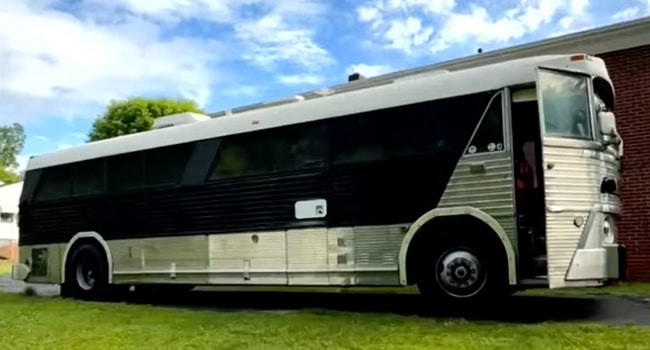
Online auction sites. GovPlanet, GovDeals, and PublicSurplus are your best bets for government-owned shuttle buses. Municipalities, VA hospitals, state agencies, and federal offices all use shuttle buses and cycle them out regularly. The prices are often below market because these are straight liquidation sales with no dealer markup. The catch is that you usually can’t test drive them, the descriptions are minimal, and you’re buying as-is. I always recommend physically inspecting any auction bus before bidding if you possibly can.
Commercial vehicle auctions. Ritchie Bros., IronPlanet, and Purple Wave handle fleet vehicle disposals for private companies. Airport shuttle companies, hotel chains, and medical transport outfits are the sellers here. These tend to be better maintained than government units because the companies had a financial incentive to keep them running. Prices are a bit higher but so is quality.
Direct from businesses. This is the approach that fewer people think of, and it’s where I’ve seen the best deals. Call the shuttle companies at your local airport. Call hotel chains. Call nursing homes and assisted living facilities. Call daycare centers and churches. Ask if they have any vehicles they’re planning to retire. Sometimes they’ll sell you a bus for below auction value just to avoid the hassle of listing it. You also get to talk to the person who maintained it and get the service history firsthand. That’s worth more than the price savings.
Facebook Marketplace and Craigslist. Search “shuttle bus,” “passenger bus,” “church bus,” “medical bus,” “handicap bus,” and “wheelchair bus.” The wheelchair bus search is a good one because ADA-equipped shuttle buses with wheelchair lifts are common and sometimes sell for less because buyers don’t want to deal with the lift hardware. As I mentioned, that lift bay is actually an asset for a conversion.
Dealer lots. There are used commercial vehicle dealers who specialize in buses, vans, and medium-duty trucks. They’ll charge more — that’s the dealer markup — but you get a vehicle that’s been inspected, sometimes comes with a limited warranty, and you can test drive it. For people who want peace of mind over the lowest possible price, this is a reasonable path.
National shuttle bus brokers. Companies like Creative Bus Sales, National Bus Trader, and BusesForSale.com list shuttle buses from all over the country. You can filter by chassis, engine, length, and year. Useful if you’re willing to travel or arrange shipping to pick up the right bus.
One last sourcing tip. When I was doing my research, I noticed that shuttle bus inventory fluctuates seasonally. Hotels and airports tend to replace vehicles in the fall and winter — slow travel season. That’s when the most inventory hits the market and prices are softest. Spring and summer, when everyone’s traveling and thinking about bus conversions, is when prices climb. If you can, shop in November through February.
—
So that’s shuttle buses. They’re not the flashiest platform in the conversion world and they don’t have the community momentum that skoolies do. But for certain people — tall people, people who want flat floors, people who don’t want to raise a roof, people who want something in that 24 to 30-foot sweet spot — a shuttle bus is genuinely hard to beat.
What I keep telling people when they ask me about this is to go look at one in person before you make up your mind. Stand inside a shuttle bus. Then stand inside a school bus. Feel the difference in ceiling height and floor layout. That physical experience does more than any article can to help you decide. Every bus conversion is a series of compromises, and the right platform is just the one where the compromises line up with what you can live with.
If you’re still figuring out which type of bus is right for you, check out our guide on types of buses you can convert for the full picture. And if you’ve already decided on a shuttle bus, our articles on how to choose the right school bus and things to check before you buy apply just as much to shuttle buses — the inspection process is basically the same.