
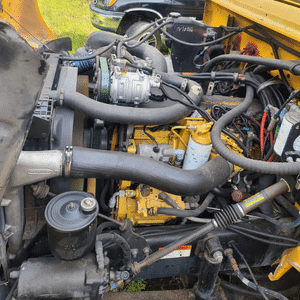
If you’re thinking about buying a bus to convert, there’s one question that comes up before almost anything else — how much is this thing gonna cost me to drive? I get it. I had the same anxiety when I was first researching. You look at this massive vehicle and picture yourself at the pump watching the numbers spin like a slot machine. But here’s what I found after digging into this for way too long: the fuel costs are real, but they’re also way more manageable than most people assume, especially once you understand how skoolie life actually works day to day.
This guide covers everything about fuel economy and travel costs for converted school buses. A typical full-size diesel skoolie gets 7-10 MPG after conversion, costing $0.40-$0.57 per mile in fuel at current diesel prices. Most full-timers spend $150-$400 per month on fuel because they’re not driving every day — they move the bus a few times a month and stay put. Your total travel costs including fuel, camping fees, maintenance, and incidentals typically run $500-$1,200 per month depending on how much you move. Gas engines cost more per mile than diesel despite cheaper fuel prices, weight is the biggest MPG killer after speed, and there are real strategies to improve your fuel economy by 10-20%. This guide breaks down every number you need to budget accurately.
How many miles to the gallon?
This is the first thing everybody asks, and the answer depends on a handful of variables that matter more than most people realize. Bus size, engine type, build weight, terrain, speed, and even wind direction all play into it.

Here’s the general breakdown by bus type and engine:
| Bus Type | Engine | MPG (Gutted) | MPG (Built Out) |
|---|---|---|---|
| Short bus (E-450 gas) | V10 Triton / V8 | 8-12 | 7-10 |
| Short bus (3500/4500 diesel) | Cummins / Duramax | 12-16 | 10-14 |
| Full-size Type C (diesel) | DT466 / Cummins 5.9 | 10-13 | 8-10 |
| Full-size Type C (gas) | 8.1L Vortec / V10 | 6-8 | 4-6 |
| Full-size Type D flat nose (diesel) | Cummins 8.3 / CAT 3126 | 8-10 | 6-8 |
| Coach / transit (diesel) | Detroit / Cummins ISM | 6-8 | 5-7 |
Those numbers assume highway driving at reasonable speeds on mostly flat terrain. Start climbing mountains or fighting headwinds and you can knock 1-3 MPG off any of those numbers real fast.
I was surprised to find out how much the specific engine matters within the same bus type. A full-size Blue Bird with a Cummins 5.9 will often outperform the same bus with a DT466 by a solid 1-2 MPG. And rear-end gear ratios play a huge role too. A bus with highway gears (like a 4.11 or 4.33 ratio) is gonna be way more fuel efficient on the interstate than one with mountain gears (5.13 or 5.38). I talked to one guy in a forum who swapped his rear end from 5.38 to 4.56 gears and picked up almost 2 MPG on the highway. That’s a massive difference over the life of the bus.
What’s your gas mileage?
People ask this one constantly in every skoolie group I’ve been in. The problem is the answers are all over the place, and it took me a while to figure out why.

Someone will say “I get 11 MPG” and someone else with basically the same bus says “I’m getting 6.” And both are telling the truth. The difference usually comes down to three things: how they’re measuring it, how fast they drive, and how much their build weighs.
The hand calculation method is the only one I trust. Fill your tank completely, reset your trip odometer, drive until you need fuel again, fill up completely, then divide the miles driven by the gallons it took to fill up. That’s your real MPG. The dash gauges on a lot of these buses are laughably inaccurate. I read one thread where a guy was bragging about 12 MPG on his full-size flat nose and then somebody asked if he’d actually calculated it by hand. He hadn’t. When he did, it was 7.8. The dash was lying to him by over 50%. (See our guide on How Many Miles Is Too Many When Buying a School Bus? for more on this.)
Speed is the other huge factor. I keep coming back to this because it really is the single biggest thing you can control. At 55 MPH, a typical diesel full-size might get 9-10 MPG. Push that to 65 and you’re at 7-8. Hit 70 and you might be down to 6-7. Aerodynamics on a school bus are terrible — they’re basically a brick going down the road — so every mph above 55 costs you disproportionately more fuel.
If someone tells you they get great mileage, ask them how fast they drive. Nine times out of ten, the people reporting the best numbers are the ones going 55-58 in the right lane.
How much Money per week do you spend in Gas a week?
This was one of the questions I spent the most time on because the answer varies so wildly that you almost can’t give a single number. But I can give you ranges that actually make sense.
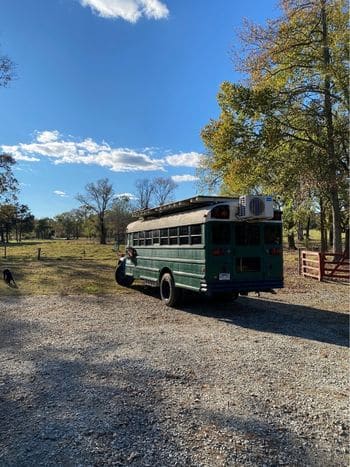
The key thing I didn’t understand until I really dug into this — most skoolie people are not driving their bus every day. Or even every week. The lifestyle is more about parking somewhere, living there for a while, and then moving on. It’s not a daily commute situation.
So here’s what real spending looks like across different lifestyles:
The Homesteader — parked on private land or a long-term RV spot, drives the bus maybe twice a month for dump stations or supply runs. Monthly fuel: $30-$80. Weekly: basically $10-$20. You’re barely touching the tank.
The Slow Roller — moves to a new location every 2-4 weeks, covers 100-300 miles per move. This is where the majority of full-timers actually land. Monthly fuel: $100-$300. Weekly average: $25-$75. Totally doable.
The Explorer — new spot every week, 150-300 miles between stops, actively traveling a region. Monthly fuel: $300-$600. Weekly: $75-$150. You’re starting to feel it, but you’re also having a lot of fun.
The Road Warrior — long-haul moves, 1,000+ miles a month, crossing states regularly. Monthly fuel: $500-$1,200+. Weekly: $125-$300. This is where fuel becomes your single biggest expense.
I was reading through a Facebook group discussion about this a while back and one couple in a 35-foot Thomas with a DT466 said their average over six months of slow traveling was $187 per month in diesel. They tracked every single fill-up in a spreadsheet. That number shocked me because it’s less than a lot of people’s car payments. They were moving about twice a month, staying at free camping spots, and driving 55 on the highway. It’s a good reminder that the way you live matters way more than the MPG your bus gets. (See our guide on How to Find Free and Cheap Camping for Your Skoolie for more on this.)
Another person in the same thread had a similar bus but was moving every 4-5 days and spending $600-$700 a month. Same MPG, completely different cost, all because of miles driven.
After all the additions, what happens to the gas mileage?
It goes down. No way around it.
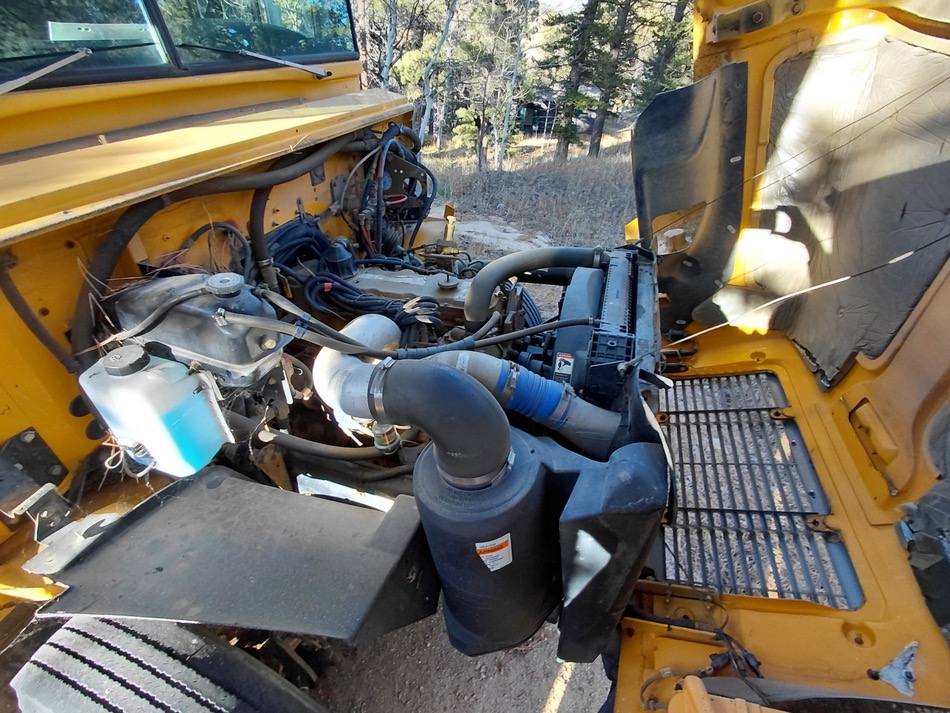
A typical skoolie conversion adds 3,000-8,000 pounds of weight to the bus. Some heavy builds with tile, stone countertops, full water tanks, and hardwood push past 8,000. Every single pound costs you fuel.
The rough math I’ve seen backed up across dozens of real-world reports is that a full build drops your MPG by 1-3 compared to the empty bus. So if your bus got 10 MPG gutted, expect 7-9 MPG once it’s fully built out and loaded with your stuff, your partner’s stuff, your dog’s stuff, and 80 gallons of fresh water.
Here’s a breakdown of where the weight typically comes from:
| Build Component | Weight Range |
|---|---|
| Framing (wood studs, subfloor) | 500-1,500 lbs |
| Insulation | 100-400 lbs |
| Wall and ceiling finish | 200-600 lbs |
| Flooring (vinyl plank vs tile) | 200-800 lbs |
| Kitchen (cabinets, countertops, appliances) | 300-800 lbs |
| Bathroom (shower, toilet, fixtures) | 200-500 lbs |
| Electrical system (batteries, solar, inverter) | 200-600 lbs |
| Plumbing and water tanks (full) | 500-1,200 lbs |
| Furniture and bed | 200-500 lbs |
| Personal belongings and gear | 500-1,500 lbs |
| Rooftop additions (AC, solar panels, deck) | 200-600 lbs |
The people who report the best post-build MPG are universally the ones who obsessed over weight during the build. Vinyl plank flooring instead of tile saves 300-500 lbs. Butcher block counters instead of granite saves 100-200 lbs. Aluminum framing instead of 2×4 wood studs can save 500+ lbs. It all compounds.
I found one really detailed build log where a couple weighed their bus at a CAT scale three times during their conversion — empty, halfway through, and fully built. They went from 16,400 lbs empty to 22,800 lbs fully built with water. That’s 6,400 lbs added. Their MPG went from 10.2 to 7.6. About a 25% decrease, which is pretty typical.
Water is the sneaky one that people underestimate. Water weighs 8.34 lbs per gallon. If you have a 60-gallon fresh tank, that’s 500 lbs just in water. Your gray and black tanks add more. Some people travel with tanks partially filled to save weight and only top off when they’re about to park somewhere for a while. It’s a small thing but it adds up to real fuel savings over thousands of miles.
Is there a way to increase gas mileage on a bus?
Yeah, actually. There’s no magic bullet that turns a school bus into a Prius, but there are legitimate things that make a noticeable difference. I went down a rabbit hole on this one and found that the combination of several small improvements can add up to 15-20% better fuel economy.

Slow down. I know I keep saying this, but it’s by far the biggest one. Dropping from 65 to 55 MPH can improve your mileage by 15-25%. On a bus, that might be the difference between 7 and 9 MPG. Over 5,000 miles of driving in a year, that’s roughly $350-$500 in fuel savings at current diesel prices. The reason is aerodynamic drag increases exponentially with speed. At 70 MPH, your engine is fighting a wall of air that’s burning fuel like crazy.
Keep tires properly inflated. Underinflated tires increase rolling resistance. Most school bus tires run 75-105 PSI depending on the tire and axle. Check them at least monthly when they’re cold. I read a study from the DOE that said every 1 PSI drop below optimal costs you about 0.2% in fuel economy. Doesn’t sound like much but across 6-8 tires that can be underinflated by 5-10 PSI each, it adds up.
Change your fuel filter and air filter regularly. A clogged fuel filter makes your engine work harder. A dirty air filter restricts airflow and reduces efficiency. These are cheap, easy maintenance items that directly affect fuel economy. I talked to a mechanic who works on fleet vehicles and he said he’s seen 1-2 MPG improvements just from a fuel filter change on buses that were overdue.
Use cruise control on flat highways. Your right foot is your worst enemy when it comes to fuel economy. Human tendency is to speed up, slow down, speed up, slow down without even realizing it. Cruise control holds a steady speed and steady throttle position, which is more efficient. Obviously don’t use it in mountains or heavy traffic, but on flat interstates it makes a difference.
Avoid excessive idling. Diesel engines burn roughly 0.5-1.0 gallons per hour at idle. If you’re sitting at a rest stop with the engine running for the AC, that’s $2-$4 an hour in fuel. Over a hot summer of idling for an hour a day, you could burn through $120-$360 worth of diesel just sitting still. A generator or shore power is way cheaper for climate control when you’re parked.
Plan routes for elevation. This one is underrated. A route that avoids mountain passes might be 50 miles longer but save you more fuel than the shorter mountainous route. Climbing grades murders fuel economy on a heavy vehicle. I’ve seen people report 3-4 MPG going up steep grades in the Rockies, versus 8-9 MPG on flat Texas highways. If you can route around major climbs, do it.
Reduce aerodynamic drag. Anything on your roof creates drag. A roof rack loaded with gear, a rooftop deck, bikes strapped to the front — it all costs you. Some people add a nose cone or fairing to the front of the bus to smooth airflow. I’ve seen mixed reports on how much this actually helps, anywhere from negligible to 1 MPG improvement. Probably depends on how it’s designed and how fast you drive.
Keep the engine tuned. Injector timing, turbo health, EGR function (on newer engines) — all of these affect combustion efficiency. A well-maintained diesel that’s running right will always get better mileage than one that’s overdue for service.
What’s the fuel economy? Diesel vs gas cost comparison
This is where the numbers get really interesting, because gasoline is usually cheaper per gallon than diesel, but that doesn’t mean gas buses are cheaper to run. In fact it’s the opposite.
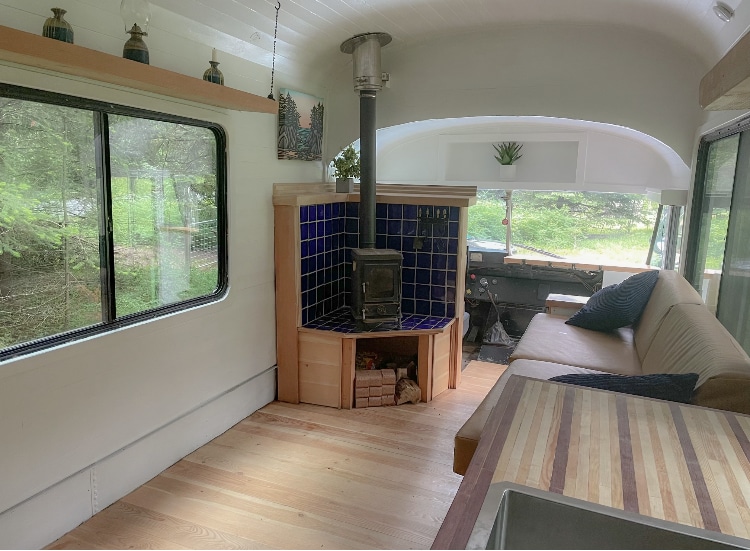
Let me lay this out clearly because it confused me at first too.
| Factor | Diesel Bus | Gas Bus |
|---|---|---|
| Fuel price (national avg) | $3.75-$4.25/gal | $3.00-$3.50/gal |
| Full-size MPG (built out) | 7-10 | 4-6 |
| Cost per mile | $0.38-$0.61 | $0.50-$0.88 |
| Cost per 1,000 miles | $380-$610 | $500-$880 |
| Cost per 5,000 miles/year | $1,900-$3,050 | $2,500-$4,400 |
Even though diesel costs more per gallon, you burn so much less of it per mile that diesel buses are almost always cheaper to operate. The difference gets bigger the more you drive. A full-timer putting 10,000 miles a year on a gas full-size bus could easily spend $2,000-$3,000 more on fuel annually than someone with a diesel bus covering the same distance.
Now here’s where it gets slightly more complicated. Diesel buses have an additional cost that gas buses don’t — DEF fluid. If your bus is 2010 or newer, it almost certainly has a Diesel Exhaust Fluid system. DEF is a urea-based liquid that gets injected into the exhaust to reduce emissions. It’s stored in a separate tank (usually 5-10 gallons) and the bus uses roughly 2-3% of your fuel consumption in DEF. So if you burn 100 gallons of diesel, you’ll use about 2-3 gallons of DEF.
DEF costs about $3-$5 per gallon at truck stops, or $10-$15 for a 2.5 gallon jug at auto parts stores. Over 5,000 miles of driving in a bus getting 8 MPG, you’d burn about 625 gallons of diesel and roughly 12-19 gallons of DEF. That’s $36-$95 in DEF costs. Not nothing, but not a dealbreaker either. Most people buy the 2.5-gallon jugs at Walmart for about $12 each and keep a few in the bus.
The real cost difference with DEF systems isn’t the fluid itself — it’s the repair costs when the system breaks. DEF sensors, injectors, and tanks can cost $500-$2,000 to repair, and the system can put your bus into limp mode if it malfunctions. This is one of the big reasons the skoolie community gravitates toward pre-2007 (or ideally pre-2004) diesel engines that don’t have any emissions equipment at all.
So how’s the gas mileage — what does fuel cost per mile?
Cost per mile is honestly the most useful number for budgeting. Once you know your cost per mile, you can estimate the fuel cost of any trip in about two seconds.
Here’s a detailed breakdown at different fuel prices:
Diesel full-size (8 MPG average)
- At $3.50/gal: $0.44/mile
- At $4.00/gal: $0.50/mile
- At $4.50/gal: $0.56/mile
- At $5.00/gal: $0.63/mile
Diesel short bus (12 MPG average)
- At $3.50/gal: $0.29/mile
- At $4.00/gal: $0.33/mile
- At $4.50/gal: $0.38/mile
- At $5.00/gal: $0.42/mile
Gas full-size (5 MPG average)
- At $3.00/gal: $0.60/mile
- At $3.25/gal: $0.65/mile
- At $3.50/gal: $0.70/mile
- At $4.00/gal: $0.80/mile
Gas short bus (9 MPG average)
- At $3.00/gal: $0.33/mile
- At $3.25/gal: $0.36/mile
- At $3.50/gal: $0.39/mile
- At $4.00/gal: $0.44/mile
Now you can plan any move. Thinking about driving 200 miles to that free camping spot in the national forest? In a diesel full-size at $4/gallon, that’s about $100 in fuel. A 1,000-mile move from Arizona to Colorado? Budget $500. Cross-country from Florida to Oregon? Maybe $1,500.
I started keeping a little spreadsheet when I was running these numbers and it honestly took so much of the anxiety away. Once you know your cost per mile, fuel stops being this scary unknown and becomes just another line item in your budget.
How much does it cost to have — monthly and annual fuel budgets
Alright, let me build out some real monthly and annual budgets because I think this is where everything clicks. The number one mistake I see people make is budgeting fuel based on how much they think they’ll drive, which is almost always too high. Most people overestimate their driving by 2-3x when they’re planning.

Scenario 1: Mostly Stationary (500 miles/month)
- Diesel full-size at 8 MPG, $4/gal: $250/month, $3,000/year
- Diesel short bus at 12 MPG, $4/gal: $167/month, $2,000/year
- Gas full-size at 5 MPG, $3.25/gal: $325/month, $3,900/year
Scenario 2: Moderate Traveler (1,000 miles/month)
- Diesel full-size at 8 MPG, $4/gal: $500/month, $6,000/year
- Diesel short bus at 12 MPG, $4/gal: $333/month, $4,000/year
- Gas full-size at 5 MPG, $3.25/gal: $650/month, $7,800/year
Scenario 3: Heavy Traveler (2,000 miles/month)
- Diesel full-size at 8 MPG, $4/gal: $1,000/month, $12,000/year
- Diesel short bus at 12 MPG, $4/gal: $667/month, $8,000/year
- Gas full-size at 5 MPG, $3.25/gal: $1,300/month, $15,600/year
Scenario 4: Slow Traveler – the sweet spot (300 miles/month)
- Diesel full-size at 8 MPG, $4/gal: $150/month, $1,800/year
- Diesel short bus at 12 MPG, $4/gal: $100/month, $1,200/year
- Gas full-size at 5 MPG, $3.25/gal: $195/month, $2,340/year
Scenario 4 is where the majority of full-timers I’ve talked to actually live. They move the bus 2-3 times a month, cover 100-150 miles per move, and park somewhere free or cheap in between. At $100-$200 a month in fuel, it’s honestly a rounding error compared to what most people were paying in rent before.
The annual numbers are where it really puts things in perspective. Even the heavy traveler in a diesel full-size is spending $12,000 a year on fuel — and they’re driving 24,000 miles. That’s a LOT of moving. Most people will fall in the $1,500-$4,000 per year range, which is comparable to or less than what plenty of people spend fueling their daily driver.
What size engine is pulling all that weight — fuel consumption details
Engine size and type have a massive impact on real-world fuel consumption. This is something I wish I’d understood better when I first started looking at buses.

The Cummins 5.9L (common in full-size Type C buses from the 90s and early 2000s) is widely considered the sweet spot for fuel economy in a skoolie. It makes enough power to handle a loaded bus without working too hard, and it sips fuel compared to bigger engines. People consistently report 8-10 MPG with these, even after a heavy build.
The Cummins 8.3L (found in flat-nose Type D buses) makes more power but burns more fuel. It’s overkill for a lot of builds, but if you’ve got a 40-foot flat nose or you’re towing a car, the extra power is nice. Expect 6-8 MPG built out.
The International DT466 is everywhere in the school bus world. It’s a solid, reliable engine but fuel economy is hit or miss — I’ve seen reports anywhere from 7 to 11 MPG depending on the bus configuration, gear ratio, and how well it’s maintained. The DT466E (electronic) tends to get slightly better mileage than the mechanical version. (See our guide on School Bus Mechanical Inspection: The Complete Pre-Buy Guide for more on this.)
The CAT 3126 / C7 is another common option, especially in mid-2000s buses. Decent fuel economy in the 7-9 MPG range, but the C7 has a reputation for injector problems that can tank your mileage if they’re not addressed.
Gas engines — and I’ll just be direct about this — are fuel hogs in a full-size bus. The Chevy 8.1L Vortec and Ford V10 both struggle to crack 6 MPG in a loaded full-size conversion. They work fine in short buses where the weight is manageable, but in anything over 30 feet, you’re gonna feel it at the pump. That said, gas engines are cheaper to buy, cheaper to maintain, and easier to find mechanics for. So there’s a trade-off.
How do you keep the engine warm — idling costs and engine management
Someone in a YouTube comment asked about keeping a diesel warm in winter, and it’s actually a fuel economy question in disguise because a lot of people idle their bus to keep the engine from gelling in cold weather. That gets expensive fast.

A diesel engine at idle burns roughly 0.5-1.0 gallons per hour. Some bigger engines burn more. At $4/gallon diesel, that’s $2-$4 per hour. If you’re idling overnight to keep the engine warm, that’s $16-$32 for an 8-hour night. Over a cold month of doing that every night, you’re looking at $480-$960 just in idle fuel costs. That’s insane.
The better solutions don’t burn any fuel from your main tank:
- Block heater — plugs into shore power and keeps the engine coolant warm. Uses about 1,000-1,500 watts of electricity. If you have a campsite with electric hookups, this costs maybe $3-$5 per night in electricity.
- Diesel fuel additives — anti-gel additives like Power Service or Hot Shot prevent fuel from gelling down to -20F or lower. Costs about $10-$15 per treatment.
- Diesel-fired heater (Webasto/Espar) — taps into your fuel tank and burns a tiny amount of diesel (about 0.1 gallons per hour) to heat your living space AND can be plumbed to warm the engine coolant. Way cheaper than idling.
Even in summer, idling for air conditioning burns through fuel. If you’re parking at Walmart overnight and running the engine for AC, you’re spending $2-$4 per hour in diesel. A portable generator running a mini-split AC costs about $0.50-$1.00 per hour in gas. A good solar and battery setup costs nothing to run. The upfront investment in alternative climate control pays for itself really quickly in fuel savings.
Very ingenious, but a lot to tow — how does towing impact MPG?
A lot of skoolie people tow a car behind their bus so they have a smaller vehicle for running errands, exploring towns, and getting groceries without moving the whole bus. Smart idea. But it comes at a cost.
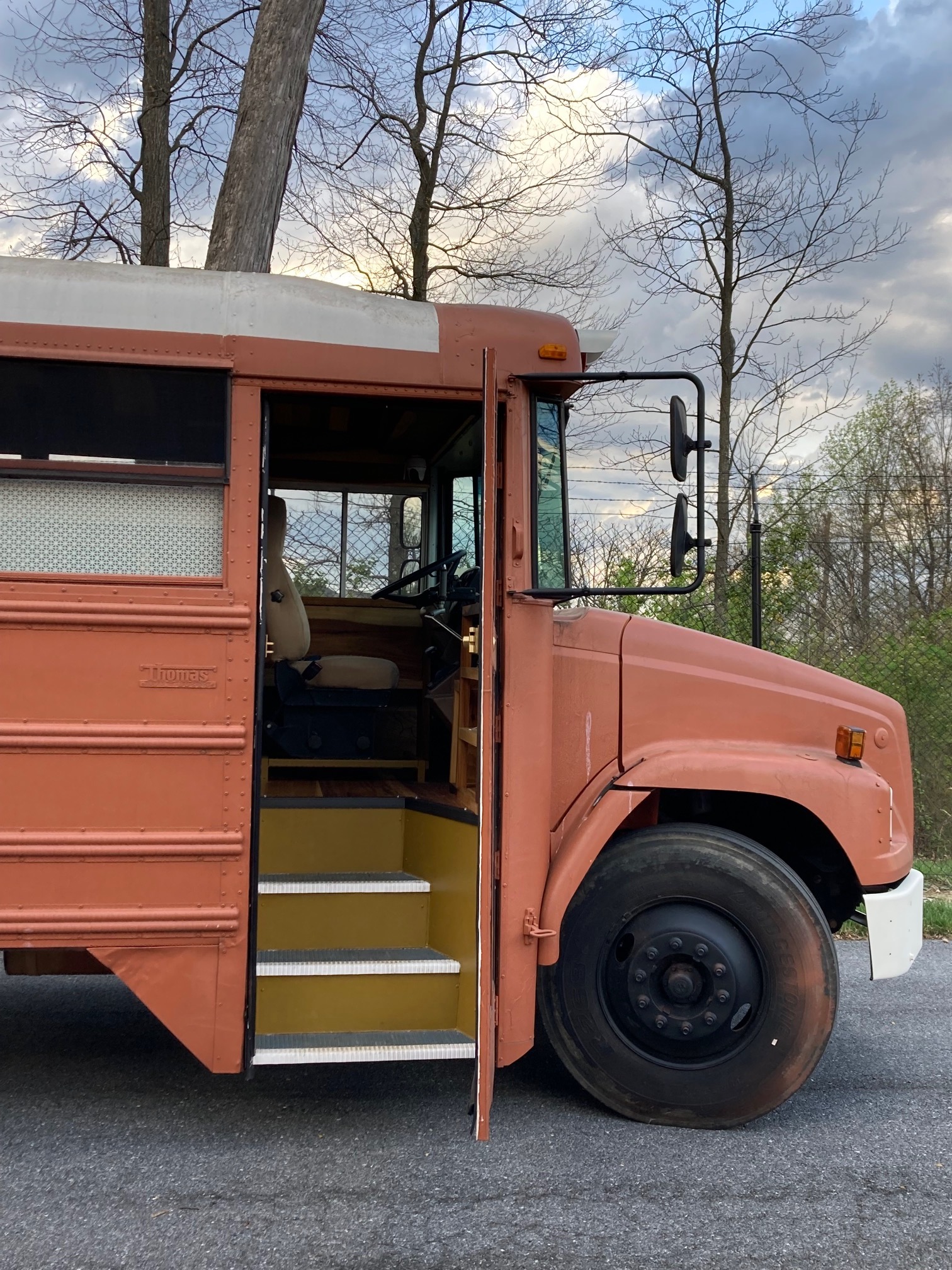
Towing a car behind your bus typically drops fuel economy by 1-3 MPG depending on the weight of the car and how it’s set up. A small car on a tow dolly (two wheels on the ground) creates less drag than a full trailer. Flat towing (all four wheels on the ground) is the most common method and adds about 1-2 MPG of penalty for a typical sedan.
Here’s what that looks like in real dollars:
| Scenario | MPG Without Tow | MPG With Tow | Extra Cost per 1,000 Miles |
|---|---|---|---|
| Diesel full-size, light car | 8 | 6.5 | $92 |
| Diesel full-size, SUV/Jeep | 8 | 5.5 | $182 |
| Diesel short bus, light car | 12 | 10 | $67 |
On 5,000 miles of annual driving, towing a light car behind a full-size diesel bus adds roughly $460 to your fuel bill. Towing something heavier like a Jeep Wrangler pushes that to $910. Not catastrophic, but worth factoring in.
The flip side is that having a tow vehicle means you don’t have to move your bus for every little errand. If you’d otherwise be driving the bus 100 extra miles a month for grocery runs and exploring, the tow vehicle actually saves you money because running a car those miles costs a fraction of what the bus would burn. I ran the numbers once and figured that if towing a car saves you even 50 miles of bus driving per month, it roughly breaks even on fuel. Anything beyond that and the tow vehicle is actually saving you money.
Where do you park — camping fees and the total travel cost picture
Fuel is just one piece of the total travel cost puzzle. The other big one that surprises people is camping fees, or the complete lack thereof if you know what you’re doing.
Here’s a realistic breakdown of total monthly travel costs across different styles:
Budget Traveler (lots of free camping)
- Fuel (300 miles/month, diesel full-size): $150
- Camping/parking: $0-$100 (mostly boondocking, occasional Harvest Hosts or $10 BLM sites)
- Propane: $20-$40
- DEF fluid: $5-$10
- Vehicle maintenance reserve: $50-$100
- Dump station fees: $0-$20
- Total: $225-$420/month
Moderate Traveler (mix of free and paid)
- Fuel (600 miles/month, diesel full-size): $300
- Camping/parking: $200-$500 (mix of RV parks at $30-$50/night and free spots)
- Propane: $30-$50
- DEF fluid: $5-$15
- Vehicle maintenance reserve: $75-$150
- Dump station fees: $10-$30
- Laundry and misc: $30-$50
- Total: $650-$1,095/month
Comfort Traveler (mostly RV parks with hookups)
- Fuel (800 miles/month, diesel full-size): $400
- Camping/parking: $600-$1,200 (RV parks at $30-$60/night)
- Propane: $20-$40 (less needed with hookups)
- DEF fluid: $10-$15
- Vehicle maintenance reserve: $100-$200
- Dump station fees: $0 (included with RV park)
- Laundry and misc: $30-$50
- Total: $1,160-$1,905/month
The difference between the budget traveler and the comfort traveler is mostly camping fees, not fuel. That’s something I didn’t fully appreciate until I laid it all out. A couple that boondocks on BLM land, national forest dispersed camping, and Walmart parking lots can travel for under $500 a month total. A couple staying at nice RV parks every night is spending $1,500+ — and most of that is the campsite, not the diesel.
This is where apps become really valuable. GasBuddy helps you find the cheapest fuel prices along your route. Trucker Path and Pilot Flying J’s app show you truck stops with diesel pumps that accept your fuel cards. iOverlander and FreeRoam show free camping spots. Campendium lets you filter by price and read reviews. Harvest Hosts gives you free overnight parking at wineries, farms, and breweries for about $99/year.
For fueling specifically, truck stops are almost always cheaper than regular gas stations for diesel. The big names — Love’s, Pilot, Flying J, TA, Petro — also have loyalty programs that knock off a few cents per gallon. Some skoolie owners get a fuel card through a company like TSD or Mudflap that gives them truck-stop pricing, which can save $0.10-$0.50 per gallon. On a 70-gallon fill-up, that’s $7-$35 in savings every time you fuel up.
What’s the cost benefits — route planning for fuel efficiency
Route planning is an underrated way to save on fuel costs, and it goes beyond just finding cheap gas stations.

Elevation matters more than distance for a heavy vehicle. I saw somebody post their fuel log from a trip through the Rockies versus a trip of similar distance through Kansas. The flat route averaged 8.7 MPG. The mountain route averaged 5.9 MPG. That’s a 32% difference in fuel consumption for roughly the same number of miles. If you have the flexibility to take a flatter route, even if it’s slightly longer, you’ll often come out ahead on fuel.
Wind is another factor people don’t think about until they’re driving a 40-foot flat-sided box through the Texas panhandle. A 20 MPH headwind can cut your MPG by 2-3. A tailwind can boost it. If you’re planning a long east-west trip, checking wind patterns and timing your driving days can genuinely save fuel. I know that sounds like overthinking it, but when you’re looking at a 2,000-mile cross-country drive, even 1 MPG difference is $75-$100.
Time of day matters too. Driving during rush hour through cities means stop-and-go traffic, which is the worst possible fuel economy for a heavy diesel. A bus that gets 8 MPG on the highway might get 3-4 MPG in city traffic. If you can time your movements to avoid major metro areas during peak hours, you’ll burn less fuel and have a much less stressful drive.
Some people plan their entire travel pattern around seasonal fuel prices. Diesel tends to be cheapest in fall and most expensive in late winter/early spring (heating oil demand drives prices up). Heading south in winter isn’t just about warmer weather — diesel is often cheaper in southern states too. Texas, Oklahoma, Louisiana, and Mississippi consistently have some of the lowest diesel prices in the country. California, the Northeast, and the Pacific Northwest tend to be the most expensive.
How can you afford gas — is it really feasible at over $3 a gallon?
Someone asked this in a YouTube comment and I think it’s worth addressing head-on because the fear of fuel costs keeps a lot of people from even starting.
Here’s the honest math. Take the slow traveler scenario — 300 miles per month, diesel full-size getting 8 MPG, diesel at $4/gallon. That’s $150 a month in fuel. Add another $200 for cheap camping, $50 for propane, $100 for maintenance reserves. That’s $500 a month to live and travel in your own home.
The average rent in the US is over $1,400. Add a car payment ($700 average), car insurance ($150), gas for commuting ($150), and you’re at $2,400+ before utilities, renter’s insurance, or anything else. Even comparing apples to apples, skoolie life is dramatically cheaper for most people.
Is fuel expensive? Sure, compared to a Honda Civic. Is it expensive compared to a conventional lifestyle? Not even close. The people who struggle with fuel costs in a skoolie are the ones who are constantly driving long distances. If you settle into a slower pace — and most people do, naturally, once the initial excitement of hitting the road wears off — fuel costs are genuinely modest.
I keep thinking about what that guy in the Facebook group said about his old life in San Diego. He was paying $2,200 in rent, $450 car payment, $200 insurance, $150 gas for commuting, plus utilities. Call it $3,300 a month minimum. He traded all of that for a skoolie where his monthly costs, fuel included, ran about $800. Even at 7 MPG and $4 diesel, the math wasn’t close.
What is the weight of the bus after construction — staying under GVWR
Weight management ties directly into fuel economy because the heavier your bus, the more fuel you burn. But there’s a legal dimension too — every bus has a Gross Vehicle Weight Rating (GVWR) that you’re not supposed to exceed.
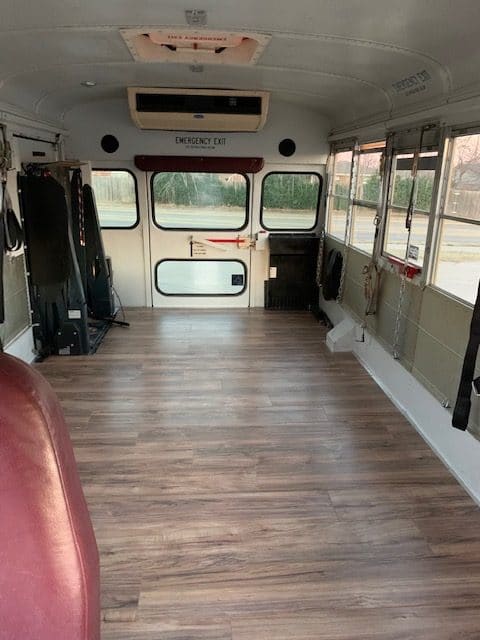
Most full-size school buses have a GVWR between 25,000 and 36,000 lbs. The bus itself weighs 15,000-24,000 lbs empty. That means you have somewhere between 8,000 and 15,000 lbs of payload capacity for your build, your stuff, passengers, and fuel.
That sounds like a lot, and it is, but heavy builds can eat through it surprisingly fast. I’ve seen conversion builds that added 8,000-10,000 lbs. Add two adults (350 lbs), a dog (80 lbs), full water tanks (700 lbs), fuel (500 lbs), and personal belongings (1,000 lbs), and you can find yourself pushing the GVWR limit.
Why does this matter for fuel economy? Because an overweight bus:
- Burns more fuel per mile
- Puts more stress on brakes, tires, and suspension
- Is technically illegal to operate over GVWR
- Could void your insurance if you’re in an accident while overweight
- Is harder on transmissions, especially when climbing hills
Getting your bus weighed at a CAT scale costs about $10-$15. I’d strongly recommend doing it with the build completed and everything loaded as if you’re about to travel. Weigh each axle separately because the weight distribution matters too. If your rear axle is overloaded even though total weight is fine, you’ve still got a problem.
For every 1,000 lbs you can shave off your build, you’re likely saving 0.2-0.5 MPG. Across 5,000 miles of annual driving, that’s roughly $50-$150 per year in fuel. Not life-changing on its own, but combined with lighter materials, proper tire pressure, and reasonable speeds, the savings stack up.
The bottom line on skoolie fuel and travel costs
Look, I’m not gonna sit here and tell you fuel costs don’t matter or that 8 MPG is great gas mileage. It’s not. By normal car standards it’s terrible. But skoolie life doesn’t work by normal car standards, and that’s kind of the whole point. (See our guide on What Kind of Gas Mileage Does a Skoolie Get? for more on this.)

What I found after spending way more time than any reasonable person should on this topic is that fuel costs are predictable, manageable, and almost always less than what people fear before they start. The typical full-timer spending $150-$300 a month on diesel is living in a home they own outright, traveling whenever they feel like it, and spending a fraction of what a conventional lifestyle costs. (See our guide on Should You Buy a Gas or Diesel School Bus? for more on this.)
The things that make the biggest difference aren’t complicated. Buy a diesel. Drive 55. Build as light as you can. Don’t move the bus unless you actually want to be somewhere new. Use truck stops and fuel apps. Boondock when you can. And stop trying to calculate fuel costs based on driving the bus every day, because you won’t.
If the fuel economy question is the thing standing between you and a bus, I’d say run the numbers based on how you actually plan to live — not the worst case scenario. For most people, the answer is a lot more comfortable than they expected. It was for me.