
You’re looking at your bus and doing the math on headroom. Standing up straight inside a standard school bus means about 6 feet of clearance, and if you’re taller than that, or you want to add insulation and flooring without losing precious inches, a roof raise starts looking real appealing. (See our guide on How to Raise the Roof on a School Bus (Step by Step) for more on this.)
Yes, you can raise the roof on a school bus, and people do it all the time in the skoolie community. The most common roof raises are between 12 and 24 inches, with 18 inches being the sweet spot most builders land on. The process involves cutting the bus walls at a chosen height, welding in new steel framing to extend the walls, and then reattaching the original roof on top. It’s not a weekend project though. Expect to spend $2,000 to $6,000 in materials alone, plus 100 to 300 hours of labor depending on your welding skills and how much help you’ve got.
“How much did you raise the roof?”
When I started digging into roof raises, I noticed most builders in the forums and YouTube comments kept landing on the same number. Somewhere between 14 and 20 inches. The reasoning makes sense once you think about it. You want enough extra height to stand comfortably, add a subfloor, insulate the ceiling, and still feel like you’re in a home, not a tunnel. (See our guide on What Is the Maximum Legal Height for a Converted Bus? for more on this.)
I found that the guys who went with 12 inches were generally shorter builders, maybe 5’8″ or under, and they just needed a little breathing room after losing a couple inches to flooring and ceiling materials. The ones who went with 20 to 24 inches were typically taller, or they had specific plans like loft beds or overhead storage that needed the extra vertical space.
The thing that surprised me was how many people said they wished they’d gone a little higher. I read one comment from a guy who did 14 inches and said if he could do it over, he’d go 18. Once you’ve already committed to cutting your bus apart, another 4 inches of steel isn’t that much more work or cost, but the difference in livability is noticeable.
“How high of a roof raise did you do?”
So this question pops up constantly, and I think it’s because people want a specific number they can plan around. Here’s what I found when I looked at a bunch of completed builds.
The 18-inch raise is hands down the most popular. I kept a mental tally while scrolling through build threads, and I’d say at least half the roof raises I came across were in the 16 to 18 inch range. At 18 inches, a standard school bus goes from roughly 6 feet of interior ceiling height to about 7 feet 6 inches before you account for flooring and ceiling finishes. After you lose 2 to 4 inches on the floor and another inch or two on the ceiling, you’re still looking at around 7 feet of usable headroom. That’s genuinely comfortable for almost everyone.
Now, I talked to a builder at a skoolie meetup once who had gone full send with a 24-inch raise. His reasoning was that he’s 6’4″ and his wife wanted hanging plants. Can’t argue with that. But he also admitted the build took him almost twice as long as he’d planned, and the welding on those taller wall extensions was trickier than he expected because the panels wanted to flex more.
If you’re doing the work yourself and you’ve never welded before, that’s something to factor in. The taller the raise, the more structural rigidity you need to add, and that means more crossbracing, more material, more time.
“What is the overall height of the new home on wheels? They raised it 18 inches and added an air conditioner. I was thinking about bridge height across US and Canada.”
This is the question that honestly kept me up at night when I was researching this topic. Because you can build the most beautiful raised-roof skoolie in the world and then take the top off it on a low bridge.
Here’s the math. A standard full-size school bus is typically about 10 feet 6 inches tall, give or take depending on the model. You add an 18-inch roof raise and you’re at 12 feet. Slap a rooftop air conditioner on there, that’s another 12 to 14 inches. Now you’re looking at roughly 13 feet to 13 feet 2 inches total height.
Most interstate highway overpasses in the US have a minimum clearance of 14 feet. So you’re usually fine on interstates and major highways. But here’s where it gets hairy. City bridges, railroad overpasses, old downtown underpasses, parking garages — those can be anywhere from 9 feet to 13 feet. I found a database of low-clearance bridges and there are thousands of them across the country under 13 feet.
Canada is a whole different situation. Bridge clearances vary by province, and some older routes in Quebec and the Maritimes have clearances that’ll make you sweat. The Trans-Canada is generally fine, but side roads and smaller highways can drop to 12 or even 11 feet in spots.
What I learned is that most raised-roof skoolie owners do three things. They measure their exact height with a pole on the roof, they use trucker GPS apps like CoPilot or Hammer that filter for vehicle height, and they avoid unknown routes without checking clearances first. A guy I was chatting with online told me he actually mounted a height indicator pole on his front bumper, basically a piece of PVC pipe cut to his exact roof height, so if it hits something, he stops before the roof does. I thought that was pretty clever.
Related: How Do You Remove School Bus Windows?
Related: What Is the Best Way to Paint a School Bus?
Related: How to Paint a School Bus (DIY vs Professional)
“Is this a raised roof bus or are you very short?”
I love this question because it gets asked on almost every skoolie tour video where the builder looks comfortable standing up. And it’s a fair question because there’s a huge range of heights out there.
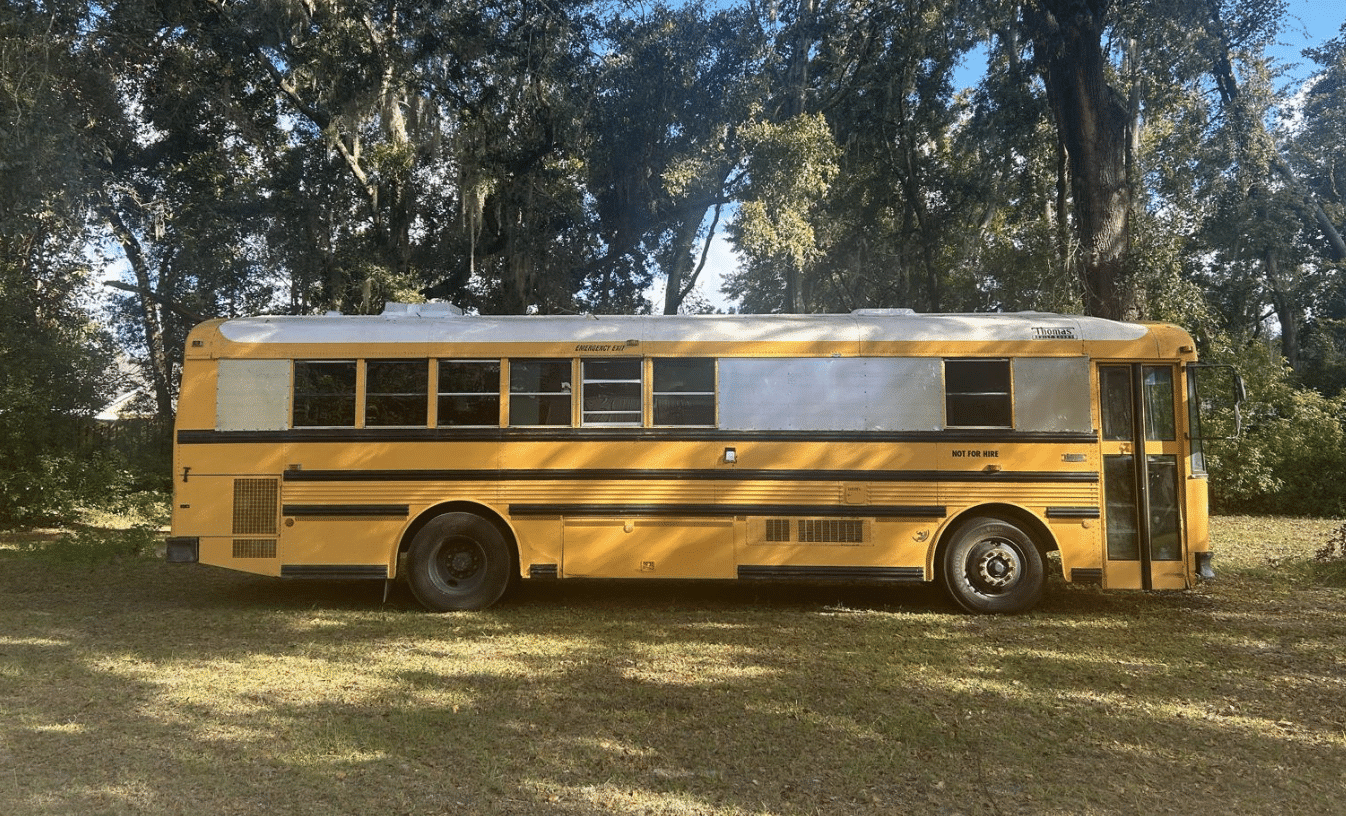
So here’s the deal. If you see someone who’s 5’6″ standing comfortably in a standard-height school bus, that bus probably doesn’t have a roof raise. A stock school bus gives you about 72 inches of interior ceiling height, which is exactly 6 feet. After you add a subfloor with insulation, you lose 2 to 3 inches. So someone who’s 5’8″ or shorter can get away without a raise, especially if they keep the ceiling treatment minimal.
But for anyone 5’10” and up, you’re gonna want a roof raise. I’m not what anyone would call tall, but even I found that the idea of living in a space where I couldn’t fully stretch my arms overhead without hitting the ceiling felt claustrophobic. It’s not just about standing height either. It’s about the feeling of the space. A raised roof makes a bus feel like a tiny home instead of a vehicle you’re crouching in.
There’s also a middle ground that some builders go for. Instead of a full roof raise, they’ll do a partial raise on just one section of the bus, usually the living area, and leave the cab area stock height. This saves on materials and labor but gives you that extra headroom where you spend the most time. I’ve seen a few builds like this and honestly, the transition between heights looked a little odd from the outside, but inside you barely noticed it.
The other option I came across is simply choosing a bus with more headroom to begin with. Transit buses and some coach buses have higher ceilings than school buses. A few builders I found online skipped the roof raise entirely by starting with a flat-nose bus that already had 6’3″ or 6’4″ of interior clearance. After losing a couple inches to the floor, they were still at 6 feet even, which worked for them. Not ideal for everyone, but it’s worth considering if the idea of cutting your bus in half terrifies you, which honestly it should at least a little bit.
One more thing on this. I read a comment from a woman who was 5’2″ and she’d done a 12-inch roof raise anyway. Her reason wasn’t about her own standing height at all. She wanted the extra space for upper cabinets and a ceiling fan. The raised roof gave her room for proper kitchen storage above the countertops without everything feeling like it was closing in on her. That’s a perspective I hadn’t considered before, and it made a lot of sense.
So whether or not you need a roof raise depends on more than just how tall you are. It’s about how the space feels, what you want to put up there, and how much work you’re willing to take on. But if you’re on the fence and you’ve got the budget and the welding skills, or know someone who does, I’d say go for it. Every single builder I came across who did a roof raise said it was worth it. Not one of them said they regretted the extra height. The only regrets were from people who wished they’d gone a few inches higher.
That’s really the bottom line on this one. You can absolutely raise the roof on a school bus, most people go with 18 inches, and the main thing to watch out for is bridge clearances once you’re done. Get yourself a trucker GPS app, know your exact height, and you’ll be fine. It’s a lot of work, but the builders who’ve done it all say the same thing — it transforms the bus from something you’re camping in to something you’re living in.
yzdttu
qopzp3
tkdr7z