
This is one of those questions that comes up every single time someone posts a tile shower in their bus build. People see subway tile or porcelain on walls inside a vehicle and immediately think, “There’s no way that survives the first pothole.” I saw it enough times in comment sections that I had to actually dig into what’s going on.
Shower tile in a bus does not crack from driving if you install it correctly. The bus has suspension that absorbs road vibration, and the tile itself is bonded to a solid substrate with flexible adhesive and grout. People have driven tiled buses tens of thousands of miles with zero cracking. The failures you hear about are almost always installation problems, not driving problems.
I’ll walk through the specific concerns I kept seeing, because they’re all slightly different questions even though they sound the same at first.
How does the shower tile not crack when you drive and hit bumps?
So this was the first thing I wanted to understand, because on the surface it doesn’t make sense. Tile is rigid. Buses bounce. Rigid things that bounce should break. That’s how most people think about it, and honestly I thought the same thing for a while.
What changed my thinking was learning more about how tile actually fails. Tile doesn’t crack because of vibration. Tile cracks because of flex. Those are two very different things. Vibration is rapid, small, repetitive movement. Flex is when the surface underneath the tile bends or shifts unevenly, which puts tension on the tile from behind. A bus going down the highway at 60 mph is vibrating, sure, but the subfloor and wall framing aren’t flexing in and out. Everything moves together as one unit.
I was reading a thread a while back where a guy who’d been a tile installer for 20 years chimed in on a skoolie forum. He said the number one reason tiles crack in houses is because the substrate flexes, not because of any kind of impact or vibration. Plywood subfloors in houses flex all the time when you walk on them, and that’s where cracks start. He said a properly built bus subfloor is actually more rigid than a lot of residential floors because you’re screwing plywood down to steel cross members every 12 to 16 inches. I thought that was interesting because I’d been assuming the bus would be worse than a house, and this guy was saying the opposite. (See our guide on What Kind of Toilet Should You Use in a Skoolie? for more on this.)
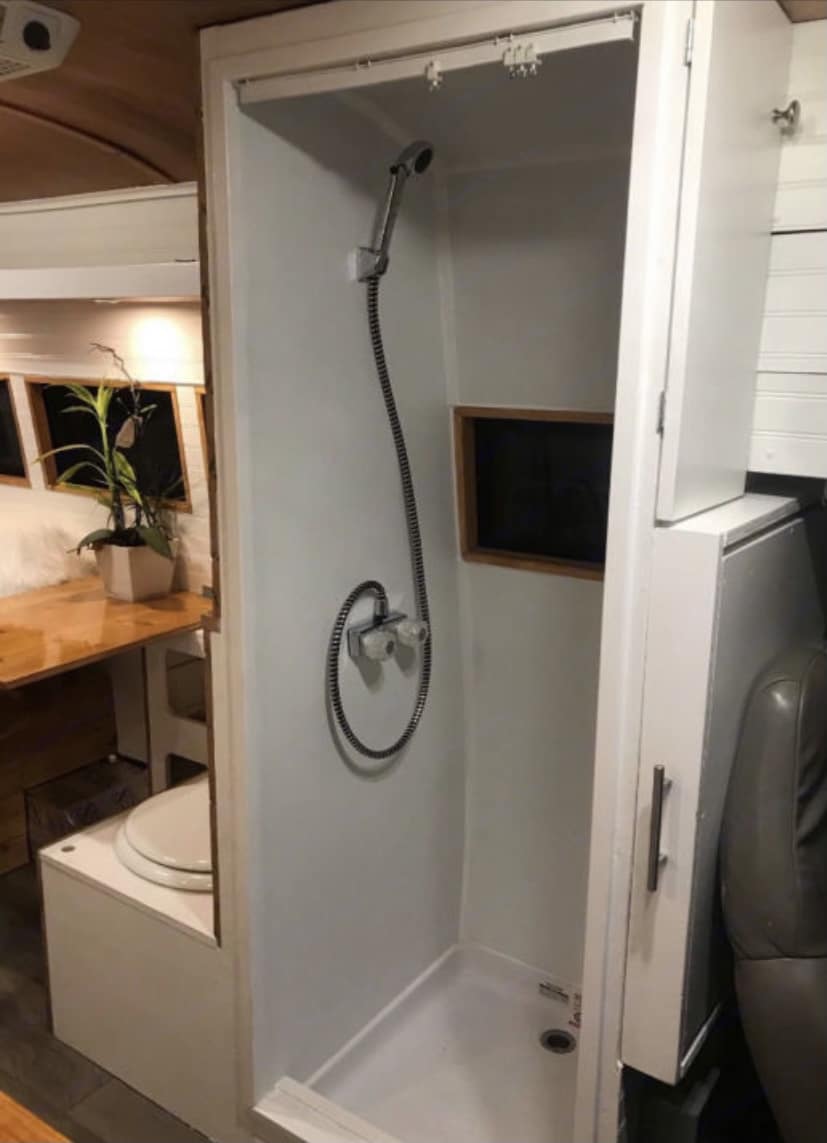
Now the shower walls are a slightly different situation than the floor because they’re vertical and they’ve got water hitting them constantly. But the principle is the same. If your wall framing is solid and doesn’t flex, and you use the right adhesive and grout, the tile stays put. Most people building shower walls in a bus are framing with 2x2s or steel studs screwed directly to the bus ribs, then putting cement board over that, then tiling onto the cement board. That layered approach gives you a rigid surface that moves with the bus, not against it. (See our guide on How Do You Get Water in a Converted Bus? for more on this.)
are you guys not worried that your floor tile will crack while driving and hitting bumps
I love how blunt this question is, because it’s basically saying “you’re all crazy and I need someone to explain why.” And I get it. When I first saw builds with full tile floors I had the exact same reaction.
Here’s the thing though. I went looking for people who actually had tile crack from driving, and it was surprisingly hard to find. What I found instead were a lot of people saying “I’ve had tile for two years and 30,000 miles, no issues.” Over and over. The ones who did have problems? Almost every time it came down to three things: thin plywood that flexed between supports, using the wrong adhesive, or not using cement board as a backer.
Let me get specific about the adhesive thing because I think it’s the part most people skip over. Regular thinset mortar, the stuff you’d use in a bathroom at home, is designed to be rigid when it cures. It works fine in a house where nothing moves. In a bus, you want a modified thinset with some polymer in it, or even a flexible tile adhesive. The polymer gives it just enough flex to absorb micro-movement without cracking. Same deal with grout. Standard sanded grout is rigid and will crack if there’s any movement. Flexible grout or epoxy grout handles the vibration. The price difference is maybe 10 bucks more for a bag of the good stuff. It’s one of those situations where spending an extra 30 to 40 dollars on materials saves you from ripping everything out later.
And then there’s the subfloor. Most skoolie builders are running 3/4 inch plywood screwed down to the steel frame with self-tapping screws every 12 inches or so. Some people double up with a layer of 1/2 inch cement board on top of the plywood before tiling. That double layer basically eliminates any flex. I talked to a builder at a meetup who said he’d driven his bus from Oregon to Florida and back with porcelain floor tile, and the only issue he’d ever had was one grout line near the door that cracked because he rushed the install and didn’t let it cure long enough. He patched it in five minutes and it held after that.
One thing I want to mention that nobody really talks about is weight. Tile is heavy. A full tile shower plus a tile floor in a bus can add 300 to 500 pounds depending on the size and material. That’s real weight, and it matters for your GVWR calculations. Porcelain is lighter than natural stone, and large format tiles are generally lighter per square foot than small mosaic tiles because you’ve got less grout and adhesive. Something to think about if you’re already tight on weight.
Related: Skoolie Plumbing and Water Systems: The Complete Guide
Related: How Do You Do Laundry Living in a Bus?
Related: Can You Put a Washer and Dryer in a School Bus?
Would sheetrock really stay on the ceiling on a moving bus? Also the weight of the sheetrock.
Alright, this one isn’t tile but it’s the same underlying concern, which is “won’t building materials shake themselves loose in a vehicle?” So it fits here.
Short answer, yes, sheetrock stays on the ceiling. I know it seems like it shouldn’t. You’re picturing a heavy sheet of drywall just vibrating off screws over time and crashing down on you while you sleep. But that’s not how fasteners work. A drywall screw driven into solid framing doesn’t back out from vibration. The threads grip and they stay. People have had sheetrock ceilings in buses for years with no structural issues from driving.
Where sheetrock does become a problem in a bus is moisture. Not vibration. A shower creates humidity. Cooking creates humidity. Breathing creates humidity. And in a metal bus, you get condensation on cold surfaces. If moisture gets behind sheetrock, it degrades the paper facing and eventually the gypsum itself starts to crumble. That’s a ventilation and vapor barrier issue, not a driving issue. I’ve seen builds where the sheetrock ceiling looked perfect after 40,000 miles of driving but started sagging after one winter of poor ventilation. The bus didn’t shake it down. The moisture rotted it.
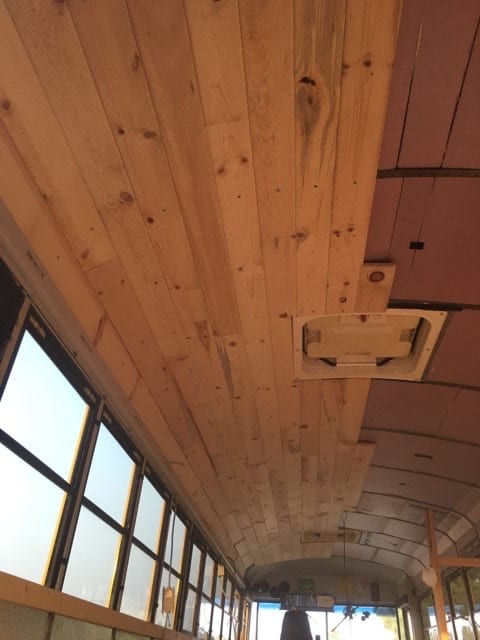
Now the weight question is real and worth addressing. A standard 4×8 sheet of 1/2 inch drywall weighs about 57 pounds. If you’re doing a ceiling in a 40-foot bus, you might need 8 to 10 sheets depending on layout, so that’s 450 to 570 pounds just for the ceiling. That’s significant. Some builders go with 1/4 inch drywall instead, which cuts the weight roughly in half. Others skip drywall entirely and use thin luan plywood, tongue and groove planking, or lightweight composite panels. I personally think the tongue and groove wood ceiling looks better anyway, and it weighs less, but that’s just preference.
One builder I came across online used 1/4 inch drywall on his ceiling and walls and said it was easier to work with, lighter, and held up fine for three years of full-time travel. His only complaint was that it was more fragile during installation and he cracked a piece trying to maneuver it into a tight corner. But once it was screwed up and finished, no problems on the road.
—
So here’s where I ended up after looking into all of this. Tile works in a bus. Sheetrock works in a bus. These aren’t fragile materials being thrown around in the back of a pickup truck, they’re building materials fastened to a solid structure that happens to move. The bus has suspension, the frame is rigid, and everything moves as one piece. The failures come from bad installation, not from driving. Use flexible adhesive and grout for tile, make sure your substrate is solid and well-supported, and don’t cheap out on the subfloor layers. For sheetrock, worry about moisture way more than vibration. That’s what actually kills it. I spent way more time researching this than I expected to, and the more I looked into it, the less worried I got. Build it right and it holds up. That’s basically the whole story.