

This question comes up in every single bus build conversation, usually right after someone realizes they need to figure out plumbing. And honestly, the toilet choice ends up shaping more of your build than you’d expect. (See our guide on Skoolie Plumbing and Water Systems: The Complete Guide for more on this.)
Most skoolie builders go with a composting toilet. A composting toilet separates liquids from solids, uses no water, needs no black water tank, and doesn’t require any plumbing hookup at all. The two biggest names are Nature’s Head (around $960) and Airhead (around $1,100). They’re not the only option though — cassette toilets, bucket systems, and even traditional flush toilets with black water tanks all work in a bus. But composting wins for most people because it’s simpler, lighter, cheaper in the long run, and way less gross to maintain than you’d think.
“What kind of toilet?”
So when I first started digging into this, I figured there’d be like two options and one would be obviously better. That’s not really how it works. There are actually four main categories, and which one makes sense depends on your budget, your travel style, and how much plumbing you want to deal with.
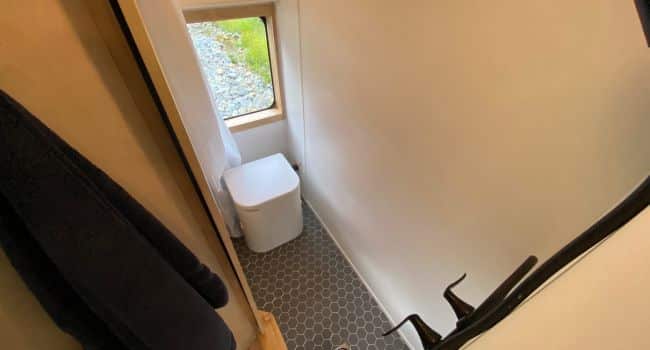
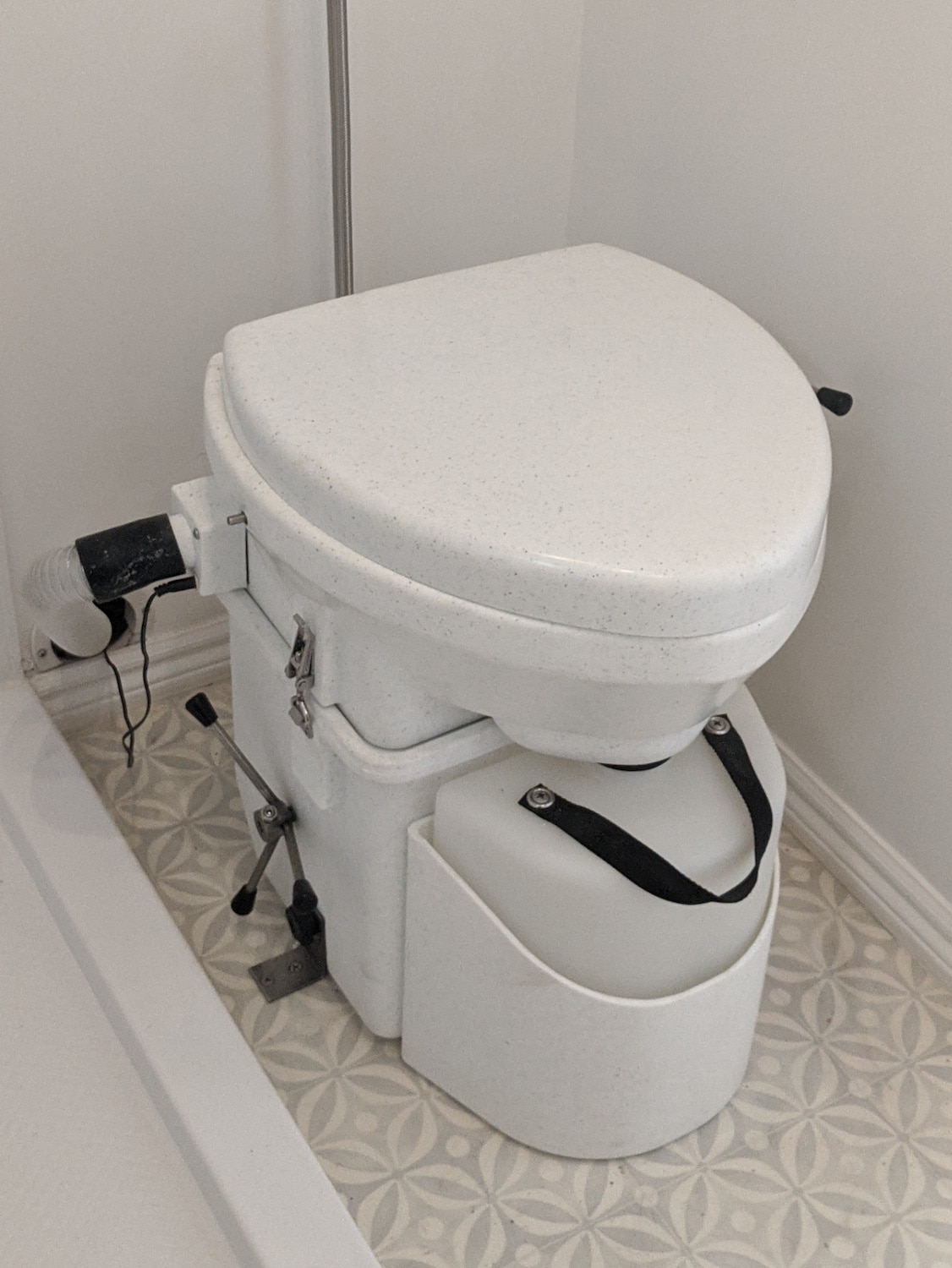
Composting toilets are the most popular by a wide margin. I kept seeing them in build after build — Nature’s Head, Airhead, and then a bunch of DIY versions people made for under $100 using a urine diverter and a five-gallon bucket. The commercial ones look like a regular toilet, more or less. You sit down, do your thing, and the solids fall into a chamber filled with coconut coir or peat moss. A handle on the side lets you churn the mixture to help it break down. Liquids go into a separate container up front. That’s it. No water, no flushing, no pipes. (See our guide on How Do You Get Water in a Converted Bus? for more on this.)
Cassette toilets are the second most common. These are basically portable chemical toilets with a removable waste tank. You’ll find them in a lot of European RVs. The Thetford Porta Potti is the one everybody knows — runs about $100-150. They work fine, they’re cheap upfront, but you’re dumping a tank of chemically-treated waste every few days at a dump station. Some people don’t mind that routine. I would.
Then there’s the bucket toilet. I’m not gonna sugarcoat it, this is literally a five-gallon bucket with a toilet seat on top and a bag liner. Some people add sawdust or kitty litter after each use. It’s the cheapest option by far — maybe $30 total — and honestly, a surprising number of full-time bus lifers use this method, especially in the first year when money is tight. I talked to a woman at a bus meetup once who said she’d been using a bucket system for two years and had zero complaints. She used compostable bags and dumped the sealed bags in regular trash. Said the whole fancy composting toilet market was overpriced for what it is. I didn’t fully agree with her, but I understood the argument.
And then there’s the traditional RV flush toilet with a black water tank. This is what you’d find in a standard motorhome. A foot pedal opens a valve, water flushes waste into a holding tank underneath the bus, and you dump it at RV dump stations. It works. But it adds serious weight, complexity, and cost. You need a tank, you need plumbing, you need a way to vent sewer gases. Most skoolie builders skip this entirely.
“What did you use for a toilet since you didn’t mention a black water tank? How about an eating table?”
This question gets asked a lot because people assume a toilet means a black water tank. In the traditional RV world, that’s true. But the skoolie community kind of collectively said “nah” to that whole system and went a different direction.
Without a black water tank, you’ve got three choices — composting, cassette, or bucket. The composting route is the most “set it and forget it” of the three. You empty the solids bin every 3-6 weeks depending on how many people are using it, and you dump the liquids jug every couple days. The solids bin just goes into a trash bag when it’s time. By that point the material has broken down enough that it doesn’t smell bad and it doesn’t look like what you’d expect. It looks and smells more like dirt than anything else.
Now the eating table part of this question is interesting because it gets at something a lot of new builders don’t think about. Space. Every square foot in a bus is doing double or triple duty. I’ve seen builds where the dining table folds down from the wall. I’ve seen ones where the table IS the bed platform with legs that adjust up and down. The toilet takes up space too, and that’s one of the arguments for a cassette or bucket system — you can literally store it under a bench or in a cabinet when it’s not in use. A composting toilet is permanently installed. It sits there all the time. For a short bus build where you’re working with maybe 80 square feet of livable space, that tradeoff matters.
The builds I found most clever were the ones where the bathroom did double duty. Wet bath designs where the toilet sits in the shower area and the whole room is waterproofed. When you’re not using the toilet, that space is your shower. When you’re not showering, it’s just a small room with a toilet. That’s how you maximize a 20-square-foot bathroom in a bus.
“How do you dispose poops and waste materials?”
Alright, let’s just get into it because this is the question everyone wants to ask but feels weird about.
With a composting toilet, the solids chamber gets emptied every 3-6 weeks. You pull the bin out, dump the contents into a heavy-duty trash bag, tie it up, and throw it away. I know that sounds wrong, but it’s actually legal in most places because the composted material isn’t classified as sewage at that point. It’s been mixed with carbon material and partially decomposed. Some people compost it further in a dedicated outdoor bin. Some just toss the bag in a dumpster.
The liquids container — which on a Nature’s Head is a small jug that holds about 2 gallons — gets emptied every 2-3 days for a couple. You can dump it in any regular toilet, pour it on the ground in rural areas (diluted urine is actually a decent fertilizer, look it up), or dispose of it at a dump station.
With a cassette toilet, you take the removable tank to an RV dump station, empty it, rinse it out, add fresh chemicals, and slide it back in. Same routine as any RV. Dump stations are at most campgrounds, many truck stops, and scattered along major highways. Apps like Sanidumps and iOverlander map them out for you.
The bucket system is the simplest disposal. Bag it, tie it, trash it. Some folks use biodegradable bags and find appropriate places to dispose of them. I will say, this method gets a lot of side-eye from people who haven’t tried it, but the reality is that it works and millions of people worldwide use basically this same system. It’s not glamorous but it’s functional.
One thing I didn’t expect when I was researching all this — the smell issue isn’t really about the toilet itself, it’s about the ventilation. Composting toilets have a small 12V fan that creates negative pressure and vents everything outside through a small hose. That fan is doing most of the heavy lifting when it comes to odor. I read a forum post from a guy who forgot to hook up his vent fan after installing his Nature’s Head and said the first week was rough. Soon as he got the fan running, the smell was gone within a day. So if someone tells you composting toilets stink, ask them if their vent fan is working, because that’s almost always the issue.
Related: How Do You Do Laundry Living in a Bus?
Related: Can You Put a Washer and Dryer in a School Bus?
“What is a dry bath? I’m thinking of going RV life but I am disabled and walk with a walker so I have extra things to consider?”
So a dry bath is a bathroom where the toilet and sink area is separate from the shower. In a “wet bath,” everything is in one waterproofed room and the shower head sprays over the entire space, toilet included. In a dry bath, the shower is its own enclosed area.
For somebody using a walker, this distinction matters a lot. A wet bath floor gets slippery when the shower is running and it stays wet for a while after. A dry bath means your toilet area stays dry and safe to walk on. You can also add grab bars more easily in a dry bath setup because the walls around the toilet aren’t getting constantly soaked.
I spent some time looking into accessibility in bus builds specifically because I kept seeing this type of question come up. There’s actually a small but growing community of people building accessible skoolies, and the toilet choice comes up as a major factor. A composting toilet sits higher than a standard toilet — Nature’s Head puts you at about 19 inches off the floor, which is close to ADA-compliant toilet height (17-19 inches). That’s actually helpful for someone who has trouble lowering themselves down. Some builders raise the composting toilet on a small platform to get it even higher, which makes sitting down and standing up easier.
The other thing about accessibility and bus bathrooms is floor space. If you’re using a walker, you need room to maneuver. A full-size bus gives you enough width to build a bathroom that’s maybe 3-4 feet wide, which is tight but workable with a walker if the door is wide enough. Some accessible builds use a curtain instead of a door, which eliminates the swing clearance problem entirely. I saw one build where the person had installed fold-down grab bars on both sides of the toilet and a non-slip mat on the floor, and it looked like it worked really well for them. (See our guide on What Size Water Tank Do You Need for a Skoolie? for more on this.)
Short buses are going to be tougher for accessibility. The narrower frame and shorter length mean your bathroom is going to be smaller no matter what, and getting a walker in and out of a 24-inch-wide doorway isn’t ideal. If mobility is a concern and you’re seriously considering bus life, a full-size bus is probably the way to go. The extra space isn’t just a luxury at that point, it’s a safety issue.
One more thing on this — whatever toilet you choose, think about the height and the stability. A cassette toilet sits low to the ground and can shift slightly since it’s not bolted down in most setups. A composting toilet is bolted to the floor and sits higher. A bucket toilet is the lowest of all. For someone with mobility challenges, the composting toilet’s height and stability are probably the biggest advantages, even beyond the no-plumbing benefits.
After digging into all of this for way longer than I probably needed to, here’s where I landed. For most skoolie builds, a composting toilet is the right call. It eliminates an entire system from your build — no black water tank, no sewer hookup, no dump valve, no plumbing runs for the toilet. That’s weight you don’t carry and money you don’t spend. The upfront cost of a Nature’s Head or Airhead is real, about a thousand bucks, but you make that back pretty quickly in avoided plumbing costs and dump fees. If the budget is genuinely tight, a DIY composting setup or even a simple bucket system will get you going until you can upgrade. There’s no shame in starting simple and improving later. Most people I’ve talked to in the bus community started with less than they ended up with, and the toilet situation was no exception.
s3xjiq