
If you’re shopping for a bus to convert, the dimensions are going to dictate pretty much everything about your build. Your floor plan, your headroom, whether you can fit a real bathroom, how much storage you get — all of it comes down to the numbers. And I found out early on that those numbers vary a lot more than most people realize.
School bus dimensions break down roughly like this: a full-size Type C bus runs 35-40 feet long, about 7.5 feet wide inside, and 6’0″ to 6’3″ of interior ceiling height. A full-size Type D (flat-front) is similar in length but often a couple inches taller inside. A short bus (Type A) runs 20-25 feet long, same interior width, but the ceiling is lower at around 5’10” to 6’0″. Your actual livable space is always smaller than the overall bus length because you lose footage to the driver’s area, engine compartment, and rear exit. Most people are surprised by how much that gap is.
Full-Size School Bus Dimensions (Type C and Type D)
When I first started digging into this, I kept finding conflicting numbers online. One site would say a Type C is 35 feet, another would say 42. Turns out they were all correct because school buses aren’t one-size-fits-all. Manufacturers like Blue Bird, Thomas, and IC Bus build these things in multiple lengths depending on what the school district ordered.
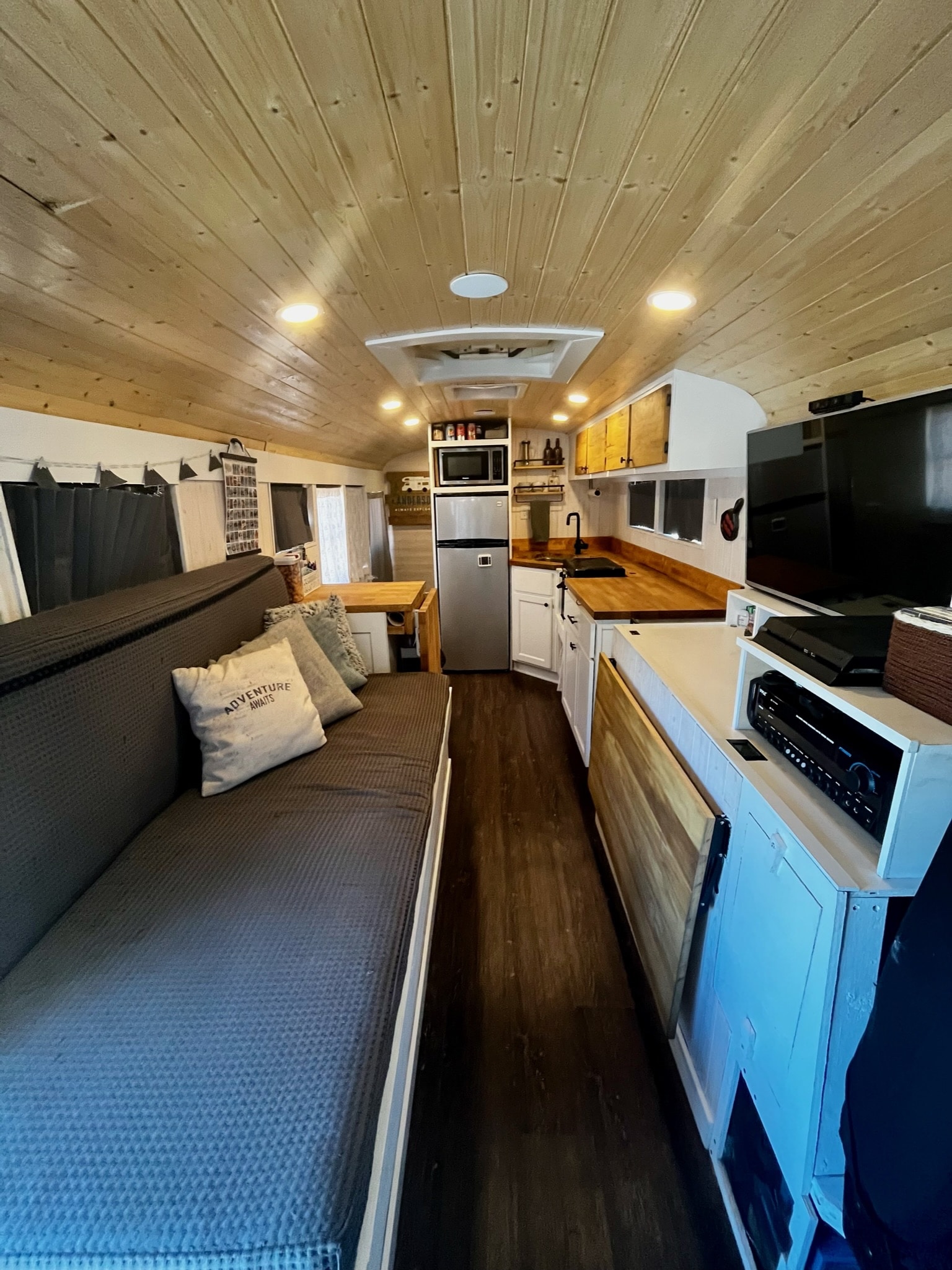
Here’s a breakdown of the typical dimensions you’ll run into on full-size buses:
| Dimension | Type C (Conventional) | Type D (Flat-Front/Transit) |
|---|---|---|
| Overall length | 35-40 ft | 35-40 ft |
| Interior width | ~90 inches (7.5 ft) | ~90-96 inches (7.5-8 ft) |
| Exterior width | ~96 inches (8 ft) | ~96-102 inches (8-8.5 ft) |
| Interior ceiling height | 6’0″ – 6’3″ | 6’1″ – 6’5″ |
| Exterior height | 10-10.5 ft | 10-11 ft |
| Usable living length | 28-32 ft | 30-35 ft |
| Wheelbase | 169-277 inches | 189-279 inches |
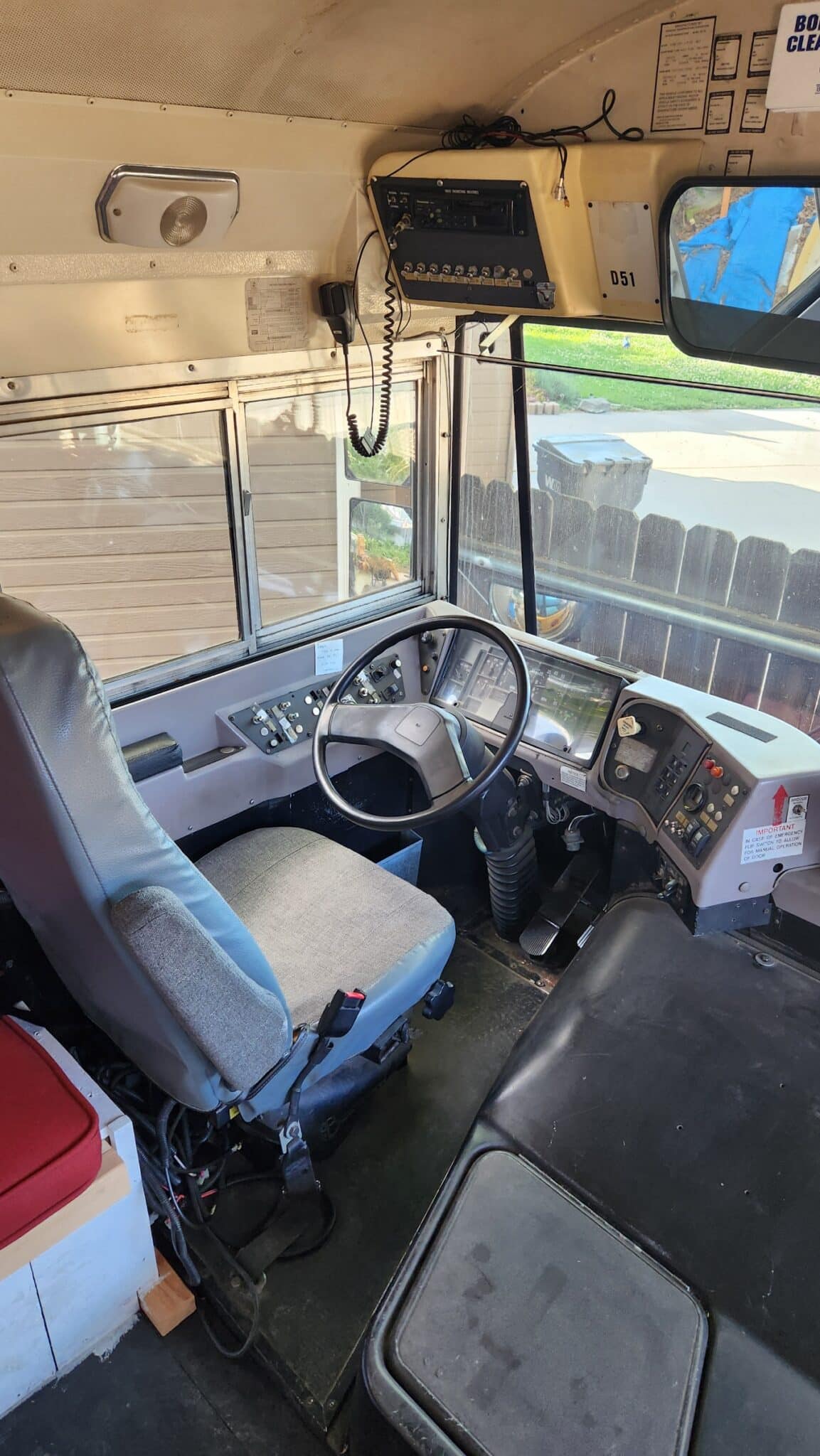
The Type C is the classic dog-nose school bus, the one with the engine hood sticking out front. It’s by far the most common bus you’ll find at auctions and on Craigslist. The Type D is the flat-front transit style where the driver sits right up above the front axle. Type D’s tend to be a little taller and sometimes a bit wider, and because there’s no engine compartment eating up the front, you get more usable interior length from the same overall footprint.
That is the exact size bus I want. What kind of bus is that and how long is that approximately?
I see this question constantly in skoolie groups, usually in the comments under someone’s tour video. The answer depends on what caught your eye. If it’s a full-size bus with a hood — that’s a Type C. Most of the ones that look “perfect” for a conversion are in the 35-38 foot range, which gives you roughly 28-30 feet of actual living space behind the driver’s seat. That’s a solid amount of room. Enough for a bedroom, bathroom, kitchen, and a small living area without everything being crammed together.
If the bus you’re looking at has a flat front and no hood, it’s a Type D. Less common in the skoolie world but some people love them because the engine is in the rear and you get extra interior length up front. A 38-foot Type D might give you 32-33 feet of living space versus 28-29 on a Type C of the same length.
One thing that tripped me up early on — the listed length of a bus is bumper to bumper, not interior wall to interior wall. On a Type C, you lose 4-5 feet to the engine compartment before you even get to the windshield. A “40-foot bus” doesn’t mean 40 feet of living space.
Short Bus Dimensions (Type A)
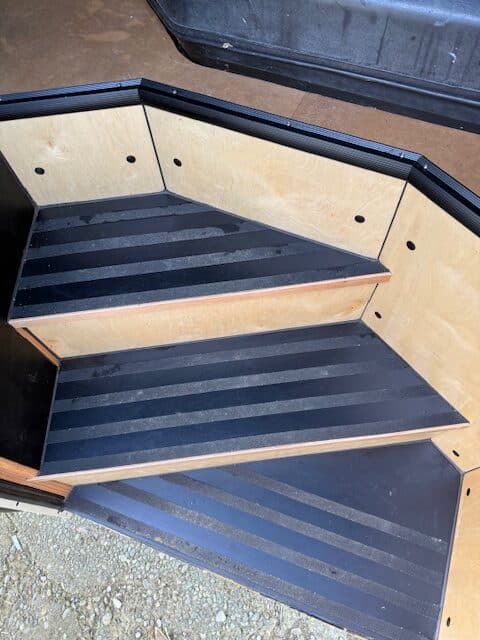
Short buses are a completely different animal. They’re built on a van chassis — usually a Ford E-450, Chevy Express 4500, or something similar — with a bus body bolted onto the back. They’re the ones people call “the short bus,” and they’ve become hugely popular for solo travelers and couples who want something more manageable than a 40-foot rig.
| Dimension | Type A (Short Bus) |
|---|---|
| Overall length | 20-25 ft |
| Interior width | ~90 inches (7.5 ft) |
| Exterior width | ~96 inches (8 ft) |
| Interior ceiling height | 5’10” – 6’0″ |
| Exterior height | 8.5-9.5 ft |
| Usable living length | 12-16 ft |
| Wheelbase | 138-176 inches |
Now, 12-16 feet of living space doesn’t sound like much. And honestly, it’s not a ton. But people do incredible things with short buses. I was scrolling through a Facebook group one time and saw a guy who built out a 22-foot Type A with a full kitchen, a composting toilet in a small wet bath, and a fixed queen bed in the back. It was tight, sure, but everything worked. He’d been living in it for over a year traveling the west coast. The constraints force you to be creative, and some of the best builds I’ve seen have been on short buses. (See our guide on What Is the Best Way to Paint a School Bus? for more on this.)
How many feet is this bus?
This is one of those questions that sounds simple but the answer usually needs more context. When someone says their bus is “24 feet,” they mean the total exterior length from bumper to bumper. But what matters for your conversion is the interior living length, which on a 24-foot Type A is usually only 14-16 feet. The rest is the cab, the front wall, and the rear wall structure.
If you’re looking at a bus listing and it doesn’t say the length, you can usually figure it out from the number of windows. A short bus with 3-4 windows per side is typically 20-24 feet. A full-size bus with 7-9 windows per side is usually 35-40 feet. Not exact, but it gets you close. You can also decode the VIN — free VIN decoders online will often pull the body length. When I was bus shopping, I kept a spreadsheet with VINs decoded so I could compare without driving to see each one. (See our guide on How Do You Remove School Bus Windows? for more on this.)
How Bus Length Affects Your Floor Plan
This is where the dimension numbers actually matter for your life. On a short bus with 14 feet of living length, you’re making hard choices. You can have a kitchen and a bed, or a kitchen and a bathroom, but probably not all three without everything overlapping. Most short bus builds use a platform bed in the rear with storage underneath, a compact galley kitchen on one side, and either a small wet bath or no bathroom at all.
What is the interior living length?
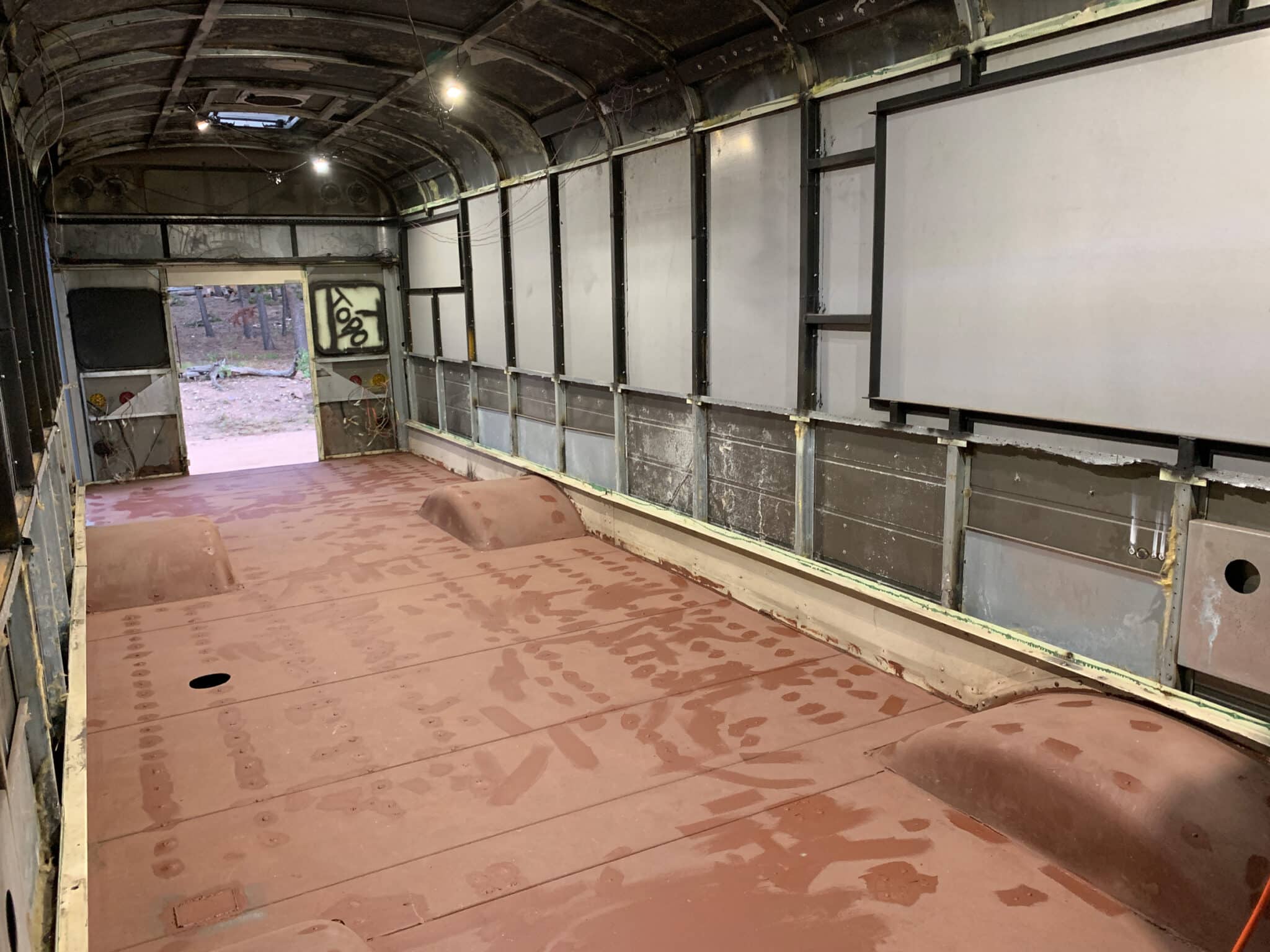
I kept running into this exact question when I was researching floor plans. The interior living length is the space you actually get to build in, from just behind the driver’s area to the inside of the rear wall. Always significantly less than the overall bus length.
Here’s the general rule of thumb I found:
| Bus Type | Overall Length | Approximate Living Length |
|---|---|---|
| Type A (Short) | 20 ft | 12-13 ft |
| Type A (Short) | 24 ft | 14-16 ft |
| Type C (Full) | 35 ft | 25-28 ft |
| Type C (Full) | 40 ft | 28-32 ft |
| Type D (Flat) | 35 ft | 28-30 ft |
| Type D (Flat) | 40 ft | 30-35 ft |
These are approximations. Every bus is a little different depending on where the driver’s seat sits and how thick the front and rear walls are. But they’re close enough to plan around.
When I was sketching out floor plans on paper, I learned to always start with the living length, not the overall length. I drew out at least three plans that were too long before I finally measured an actual bus and adjusted. It’s one of those mistakes you only make a few times before the habit sticks.
The wheel wells are the other thing you’ve gotta factor in. On most full-size buses, the rear wheel wells protrude into the interior about 8-10 inches on each side. So near the rear axle, your usable width drops from 90 inches down to about 70 inches. If you’re planning to put your bathroom or closet near the rear axle, measure around those wheel wells before you commit to anything. And if you keep extra passenger seats up front, you’re shortening your living area by another 3-5 feet on top of everything else.
Interior Height: Can You Stand Up?
Ceiling height was one of the things I obsessed over when I was looking at buses. I talked to a couple of builders about this, and the consensus was that if you’re over 5’10”, stock school bus ceiling height is going to bother you at least a little. (See our guide on What Is the Maximum Legal Height for a Converted Bus? for more on this.)
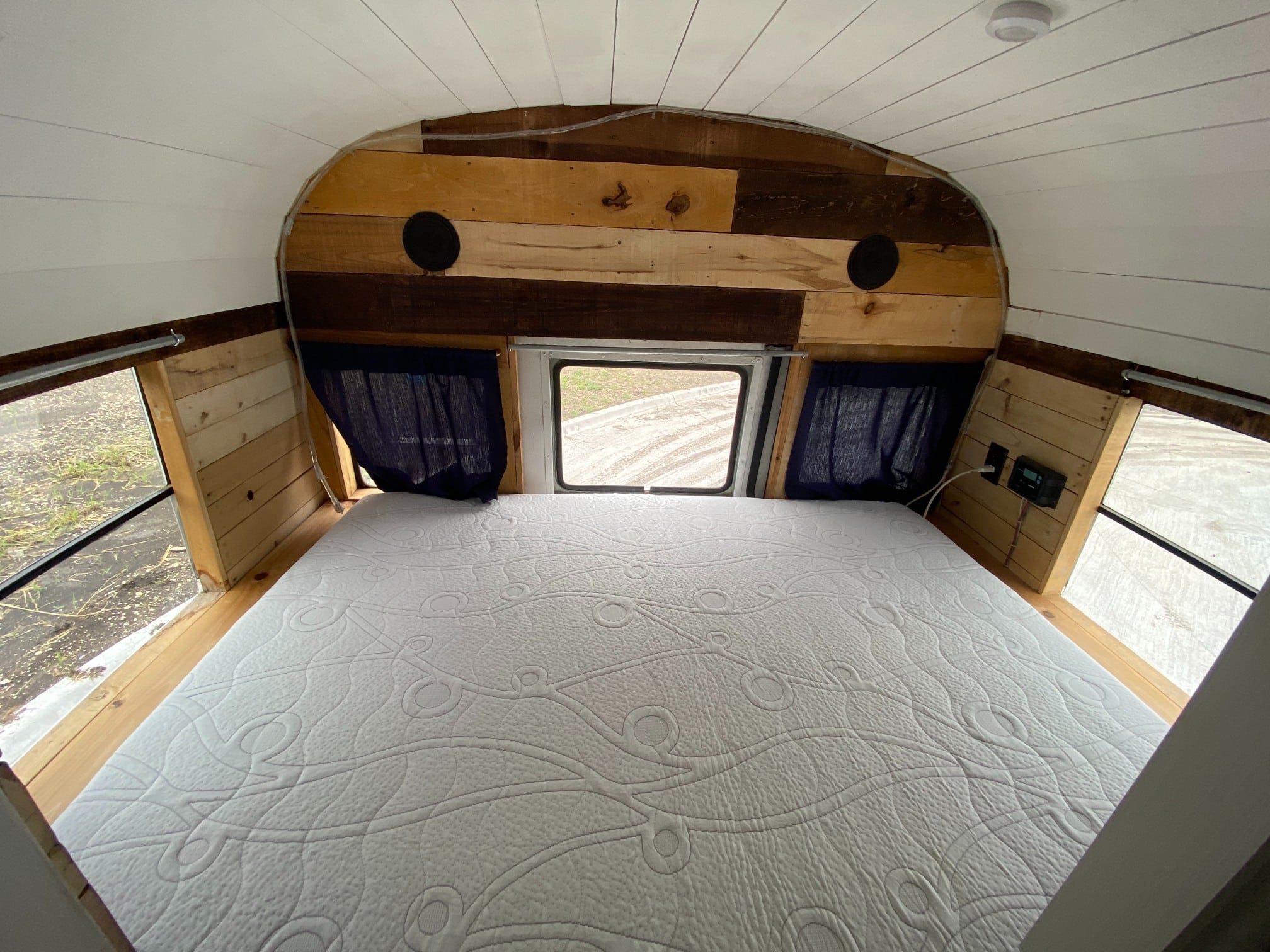
The raw ceiling height on a full-size bus — floor to the bottom of the ceiling ribs — is around 6’0″ to 6’3″. Type D buses tend to be on the taller end, sometimes hitting 6’4″ or 6’5″. Short buses are the lowest, typically 5’10” to 6’0″.
But here’s what nobody mentions in the listings. That raw number gets smaller once you build. You’re putting down a subfloor, which is usually 3/4″ plywood plus maybe an inch of rigid foam insulation underneath, plus your finished flooring on top. Call it 2-3 inches lost on the floor. On the ceiling, if you fur out the ribs and add tongue-and-groove paneling or even just thin plywood, you lose another 1-2 inches.
So your finished livable headroom on a typical Type C bus is somewhere around 5’8″ to 6’0″. On a Type D, maybe 5’10” to 6’2″. On a short bus, you might be looking at 5’6″ to 5’9″ after the build.
What length is this bus?
I know this heading is about length and we’re in the height section, but this question comes up so often alongside ceiling height questions that it makes sense to address both together. People see a tour video where someone’s standing up straight and they want to know everything about that bus — length, height, type, all of it.
The buses where people are standing comfortably are almost always one of three things: a Type D flat-front (tallest stock ceiling), a factory high-top bus (built with a raised roof for wheelchair accessibility), or a bus that’s had a roof raise done during conversion. If the person in the video is under 5’8″ and it’s a standard Type C, they might just fit. But if they’re 6 feet tall and walking around like it’s a house, that bus has been modified somehow. (See our guide on Can You Raise the Roof on a School Bus? for more on this.)
When you’re shopping, always ask about the interior ceiling height at the lowest point, which is at the ribs. Then do the math — subtract 2-3 inches for your floor build-up and 1-2 inches for ceiling treatment. That final number is what you’ll actually live with. If you’re over 5’10”, look into factory high-top models from Blue Bird and Thomas, or budget for a roof raise.
Width: Is a School Bus Really 8 Feet Wide?
I don’t think they mentioned the width. Is it 8′?
Sort of. The exterior width of a standard school bus is right around 96 inches, which is 8 feet. But the interior width — the part you’re building in — is about 90 inches, or 7.5 feet. You lose those 6 inches to the wall structure on each side (the metal exterior skin, insulation, framing, and interior paneling eat up about 3 inches per side).
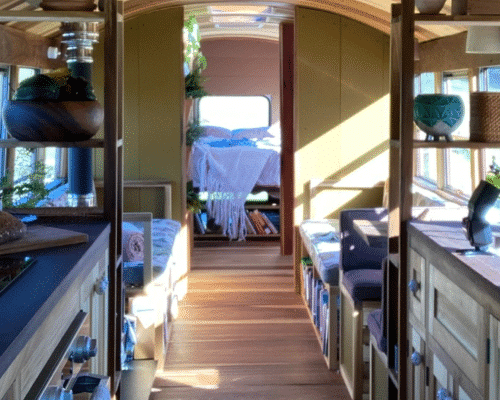
Here’s a comparison across types:
| Measurement | Type A | Type C | Type D |
|---|---|---|---|
| Exterior width | ~96 in (8 ft) | ~96 in (8 ft) | 96-102 in (8-8.5 ft) |
| Interior width (stock) | ~90 in (7.5 ft) | ~90 in (7.5 ft) | 90-96 in (7.5-8 ft) |
| Interior width (after wall build) | ~84-86 in (7-7.2 ft) | ~84-86 in (7-7.2 ft) | ~86-90 in (7.2-7.5 ft) |
That interior width after insulation and wall treatment — roughly 7 feet — is what you’re actually designing around. And it matters more than you’d think.
A queen mattress is 60 inches wide. That leaves you about 24-26 inches of walkway if you run the bed side to side across the bus. That’s tight but workable. A lot of couples go with this setup and it’s fine. If you want more walkway space, you either go with a smaller mattress or put the bed lengthwise along one wall, which eats more of your floor plan length but gives you a wider aisle.
The width is one of the things that makes a school bus feel bigger than a van. A Sprinter is about 70 inches inside, which is almost two feet less than a school bus. That’s a huge difference when you’re fitting a kitchen on one side and a hallway on the other.
Here’s something I didn’t think about until I started reading about wall insulation. If you use 2×2 furring strips and rigid foam, you lose about 2-3 inches per side. Some people skip the furring strips and glue foam directly to the metal to save space. Every inch matters when you’re working with 90 inches total, and your insulation method can be the difference between a comfortable aisle and one where you’re turning sideways.
Type D buses sometimes have a slightly wider body — up to 102 inches on the exterior — which translates to a few extra inches inside. Not dramatic, but if you’re already tight on your layout, it’s worth knowing about.
Related: How to Paint a School Bus (DIY vs Professional)
Putting It All Together
So here’s where I ended up after all my research into this. The dimensions of a school bus matter way more than most people think when they first start shopping. It’s easy to just pick a bus that looks right and figure out the rest later, but the people who measure first and buy second avoid the biggest headaches.
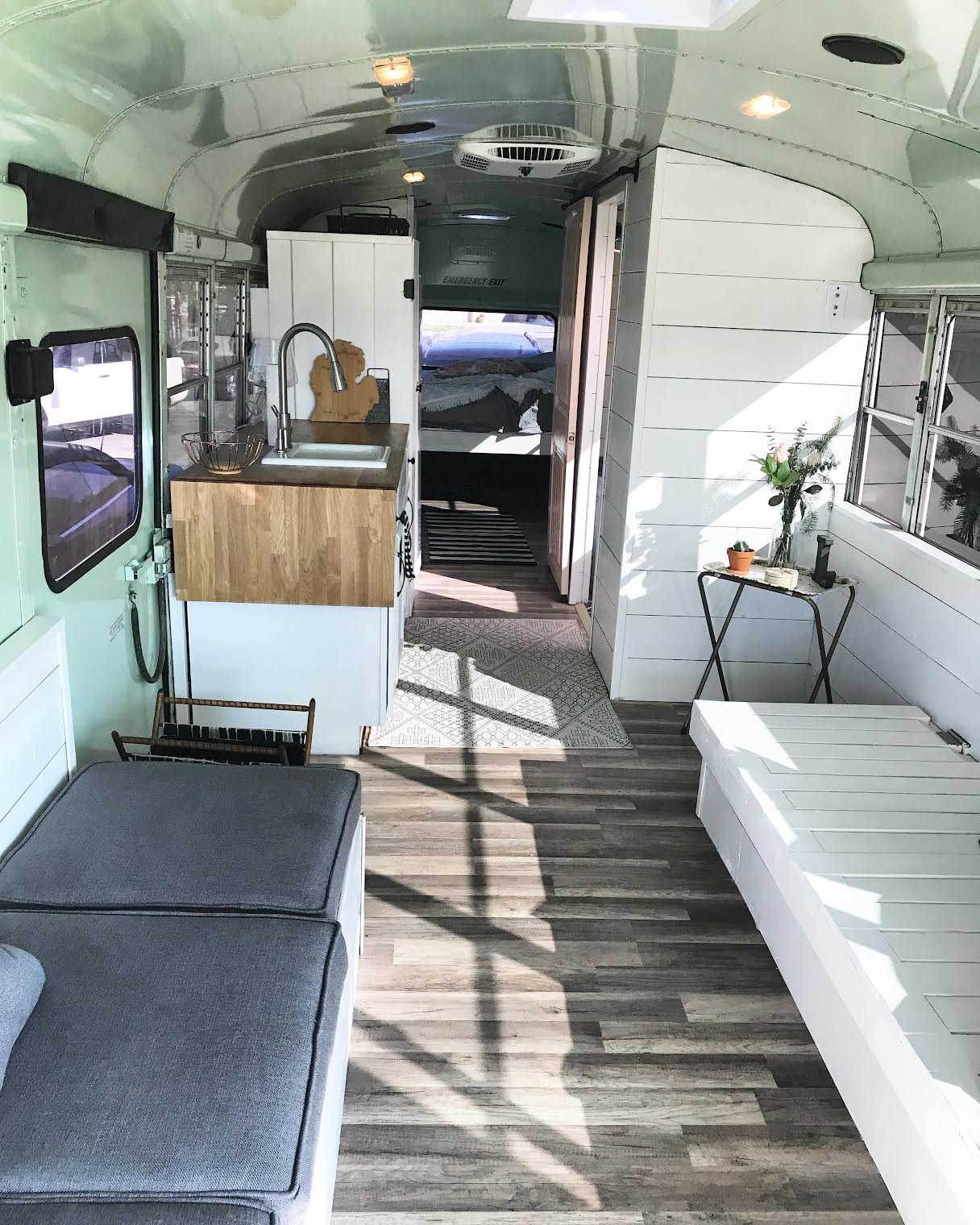
A Type A short bus at 22-24 feet gives you 14-16 feet of living space with easy parking and decent fuel economy. A full-size Type C in the 35-38 foot range is where most builders land — 25-30 feet of living space, enough for a full kitchen, bathroom, and bedroom. And if ceiling height is the priority, the Type D flat-front buses give you the best stock headroom without modification.
Whatever bus you’re looking at, grab a tape measure and get the interior dimensions yourself before you commit. The listed specs online are just a starting point. Go stand in the thing. You’ll know within thirty seconds whether the space works for you or not.