
Every appliance decision in a bus build connects to three or four other decisions you haven’t made yet. Pick a propane stove and now you need gas lines, a tank mount, ventilation, and a CO detector. Go all-electric and suddenly your battery bank needs to be twice the size you planned. It’s one of those things where you can’t just look at each appliance by itself. (See our guide on Is a Propane or Electric Stove Better for a Skoolie? for more on this.)
For most skoolie builds, a hybrid approach works best — propane for cooking and water heating, a diesel heater for space heating, and a 12V compressor fridge running off solar. This combo keeps your electrical system manageable, your fuel costs low, and your build complexity reasonable. Going all-electric is absolutely doable but requires a serious investment in batteries and solar. Going all-propane is cheap and simple but ties you to tank refills and adds more combustion sources inside a small metal box. The “right” setup depends on your power system, your budget, your travel style, and honestly how much you enjoy tinkering with systems.
Cooking: Propane Stove vs Induction Cooktop
I covered this one in a separate article in more detail, but here’s the short version for people trying to figure out the whole appliance picture at once.
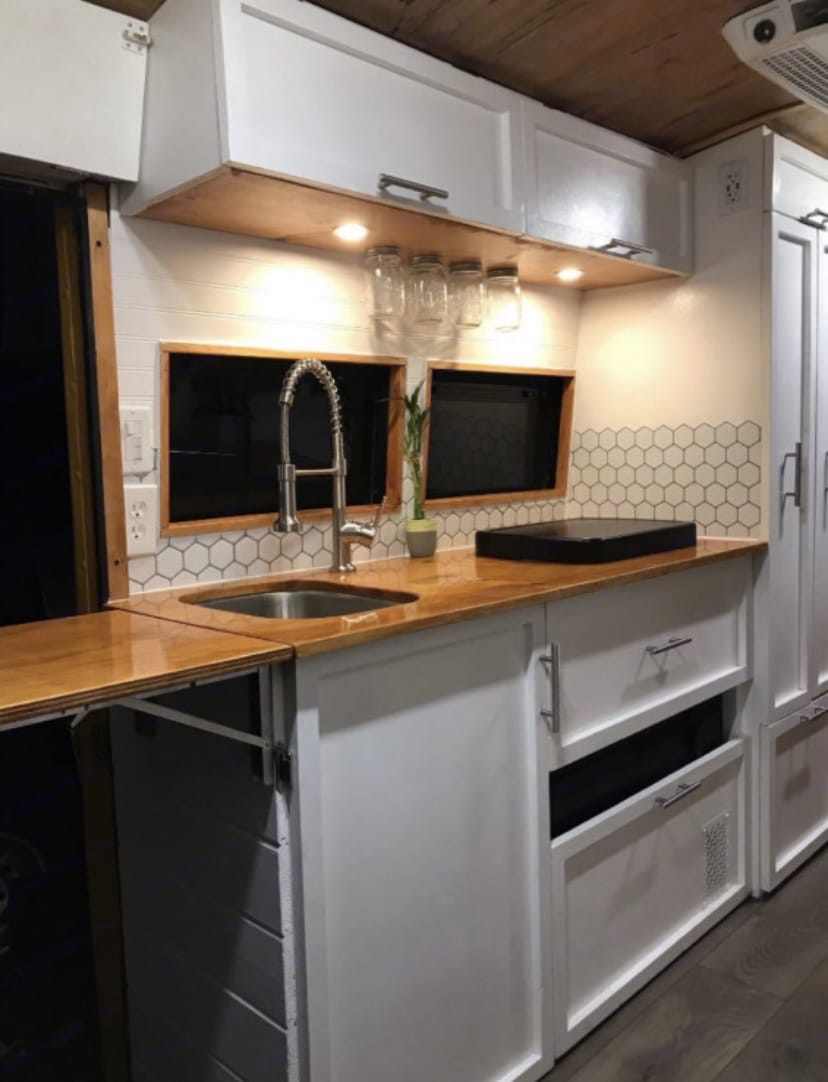
Propane wins on simplicity and energy independence. A two-burner propane cooktop runs $150-300, uses zero electricity, heats fast, and a single 20-pound tank lasts most people three weeks of daily cooking. Maybe a month if you’re not doing anything crazy. Refills are $4-5 at most gas stations, hardware stores, or exchange kiosks. You need ventilation though — a range hood or at least a cracked window, because burning propane indoors produces carbon monoxide and moisture.
Induction cooktops are flat, lightweight, and there’s no open flame. No combustion means no moisture added to your interior, which in a metal box that already wants to condensate, is a real selling point. But a two-burner induction unit pulls around 1,800 watts. That’s a huge draw. On a modest solar setup with 200Ah of lithium, you’d burn through 30-40% of your battery capacity just cooking dinner.
I talked to a guy at an RV expo who had switched from induction back to propane after six months. He said he loved the idea of all-electric but in practice he was staring at his battery monitor the whole time he was trying to make dinner. Said it took the joy out of cooking. That stuck with me.
So the real question isn’t “which stove is better” — it’s “what can your electrical system handle?” If you’ve already committed to 600+ watts of solar and 400Ah or more of lithium, induction is totally viable. The infrastructure absorbs it. But if your power system is modest, propane lets you cook without thinking about it.
Heating: Propane Furnace vs Diesel Heater vs Wood Stove
This is where things get interesting because there are genuinely three solid options, and people have strong opinions about all of them.
Diesel heaters — specifically Chinese units or the name-brand Webasto and Espar models — have become the most popular choice in the skoolie community over the last few years and I think for good reason. They tap into your bus’s existing diesel fuel tank, so you’re not managing a separate fuel source. They burn about 0.1-0.3 gallons per hour depending on the setting, which works out to maybe $3-8 a day in cold weather. They vent combustion exhaust outside the bus, so no CO risk indoors. And they’re thermostat-controlled, meaning they cycle on and off overnight without you doing anything.
The cheap Chinese diesel heaters run $100-200 on Amazon. They work. They’re loud and they can be finicky, but thousands of skoolie and van dwellers run them every winter. The Webasto or Espar units are $800-1,500 installed but they’re quieter, more reliable, and built to last. I spent way too long one night going down a rabbit hole on diesel heater forums, and the consensus seemed to be that the Chinese units are fine for a season or two, but if you’re planning to live in the bus full time through multiple winters, the name brands pay for themselves in reliability.
Propane furnaces are the traditional RV approach. A forced-air propane furnace blows heated air through ducts, which gives you more even heat distribution than a single-point diesel heater. But they burn through propane fast — a 20-pound tank might last 2-4 days if you’re running the furnace frequently in freezing temps. That adds up. And you’ve got another propane appliance pulling from your tanks, which means more frequent refills.
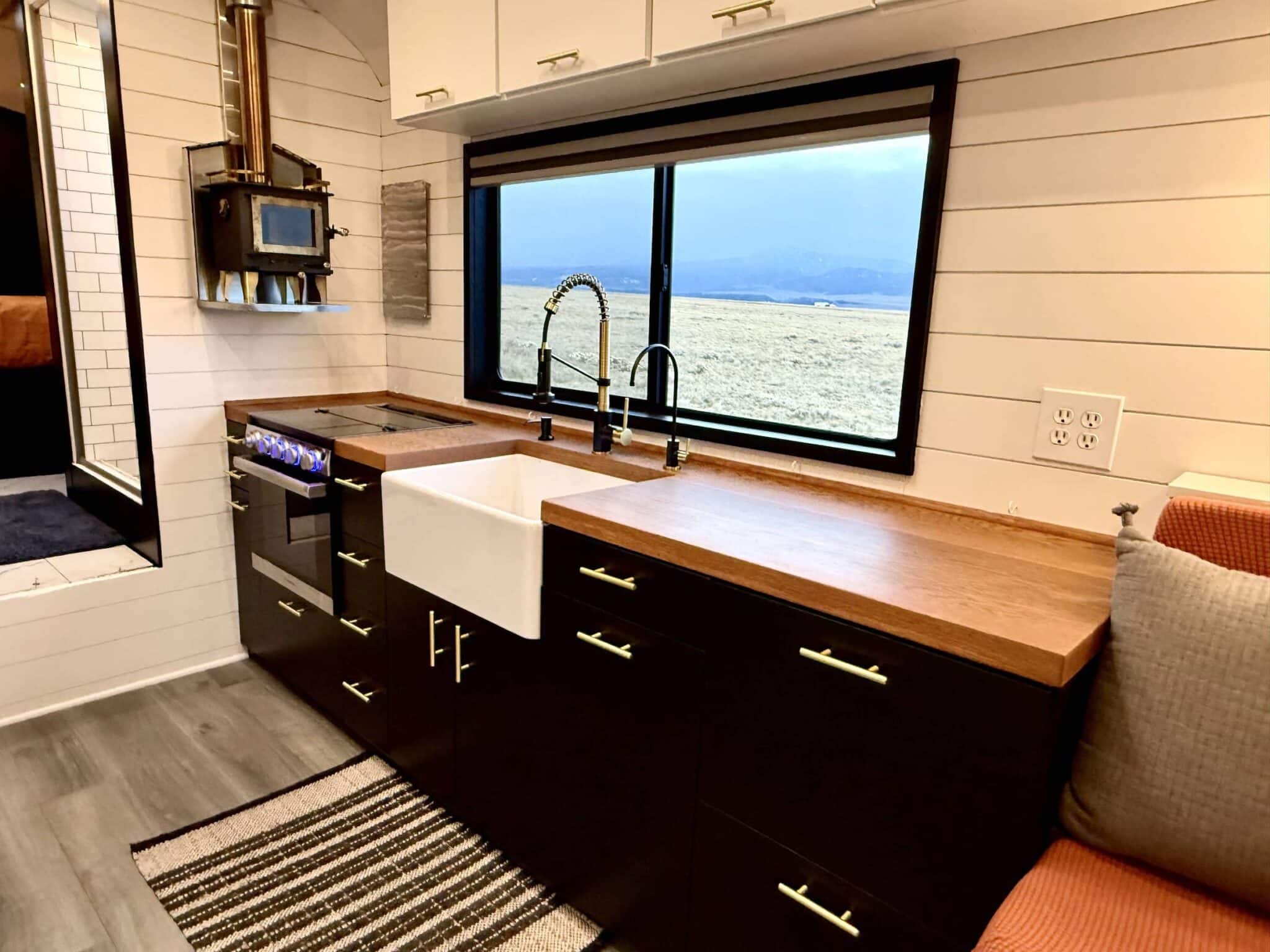
Now, wood stoves. “Where did you get your wood stove?” is a question that comes up a lot in bus build tours, and I get the appeal. There’s something about a wood stove in a tiny space that just feels right. A small marine or tent stove can heat a bus fast — almost too fast, honestly. The space is small enough that even a tiny stove puts out more than enough BTUs. And the fuel is free if you’re willing to gather it, or $5-10 a day if you buy firewood.
But here’s the thing. A wood stove requires constant tending. It goes out while you sleep, so you wake up cold. It creates insurance complications that are already hard enough to navigate with a bus conversion. And it needs a chimney pipe through your roof, which is another penetration to waterproof and another potential leak point. Some people love them and wouldn’t trade them for anything. Others install one, use it for a season, and then add a diesel heater as their primary heat source and keep the wood stove for ambiance.
If I had to pick one heater for a full-time build, it’d be a diesel heater. But if you’re a weekend warrior or you just love the ritual of building a fire, a wood stove in a bus is genuinely one of the coziest things I’ve come across in all my research.
Hot Water: Propane Tankless vs Electric vs Diesel
Hot water is one of those systems that doesn’t get enough attention during the planning phase, and then people realize halfway through their build that they haven’t accounted for it at all.
The most common approach in skoolies is a propane tankless water heater. Something like a Camplux or Eccotemp — they’re $100-250, they mount on a wall, and they fire up a propane burner whenever you turn on the hot water tap. No tank to keep heated, no standby energy loss. They produce about 1-1.5 gallons per minute of hot water, which is enough for a decent shower but not exactly a luxury spa experience. If you’re already running propane for cooking, adding a tankless heater is straightforward because the gas lines and tank are already there. You’re just adding another run of pipe and another appliance.
Electric tankless water heaters exist too, but they pull insane amounts of power. We’re talking 3,000-4,000 watts for even a small unit. That’s inverter territory — you need a big inverter, a big battery bank, and it’ll drain your system fast. I looked into these when I was researching and honestly, for an off-grid bus, they don’t make much sense. The power draw is just too high for what you get. Now, if you’re frequently on shore power at campgrounds, an electric tankless heater works fine. You’re pulling from the grid, not your batteries. Some people actually install both — a propane unit for off-grid and wire in an electric option for when they’re plugged in.
“Lastly did you use LPG for hot water and cooking or mains?” — this question comes up a lot because people are trying to figure out if they can run everything off one system. And yeah, you can. Propane for both cooking and hot water is probably the most common setup in bus builds. One fuel source, one tank system, keeps things simple. The “mains” option only works when you’re plugged into shore power, which depending on your travel style might be never, sometimes, or most of the time.
There’s also the diesel route for hot water. Some people tie into their diesel heater system — certain Webasto and Espar models can heat a coolant loop that runs through a heat exchanger, giving you hot water as a byproduct of your heating system. It’s elegant but more complex to plumb. And it only works when the heater is running, so in summer you’d need a backup. I’ve seen maybe a handful of builds actually do this. It’s cool engineering but probably more complexity than most people want to take on.
One more option I should mention — a simple black bag solar shower or a 12V heated water container. For people doing minimal builds or traveling in warm climates, this is dirt cheap and uses almost no energy. It’s not glamorous, but it works.
Refrigeration: 12V Compressor vs Propane vs Residential
Alright so refrigeration is actually one of the easier decisions in the appliance lineup, and here’s why. The 12V compressor fridge has basically won.
Units like the Dometic, Vitrifrigo, Unique, or Iceco run directly off your 12V system and they sip power. A typical 12V compressor fridge uses 30-60 watts on average — maybe 500-800 watt-hours per day total. On a reasonable solar setup, that’s completely manageable. They’re built for off-grid use, they handle being tilted and bounced around while driving, and they cool down fast. Prices range from $300 for a basic chest-style unit up to $1,200+ for a full fridge-freezer combo.
Propane absorption fridges are the old-school RV option. They use a propane flame to drive a cooling cycle, which sounds great because it doesn’t touch your electrical system. But absorption fridges have problems in a bus. They need to be level to work properly — like really level, within about 3 degrees. They’re slow to cool down. They don’t handle altitude changes well. And they’re less efficient than compressor fridges in hot weather, which is exactly when you need your fridge most. I see fewer and fewer bus builds going this route.
“What happens if the fridge needs replacement/repair?” — good question, and this is actually an argument in favor of the portable 12V units. If a chest-style Iceco or Alpicool dies on you, you pull it out and drop in a new one. They’re standard sizes, they’re not built into your cabinetry in a way that requires demolition to remove. With a built-in residential fridge, which some people do install in bigger builds, replacement gets complicated. You’ve framed the space for a specific dimension, you’re running it off an inverter which adds another failure point, and when it breaks you’re hunting for the exact same size or reframing the opening.
Residential fridges in skoolies are a thing though. People run full-size Samsung and LG fridges in their buses. They work, they’re cheap, and they give you the most space. But they need a pure sine wave inverter running 24/7 — typically 200-400 watts of draw — and they’re not designed for vibration, temperature swings, or being tilted. The compressor in a residential fridge can burn out faster in a mobile application. I’ve heard of people going through two residential fridges in three years of bus life.
So my take on refrigeration is pretty simple. If you’ve got the budget, get a purpose-built 12V compressor fridge. If you’re on a tight budget, a portable 12V chest unit for $300-500 does the job perfectly well and you can upgrade later. The propane fridge is dated technology for this application, and the residential fridge is a gamble that sometimes pays off and sometimes doesn’t.
Related: What’s the Difference Between Front Engine and Rear Engine Buses?
Related: Front Engine vs Rear Engine Buses: Pros and Cons for Conversions
Related: Mountain Gears vs Highway Gears: What Skoolie Buyers Need to Know
Related: What Kind of Gas Mileage Does a Skoolie Get?
Which Setup Makes Sense for Your Build?
“Serious question. What’s the cost and weight difference with using solar energy.” This is really the question underneath all the other questions. Because every appliance choice is ultimately a question about your power system, your fuel system, and your wallet.
Let me lay out three common approaches I kept seeing when I was researching builds.
The budget build goes mostly propane. Propane stove, propane tankless water heater, maybe a Mr. Buddy portable heater or a cheap Chinese diesel heater for warmth, and a 12V compressor fridge. Total appliance cost is maybe $600-1,000. Your electrical system can be modest — 200-300 watts of solar and 100-200Ah of lithium handles the fridge, lights, fans and phone charging. This build keeps things simple and cheap. The tradeoff is you’re refilling propane regularly and you’ve got multiple combustion sources in a small space.
The mid-range build is the hybrid I mentioned up top. Propane for cooking and hot water, diesel heater for space heating, 12V compressor fridge. Electrical system in the 400-600 watt solar range with 200-400Ah of lithium. Total appliance cost around $1,200-2,500 depending on whether you go Chinese diesel heater or name brand. This is where most full-time bus dwellers I’ve researched seem to land, and I think for good reason. You’ve got redundancy across fuel types, reasonable power demands, and nothing is being pushed to its limits.
The all-electric build is the most expensive upfront but the simplest to operate day-to-day. Induction cooktop, electric tankless water heater (or diesel heater with hot water loop), and 12V fridge. No propane at all. But you need 800+ watts of solar, 400Ah minimum of lithium batteries — realistically 600Ah for comfort — and a 3,000-watt inverter. Battery bank alone runs $2,400-4,000. Panels and charge controllers another $600-1,000. Weight adds up too, those batteries aren’t light. But once it’s built, you’re charging from the sun and you never have to think about propane refills or gas lines.
After digging into all of this for way longer than I probably needed to, here’s where I come down on it. Don’t pick your appliances first and then figure out the power system. Do it the other way around. Decide how much you want to spend on batteries and solar, figure out your realistic daily power budget, and then pick appliances that fit within it. The appliances serve the system, not the other way around.
And honestly, you can always upgrade later. Start with propane, live in the bus for six months, figure out what’s actually annoying you, and then swap things out. I’ve seen so many builds where people agonized over these decisions for months, and then changed stuff after their first winter anyway. The bus is yours. Nothing is permanent except the holes you drill in the roof.