
Alright, this one matters. Like really matters. You’re building a home on wheels and you’re going to sleep in it, park it in places you’ve never been, and drive it through weather that would make most people stay home. So let’s actually talk about safety and security in a converted bus, because the YouTube tours never seem to get around to it.
Safety in a skoolie covers a lot of ground — physical security against break-ins and theft, crash safety for you and your passengers, weather preparedness for wind and storms, fire safety inside the bus, and personal protection on the road. None of these are reasons not to do bus life, but all of them are reasons to think ahead. The people who plan for this stuff sleep better at night. Literally.
—
How do you keep someone from breaking in?
I’ve been looking into this one for a while now, and the answers I keep finding range from “I just lock my door” to people who’ve basically turned their bus into Fort Knox. The truth is somewhere in the middle. (See our guide on How Do You Keep Kids Safe While Driving a Skoolie? for more on this.)
The factory school bus door is your weakest point. Those folding doors with the lever handle? A determined person can get through one in about fifteen seconds. I talked to a guy who found this out the hard way at a rest stop in New Mexico. He woke up to someone yanking on the handle at 2 AM. Luckily they didn’t get in because he’d already swapped it out for a proper residential deadbolt, but the noise alone was enough to ruin the next three nights of sleep.
So what do you actually do about it? Most skoolie builders replace the bus door entirely or add a deadbolt to the existing one. Some people weld the bus door shut and cut in a new residential entry door somewhere on the side. That’s actually the cleanest solution — you get a real door with a real lock and you eliminate the weakest point completely.
Beyond the door, your windows are the next concern. School bus windows pop out easily from the outside because they’re designed to be emergency exits. Some people replace them with fixed RV windows. Others add window bars on the inside, which sounds extreme but honestly looks pretty normal on a bus. And a lot of people just add window film so you can’t see inside. If nobody knows there’s a laptop and a flat screen in there, they’re a lot less likely to bother breaking in.
Are these prone to robbers? Like while driving through a crime infested jurisdiction?
Here’s what I think people are really asking when they ask this, and it’s a fair question. You’re driving through unfamiliar places. You’re parking in areas you don’t know. You look like you might have stuff worth stealing.
The reality though is that skoolies don’t get targeted the way you’d think. Most thieves are looking for quick, easy scores — unlocked cars, packages on porches, that kind of thing. A converted bus is an unknown. They don’t know if someone’s inside. They don’t know if there’s a dog. They don’t know if the owner is the type of person who sleeps with a baseball bat next to the bed. There’s too many variables and not enough guaranteed payoff.
That said, you’re not immune to it either. The situations where bus dwellers run into trouble are usually the same situations where anyone runs into trouble. Parking in sketchy areas at night, leaving valuables visible through windows, being careless about locking up. Basic awareness goes a long way.
A few things that experienced bus dwellers do:
- Trust your gut. If a spot feels wrong, leave. Don’t try to rationalize staying because you’re tired.
- Don’t advertise what you’ve got. Close your curtains at night. Don’t leave expensive gear visible.
- Meet your neighbors when you park. At RV parks, at campgrounds, even in a parking lot — a quick wave and hello means someone knows you’re there and they’ll notice if something weird happens around your bus.
What happens when you get into a vehicle accident? Especially when you’re walking around like this.
Ok so this is the one that genuinely makes me nervous, and I think about it more than I probably should. In a normal vehicle you’ve got airbags, crumple zones, seatbelts designed around crash testing. In a skoolie where someone literally built the interior with lumber from Home Depot, you’ve got… cabinets.

Let me just say this straight. A converted school bus is not a crash-tested vehicle. The cab area where the driver sits still has the original safety features — the steering column, the seat, the windshield. But everything behind that is whatever you built. And in a serious accident, your kitchen cabinets become projectiles. Your unsecured cooler becomes a 40-pound missile. That cast iron skillet you love? It’s going through a window.
The good news is that school buses are incredibly strong vehicles. The frame, the body, the roll cage — they’re designed to protect 72 kids. That structural integrity doesn’t go away when you convert it. In a collision with a car, the bus wins. Every time. The concern is what happens inside the bus, to you and your stuff. (See our guide on What Happens If Your Skoolie Breaks Down? for more on this.)
So what do you do? Secure everything. I cannot stress this enough. Heavy items need to be bolted down or in latched cabinets. Doors need catches that won’t fly open under force. Your fridge, your stove, your batteries — all of it needs to be mechanically fastened, not just sitting on the floor. And drive slower than you think you need to, because stopping a 30,000 pound vehicle takes a lot more road than stopping a Honda Civic. (See our guide on How Do You Secure Things in a Bus While Driving? for more on this.)
What about seatbelts for the family in case of an accident while traveling?
This one comes up a lot, especially from families. And the answer is yes, you should absolutely have seatbelts for everyone who’s going to be in the bus while it’s moving.
Most school buses didn’t come with passenger seatbelts (they relied on “compartmentalization” — the high-backed seats absorbing impact). But you’ve ripped those seats out, so that protection is gone.
Installing seatbelts isn’t as complicated as people make it sound. You need mounting points bolted to the frame or the floor structure — not just the plywood subfloor, but the actual steel floor of the bus. You can buy seatbelt kits designed for bench seats and dinette areas. Some people install a row of forward-facing seats with three-point belts for when they’re driving.
And here’s the thing nobody wants to hear. When the bus is moving, everyone should be seated and belted. I know the whole appeal of bus life is walking around your house while it cruises down the highway, but that’s genuinely dangerous and in most states it’s illegal for passengers to be unbuckled in a moving vehicle, even an RV.
How do you make sure your bus isn’t stolen?
I’ll be honest, this one surprised me when I started researching it. I always figured who’s going to steal a school bus? But it does happen, usually not for the bus itself but for what’s inside it. Someone steals your home and you’ve lost everything.
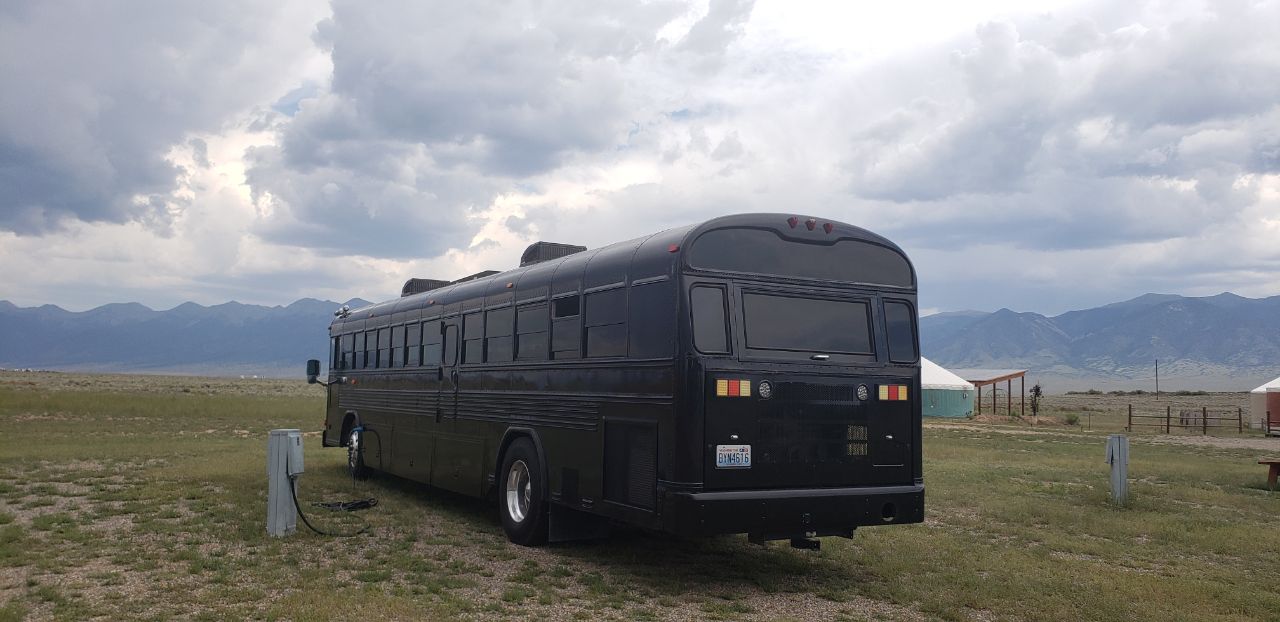
GPS trackers are the first line of defense and they’re cheap. An Apple AirTag is $30 and you can hide one basically anywhere in the bus. More serious options like a Bouncie GPS tracker or a wired GPS system give you real-time location tracking with alerts if the bus moves when it shouldn’t.
Kill switches are another popular one. A hidden switch that cuts the fuel pump or the ignition circuit. If someone hotwires the bus (which isn’t hard on older models, these things aren’t exactly high-tech), they still can’t start it without knowing where the switch is.
Steering wheel locks like The Club are old school but they work as a visible deterrent. And some people add a brake pedal lock or a gear shift lock for extra peace of mind.
But I think the biggest theft deterrent is something a lot of people overlook, and it’s just making the bus hard to move quickly. Wheel chocks, leveling blocks stacked under the tires, disconnecting the battery when you’ll be away for a while. If a thief sits in the driver’s seat and the bus won’t start, they’re not going to stick around long enough to figure out why.
Do you carry any weapons for your protection?
People ask this constantly and I get why. You’re living in a vehicle, parking in remote places, sometimes alone. It’s a legitimate concern.
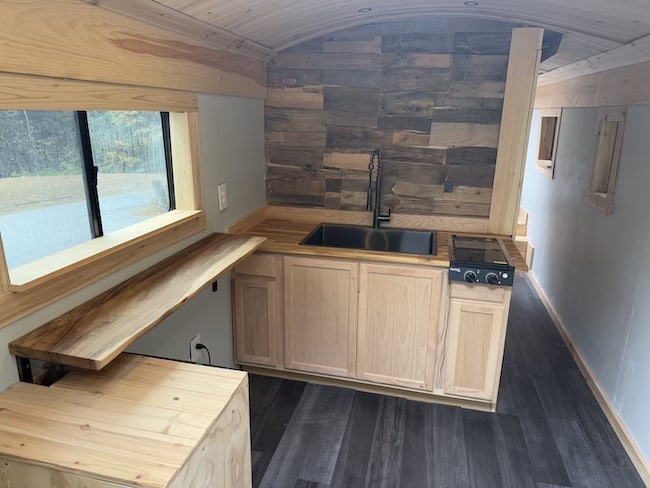
The answer varies wildly from person to person. Some people carry firearms and have concealed carry permits. Some keep bear spray. Some have baseball bats. Some have nothing and don’t worry about it at all.
If you do carry a firearm, here’s the part that matters for bus life specifically. Gun laws change at every state line. What’s legal in Arizona might get you arrested in California. If you’re crossing state lines regularly, you absolutely need to know the laws for every state you enter. There’s no federal concealed carry reciprocity that covers all 50 states, so your Texas CHL doesn’t mean anything in New York.
A lot of full-timers I’ve talked to actually prefer bear spray or pepper spray for exactly this reason. It’s legal everywhere, it’s effective, and you don’t have to worry about firearm transportation laws when you cross into a new state.
And then there’s the dog factor, which I’ll get to in a second. But honestly, the best protection is situational awareness and good parking choices. Most dangerous situations can be avoided entirely by not being in sketchy places at sketchy times. That sounds obvious but it’s true.
How do you deal with safety issues? Securement when you go to bed. Alarm. Any weapons?
This one kind of rolls everything together so let me talk about the nighttime routine that a lot of bus dwellers develop, because there is one and it becomes second nature.
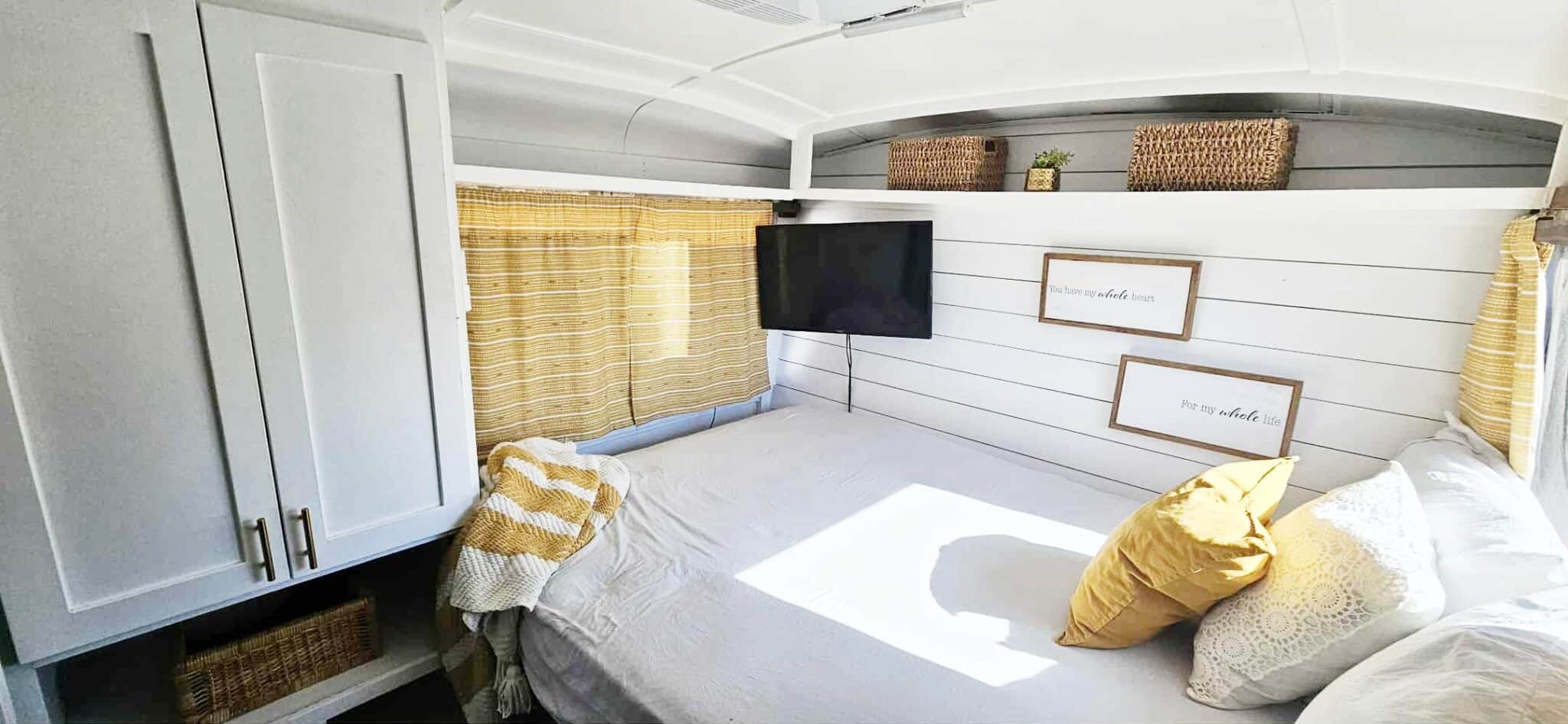
Before bed, most people do some version of this: lock the door (deadbolt, not just the handle), close all curtains, check that windows are secured, maybe flip on an exterior motion light. Some people have a Ring doorbell or a Wyze camera pointed at the door. Others have a simple battery-powered door alarm — the kind you get at a hardware store for $8 that screams if the door opens.
Dogs are probably the single most effective security system in the bus life community and I’m not even exaggerating. A dog that barks at noises will deter pretty much anyone from messing with your bus. They don’t have to be big. A 30-pound mutt that goes nuts when someone walks by is worth more than a $500 alarm system. Plus you get a friend out of the deal.
For the alarm systems themselves, there’s a range. Some people go full RV alarm with door sensors, window sensors, and a siren. Others keep it simple with one of those wedge-shaped door alarms that activates from pressure. And some people, honestly, just don’t bother. They lock the door and go to sleep.
I think the right answer depends on where you park. If you’re in a gated RV park with neighbors ten feet away, you probably don’t need much. If you’re boondocking alone on BLM land in the middle of Nevada, you might want a few more layers.
Have you been in 40+ mph wind yet? Be careful, man.
Yeah, this is the one that scares people and it should. A school bus is basically a giant sail. It’s tall, it’s flat-sided, and when the wind hits it broadside, you feel every single gust.
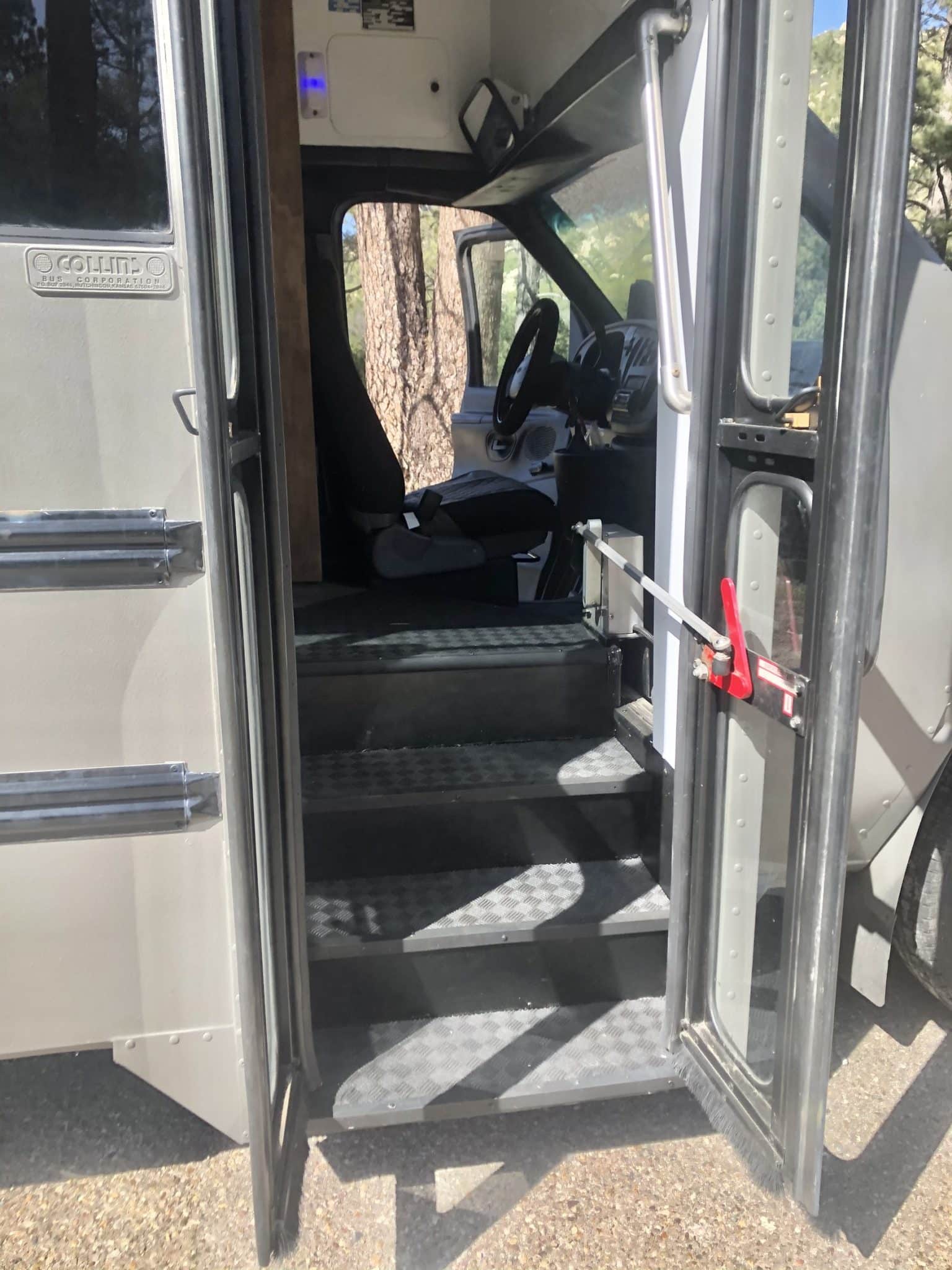
I was reading a forum post from a guy who was parked in west Texas during a windstorm. He said the bus was rocking so hard that stuff was falling off shelves and his kids were crying. He ended up driving to a truck stop and parking between two semis just to get out of the wind. That story stuck with me because it’s so practical. He didn’t panic, he just solved the problem.
When you’re driving in high wind, it’s worse. Crosswinds on the highway can push a bus into the next lane without warning. Most experienced bus drivers won’t drive in sustained winds above 30-35 mph. That might sound overly cautious until you’ve felt a 40 mph gust hit you at highway speed. Then it sounds perfectly reasonable.
So what do you do about it? Check the weather before you drive. Every time. And if the forecast says high winds, just don’t go. Wait it out. The road will be there tomorrow.
When you’re parked, try to position the bus so the nose faces into the wind. A bus is much more aerodynamic from the front than from the side. Park near buildings or natural windbreaks when possible. And secure anything outside the bus that could become airborne, because at 50 mph a folding chair becomes a real problem.
Lovely home sir…how do you deal with bad storms with heavy wind or tornadoes?
Tornadoes are the one scenario where there is no “deal with it” option. You leave. Period. A bus will not protect you from a tornado. It will become part of the tornado.
And look, I know that sounds dramatic, but a school bus weighs 25,000-30,000 pounds fully loaded and an EF2 tornado picks up vehicles like that without slowing down. If you’re in tornado alley — Oklahoma, Kansas, Texas, Missouri, anywhere in the central US during spring and early summer — you need a weather app on your phone and you need to check it obsessively.
The National Weather Service gives tornado watches (conditions are right) and tornado warnings (one has been spotted or detected on radar). If there’s a watch, know where your nearest solid building is. If there’s a warning, get to that building. Don’t stay in the bus.
For non-tornado severe weather — thunderstorms, heavy rain, hail — the bus actually handles it fine. You’re in a steel shell. Lightning can’t hurt you (same principle as a car, the steel body conducts it around you). Hail might dent the roof but it won’t come through. Heavy rain is just noisy.
Flooding is the other big one. Never park in a low-lying area near a river or creek when rain is forecast. Water rises fast and a bus stuck in two feet of water isn’t going anywhere. This is especially true in the desert Southwest where flash floods come out of nowhere through dry washes. If it rained in the mountains 30 miles away, your dry creek bed can have six feet of water in it within an hour.
Fire safety, and why this section matters more than you think
I’m not going to make this its own question heading because honestly nobody in the YouTube comments asked “hey what about fire safety?” and that’s kind of the problem. People ask about break-ins and tornadoes but not about the thing that actually kills more RV dwellers than anything else.

A converted bus is full of wood, fabric, propane, electrical wiring that somebody ran themselves, and sometimes a wood stove. That combination should make you take fire safety seriously.
Here’s what you need at minimum:
Smoke detectors. At least two. One near the sleeping area and one near the kitchen. Get the ones with a 10-year sealed battery so you don’t have to think about it.
A carbon monoxide detector. This is non-negotiable, especially if you have a propane stove, a diesel heater, a wood stove, or a generator. CO is odorless and it will kill you in your sleep. I really don’t want to be dramatic about this but people die from this in RVs and it is preventable.
Fire extinguishers. At least two. One near the door (your exit route) and one near the kitchen. Get ABC-rated extinguishers and actually learn how to use them before you need to. Replace or recharge them on schedule.
If you have a wood stove, your chimney needs proper clearances from combustible materials. Use triple-wall stovepipe where it passes through the roof. Keep a fire blanket near the stove. And never, ever leave the stove burning unattended when you go to sleep. I know people do it. I know it keeps the bus warm overnight. It’s still dangerous, and your insurance company will agree with me.
Propane systems need a leak detector and the lines should be checked regularly. If you smell rotten eggs (that’s the additive they put in propane so you can detect leaks), turn off the tank immediately and open every window and door before investigating.
And have an escape plan. In a bus, that usually means knowing which windows can be popped out as emergency exits and having a tool to break glass if needed. The driver’s window, the rear emergency door, and at least one side window should all be viable exit points. Talk about this with everyone who lives in the bus. Even the kids.
Related: School Bus Conversion Cost Breakdown (Real Numbers)
Storing valuables and keeping a low profile
I want to wrap this section up with something that might be the most practical advice in this whole article, and it’s not about locks or alarms or weapons. It’s about not looking like a target.
The skoolie community has this saying, or at least a version of it — “look broke.” Not literally, but the idea is that you don’t want your bus screaming “there’s $50,000 worth of stuff in here.” Tinted windows, closed curtains, no visible electronics through the glass. Don’t leave your solar panels’ brand-new shiny controller visible through the windshield. Don’t have a brand-name bicycle rack with a $3,000 mountain bike hanging on the back when you’re parked in a rough area.
Keep your important documents, cash, and small valuables in a hidden safe. They make small safes designed for RVs that bolt to the frame. Your passport, your title, your emergency cash — put it somewhere that isn’t obvious. Not the kitchen drawer. (See our guide on Is It Safe to Live in a Bus During a Storm? for more on this.)
And back things up digitally. Photos, documents, anything irreplaceable. If the worst happens and someone does break in or you have a fire, having digital copies of everything means you can recover. Losing a laptop sucks. Losing your only copy of your birth certificate and your bus title is a whole different level of problem.
—
Look, I know this article is a lot. Safety isn’t the fun part of bus life. Nobody’s watching YouTube tours because they want to hear about fire extinguisher placement and carbon monoxide detectors. But this stuff matters, and the people who think about it before they need to are the ones who sleep soundly every night in their bus.
You don’t need to be paranoid. You don’t need a panic room in the back of your skoolie. You just need to be thoughtful. Good locks, a weather app, smoke detectors, a dog that barks at strangers, and the common sense to leave when a situation doesn’t feel right. That covers about 95% of everything you’ll ever deal with.
The other 5%? That’s what the fire extinguisher and the escape plan are for.
For more on where to park safely, check out our complete guide to skoolie parking.