
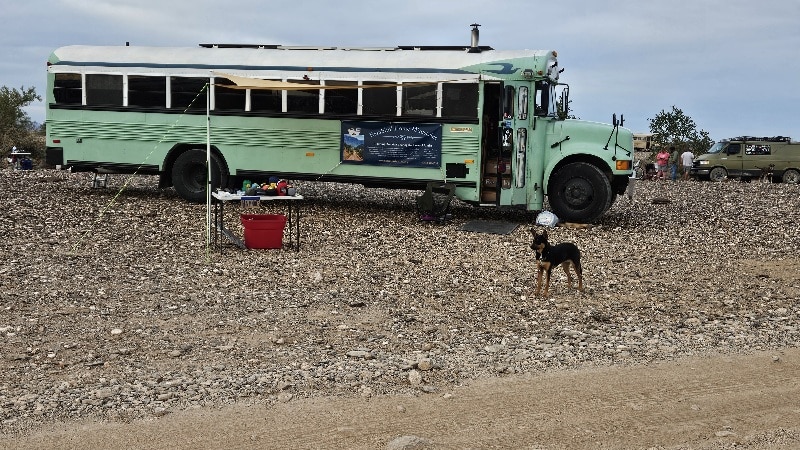
If there’s one part of the skoolie journey that makes people’s eyes glaze over, it’s this one. Nobody gets excited about paperwork. Nobody’s filming a YouTube tour of their trip to the DMV. But I’ll tell you what, this is the part that trips people up more than the actual build, and I’ve seen it happen over and over in forums and Facebook groups. Someone finishes a beautiful conversion and then spends three months fighting with their state to get it registered.
So let’s go through the whole thing. Titling, registration, inspections, CDL questions, the states that make it easy, the states that make it painful, and the timing tricks that save you headaches.
Registering and titling a converted school bus involves transferring the title from a commercial school bus designation to an RV or motorhome classification, passing any required state inspections, getting the bus weighed in some states, removing school bus markings and the yellow paint, and paying registration fees that vary wildly by state. The process can be as simple as one DMV visit or as complicated as a multi-month ordeal, depending entirely on where you do it. Vermont, South Dakota, and Montana are popular workaround states for people who live in difficult-registration states.
—
How were you able to get the title restructured to register it as an RV or how does that process go?
We’ve got a shorter article on this specific question if you want the quick version, but I’m going to go deeper here because the pillar details matter.
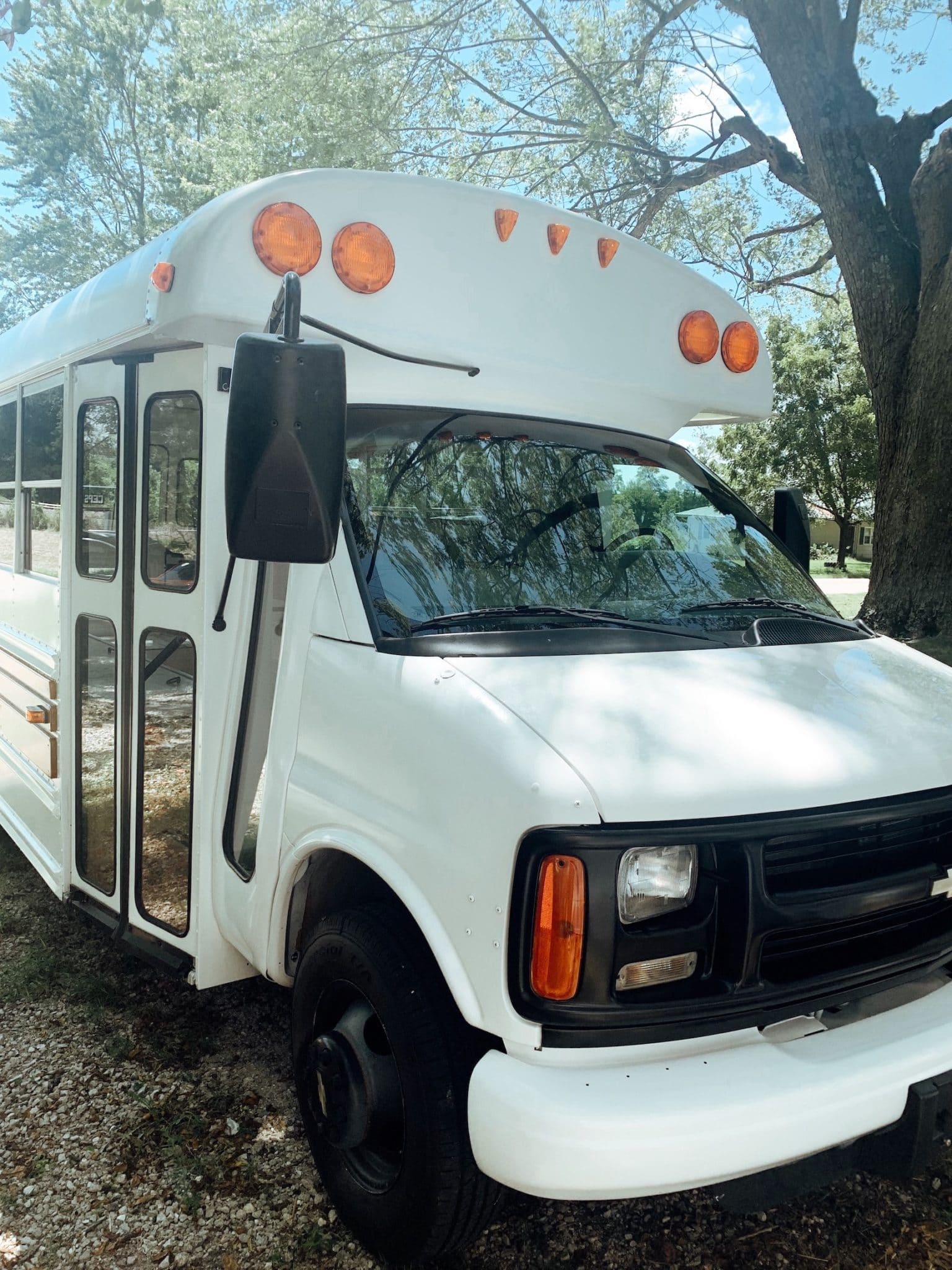
The basic process in most states looks like this. You buy a bus, it comes with a title that says “school bus” or “bus” or sometimes “commercial vehicle.” You need to get that changed to “motorhome” or “recreational vehicle” or whatever your state calls it. (See our guide on Do You Need a CDL to Drive a Skoolie? for more on this.)
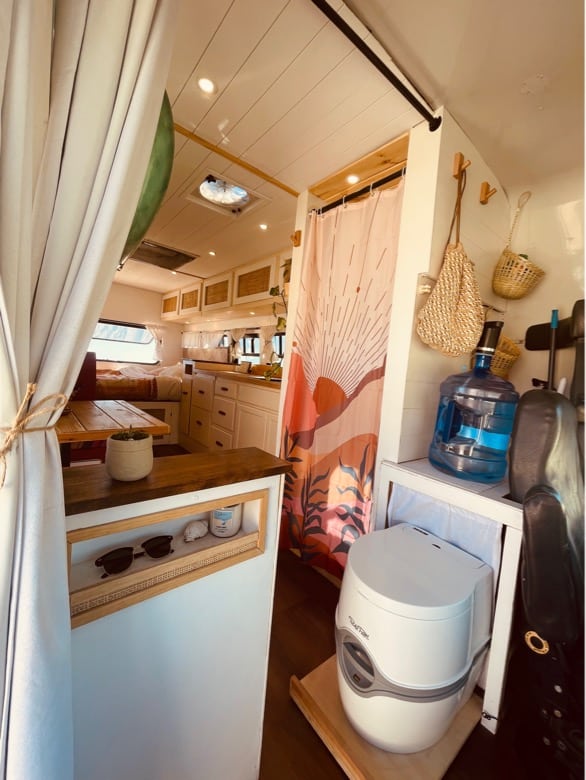
To do that, most states want you to prove the bus is actually being used as living space. That means having some combination of a sleeping area, a cooking area, and a water system installed. The exact requirements vary and I swear some of these state DMV websites were written by people who’ve never had to actually use them, but the general idea is the same everywhere. Show us it’s a home, not a bus.
Here’s where people get confused though. You don’t need a finished build. You need the minimum amenities your state requires. In a lot of states that’s literally a bed, a cooktop of some kind, and a water container. I’ve heard of people getting approved with an air mattress, a Coleman camp stove bolted to a counter, and a 5-gallon water jug. It’s not about how nice it looks, it’s about checking the boxes.
Then you go to the DMV with your current title, photos of the interior (some states) or the actual bus for inspection (other states), your ID, and your fee. You walk out with a new title that says RV or motorhome. That’s it. That’s the whole process in states that make it easy.
I have a question for tip #2, do you have any advice on when it’s best to get it reregistered?
This is one of those questions where everyone has an opinion and I’ve gone back and forth on it myself while researching.
The argument for re-titling early — as in, as soon as you have the bare minimum amenities installed — is that it solves three problems at once. First, you can get proper RV insurance right away instead of dealing with the nightmare of insuring a vehicle titled as a commercial bus. Second, it eliminates any CDL gray area since an RV under 26,001 pounds doesn’t need one. Third, you stop driving around in what the law considers a commercial vehicle, which can create problems at weigh stations and during traffic stops. (See our guide on Can You Get Insurance for a Converted School Bus? for more on this.)
The argument for waiting until the build is done is honestly weaker, but some people do it. Their reasoning is usually that they don’t want to deal with the DMV twice, or they’re worried the state will inspect it and find the conversion lacking. But in my experience reading through hundreds of build threads, the people who re-titled early almost always say they wish they’d done it even sooner.
So my advice? Get the minimum requirements installed, re-title it, and then finish your build on your own timeline. The peace of mind alone is worth the DMV trip.
What about motor vehicle inspection? What states are more difficult to get homemade vehicles passed?
Oh man, this is where it gets interesting. And by interesting I mean frustrating.
Some states don’t inspect at all. You bring your paperwork, you pay your fee, you’re done. Texas is like this for the most part. South Dakota is famously easy. Florida doesn’t require inspections for vehicles coming from out of state to register (they abolished their inspection program years ago). (See our guide on How Do You Register a Converted School Bus as an RV? for more on this.)
Then you’ve got states that do a basic inspection, mostly verifying that the bus has the required RV amenities and that the VIN matches the paperwork. This is what most states do and it’s not a big deal. Someone looks at the bus, checks some boxes, signs a form.
And then there are the states that will make you question every life decision that led you to this point. California has CARB requirements and their BAR referee stations can be unpredictable. Pennsylvania requires annual safety inspections and some inspectors won’t know what to do with a converted bus. New York has its own universe of vehicle regulations and good luck figuring out which ones apply to you without a lawyer. (See our guide on The Complete Guide to Insuring a Converted School Bus for more on this.)
A couple months ago I was reading through a California skoolie group and this one woman posted about her inspection experience. She brought her bus to the referee station and the inspector had never seen a converted school bus before. He spent two hours going through it, called his supervisor twice, and ultimately passed it — but not before she’d basically had to explain what a skoolie was from scratch. She said the worst part wasn’t the inspection itself, it was the three-week wait to get the appointment.
If you’re in a difficult state, the workaround that a lot of people use is registering in a different state entirely. Which brings us to the next thing.
The Vermont, South Dakota, and Montana trick
I have to be careful how I frame this because I’m not telling anyone to commit fraud. But the reality is that thousands of bus and van converters register their vehicles in states that aren’t their home state, and it’s completely legal as long as you do it right.

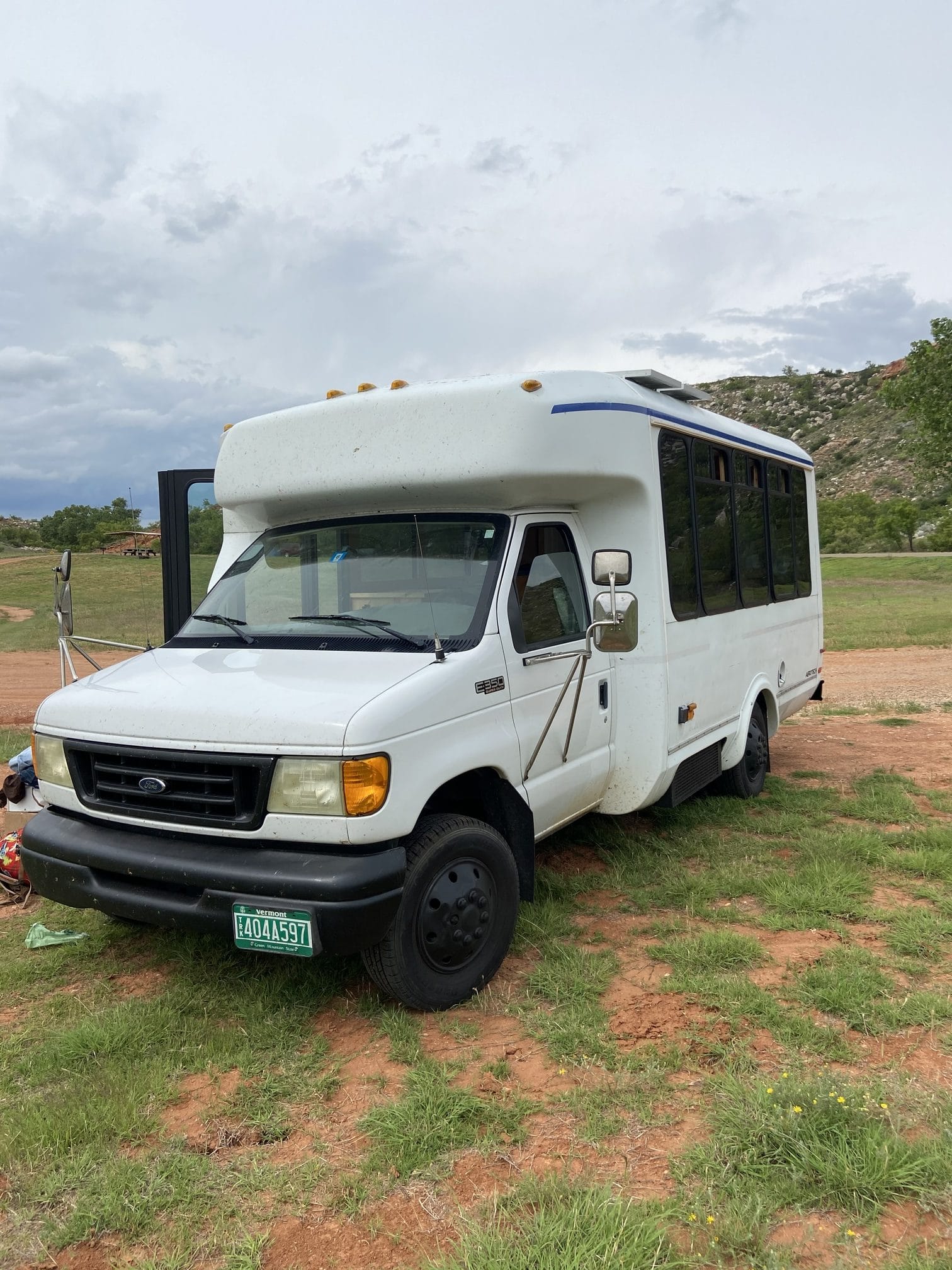
Vermont is the most famous one. Vermont allows you to register a vehicle by mail without a title. You send them a bill of sale, they send you Vermont plates. No inspection. No title needed. This is huge for people who bought a bus without a title, which happens more often than you’d think — auction buses, government surplus, private sales where the seller lost the paperwork. Vermont is how you get a titled vehicle out of an untitled one.
Once you have Vermont registration, you can then transfer that to your home state and get a proper title there. It’s an extra step but it solves the “I don’t have a title” problem that stops a lot of builds before they start.
South Dakota is popular for full-timers who want to establish domicile in a state with no income tax, low registration fees, and an easy process. You can establish residency with one night at a campground and a mail forwarding address. Registration is straightforward and cheap. A lot of the full-time RV community uses South Dakota as their legal home base.
Montana is the one people use to avoid sales tax on expensive vehicles. You form an LLC in Montana, register the vehicle under the LLC, and Montana has no sales tax. This is technically legal but it’s been challenged in court in a few states, and if your home state finds out you’re using a Montana LLC to avoid their sales tax, they might come after you. I’m not a lawyer and I’m not going to tell you to do this, but I’d be leaving out important information if I didn’t mention it because it’s extremely common in the bus and RV world.
So did they have to get the bus weighed for title and licensing after the finished rebuild?
Some states require a weight certificate as part of the registration process. It’s not universal but it’s common enough that you should be ready for it.
Getting weighed is easy. Drive to any truck stop with a CAT scale — they’re everywhere along interstates. It costs about $12-$15. You drive onto the scale, they print a ticket showing your gross weight, and you’re done. Takes five minutes.
Why do they want the weight? Two reasons. First, some states base registration fees on vehicle weight. Heavier vehicle, more fees. Second, the weight determines whether you need a CDL. That magic number is 26,001 pounds GVWR. If your bus is under that, you’re fine with a regular license. If it’s over, things get complicated. We’ve got a full article on CDL requirements here.
Even if your state doesn’t require it, get your bus weighed after the build. I keep saying this across multiple articles because it matters that much. Knowing your actual weight tells you if you’re within your tire ratings, your brake capacity, and your legal limits. And if you’re over… well, it’s better to find out at a truck stop than during a roadside inspection.
Can someone tell me what it would cost to plate the bus (license plates)?
Registration costs are all over the map and I wish I could give you one number but I can’t. It depends on your state, your vehicle’s weight, its age, and sometimes its declared value.
On the cheap end, states like South Dakota, Arizona, and Montana charge somewhere between $100 and $300 per year for RV registration. That’s one of the reasons they’re popular domicile states.
On the expensive end, California and New York can run you $300 to $800+ per year depending on weight and other factors. I’ve seen people in certain counties paying over $1,000 annually, though that’s unusual.
Here’s the breakdown of what you’re typically paying:
- Title transfer fee: $15-$75 (one time)
- Registration fee: $100-$500 per year (weight-based in many states)
- Plate fee: $5-$25 (one time, some states charge annually)
- Inspection fee: $0-$100 (if required)
- Sales tax: 0-10%+ on the purchase price (varies by state, some states tax the full value, some tax a reduced amount for used vehicles)
The sales tax is often the biggest single cost and it’s the one people forget about. If you paid $8,000 for a bus and your state charges 7% sales tax, that’s $560 right there on top of everything else.
How is the bus registered when you pick it up from the desert where you bought it and you get it home prior to being an RV?
This is the chicken-and-egg problem that every first-time buyer runs into. You just bought a bus at an auction in Arizona. It’s titled as a school bus. You need to drive it 1,200 miles home to Tennessee. You don’t have insurance because it’s a commercial vehicle and your insurance company won’t touch it. You don’t have registration in your state because you just bought it in another state. What do you do?
Here’s what most people actually do and I want to be straightforward about this. A lot of them just drive it home. They have the bill of sale, they have the existing title in hand, and they drive it home and deal with the registration when they get there. Is this technically a gray area? Yes. Does it usually cause problems? Not really. Most states give you a window — usually 30 days — to register a newly purchased vehicle, and having the bill of sale and title in the glovebox covers you during a traffic stop.
Some states offer temporary transit permits or trip permits for exactly this situation. You apply online or at a DMV office, pay a small fee ($15-$50), and get a permit that’s valid for 3-10 days. That gives you legal authority to drive the vehicle to your home state.
The more cautious approach is to hire a transport company. They’ll put the bus on a flatbed or drive it for you. Cost runs about $1-$3 per mile, so a cross-country move could be $2,000-$5,000. That’s a lot of money but some people prefer the peace of mind.
And then there’s the insurance angle. You need insurance to register, but you need registration (or at least an RV title) to get insurance. The way around this is to call a specialty insurer like National General or Roamly before you buy the bus. Explain the situation. Some of them will write a policy on a bus that’s still titled as a school bus, as long as you’re planning to convert it. Having that conversation before the purchase saves a lot of headaches after.
Is it possible to convert an electric bus into a recreational vehicle and register it with the DMV?
Somebody in the comments asked specifically about converting a BYD electric bus, and I love that question because it shows where this whole movement is heading.

The short answer is that the registration process for an electric bus conversion would be essentially the same as for a diesel or gas bus. You’re still converting a commercial vehicle into a recreational vehicle. The DMV cares about the same things — does it have a bed, a kitchen, water storage? They don’t care what powers the drivetrain.
The practical challenges with an electric bus conversion are different though. Range is the big one. A commercial electric bus might have a range of 150-200 miles, and that’s before you add the weight of a full conversion. Your range could drop to 100-130 miles, which limits your travel significantly.
Charging infrastructure is the other challenge. You can’t just pull into a gas station. You need a Level 2 or DC fast charger, and those aren’t everywhere yet, especially in the rural areas where bus life tends to happen.
But is it possible? Absolutely. And as battery technology gets better and charging networks expand, I think we’re going to see a lot more electric bus conversions. We’re just not quite there yet for most people.
Did you have to get a CDL license to drive the bus?
This question shows up so often that we wrote an entire article about CDL requirements for skoolies. But since this is the comprehensive guide, here’s the summary.
You probably don’t need a CDL. The threshold is 26,001 pounds GVWR. Most school buses used for conversion — Type C (the ones with the dog-nose hood) and short buses — have a GVWR well under that. Once you re-title as an RV, you’re driving a personal recreational vehicle and the commercial license requirement doesn’t apply.
Where it gets tricky is with full-size flat-front transit buses and coach buses. Some of these have GVWRs above 26,000 pounds. In those cases, you might need a non-commercial Class B license or even a CDL, depending on your state.
A few states have their own quirks. New York requires a special license for vehicles over 10,000 pounds in some situations. California has unique rules around air brakes. Pennsylvania is… Pennsylvania.
The bottom line: check your bus’s GVWR sticker (inside the driver’s door jamb), check your state’s DMV website, and if the GVWR is under 26,001 pounds, you’re almost certainly fine with your regular license.
Question: to get tags and all the registration did this need inspection like a mobile home? And also CDL?
This question bundles two things together, and it’s actually a really common point of confusion. People hear “inspection” and think of a mobile home inspection, which is a whole different thing with HUD standards and all that.
A bus conversion is NOT classified as a mobile home or manufactured housing. It’s classified as a motorhome or recreational vehicle. These are different categories with different regulations. Mobile homes are regulated by HUD. RVs are regulated by RVIA standards, but those standards are voluntary for DIY builders — they only apply to manufacturers.
What this means practically is that your converted bus doesn’t need to meet manufactured housing standards. The inspection your state might require is just verifying that the vehicle has the minimum RV amenities (bed, kitchen, water) and that the VIN matches. They’re not checking your electrical work against code or pressure-testing your plumbing. At least not in most states.
Is that good or bad? Well, it’s good in that the barrier to registration is low. It’s bad in that nobody is checking your work, which means the safety of your build is entirely on you. Get your electrical checked by someone who knows what they’re doing. Have a plumber look at your propane lines. These aren’t legal requirements but they should be personal ones.
Painting the bus and removing school bus markings
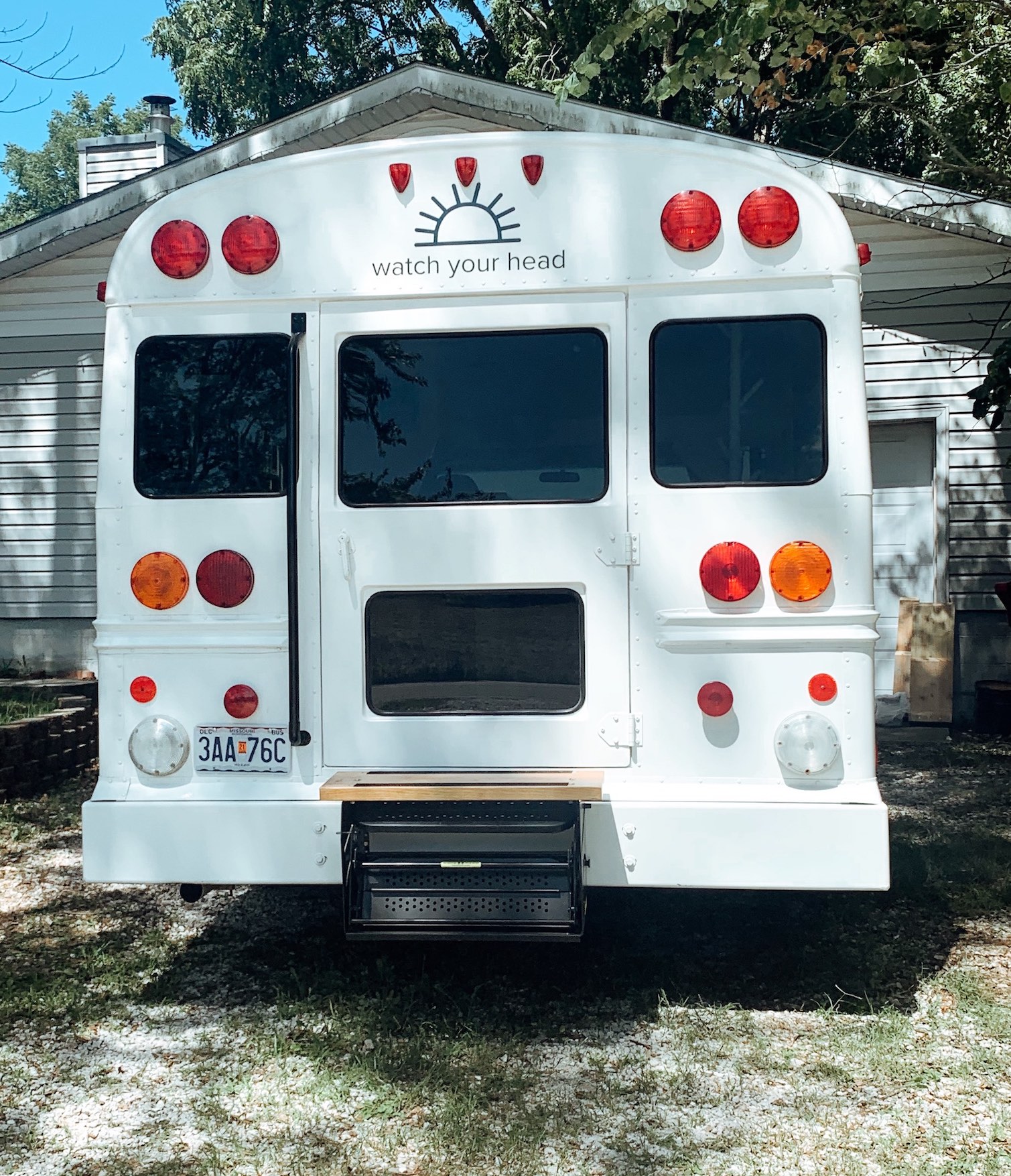
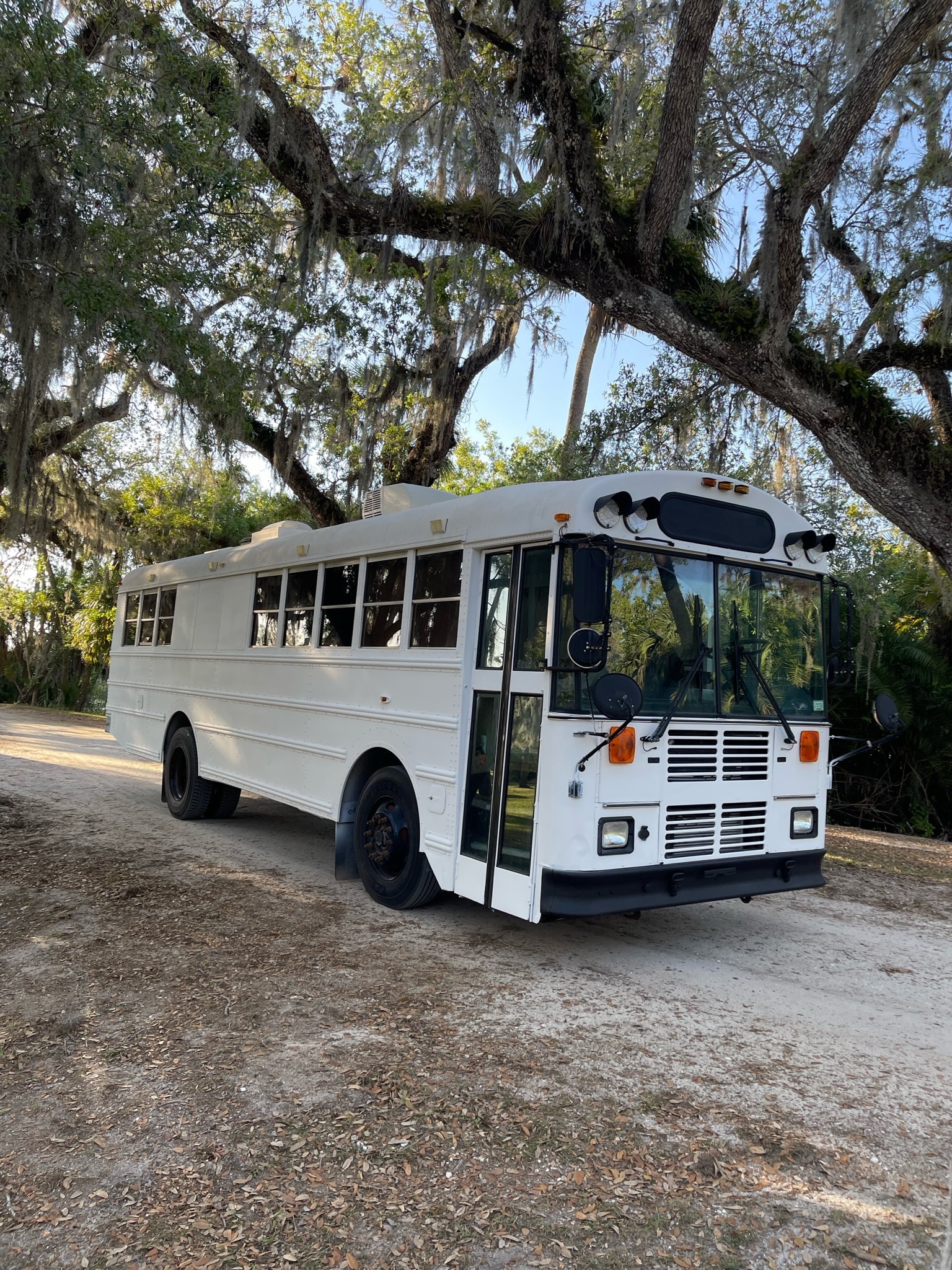
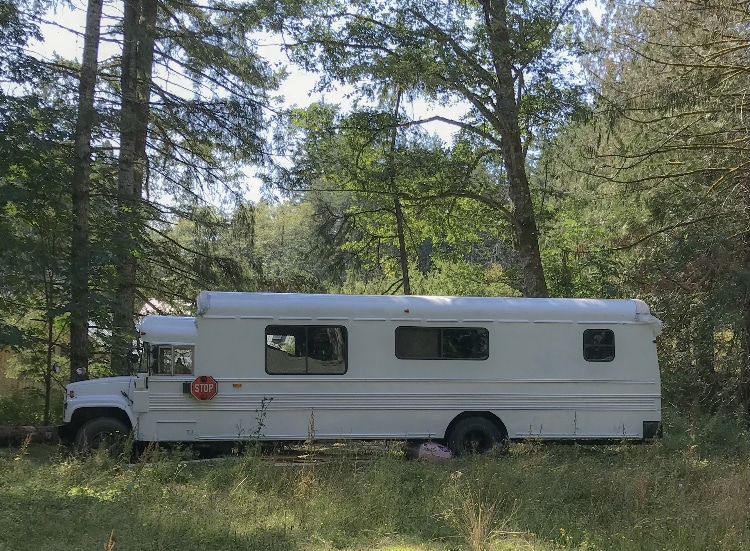
I want to talk about this because it’s a step that some people skip and then regret. In most states, you cannot register a vehicle as an RV if it still looks like a school bus. That means the yellow paint has to go, and all the school bus signage — the stop sign arm, the flashers, the “SCHOOL BUS” lettering — needs to be removed.
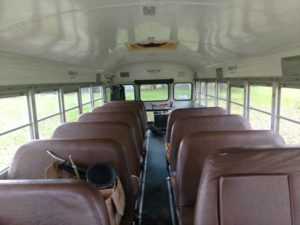
Some states are very specific about this. They’ll reject your re-title application if the bus is still yellow. Others are more relaxed but will note it on the inspection.
Painting a bus is a bigger job than people expect. A full-size bus has a LOT of surface area. You’re looking at roughly 350-450 square feet of paintable surface. Options range from cheap to expensive:
- Rustoleum roller paint: $200-$400 in materials. Takes a weekend. Won’t look amazing up close but looks fine from ten feet away. This is what the majority of budget builders do and honestly it holds up better than you’d think.
- Bedliner (Raptor Liner): $400-$600. Extremely durable, hides imperfections, textured finish. Popular choice.
- Professional spray paint: $3,000-$8,000. Looks incredible. Costs a fortune.
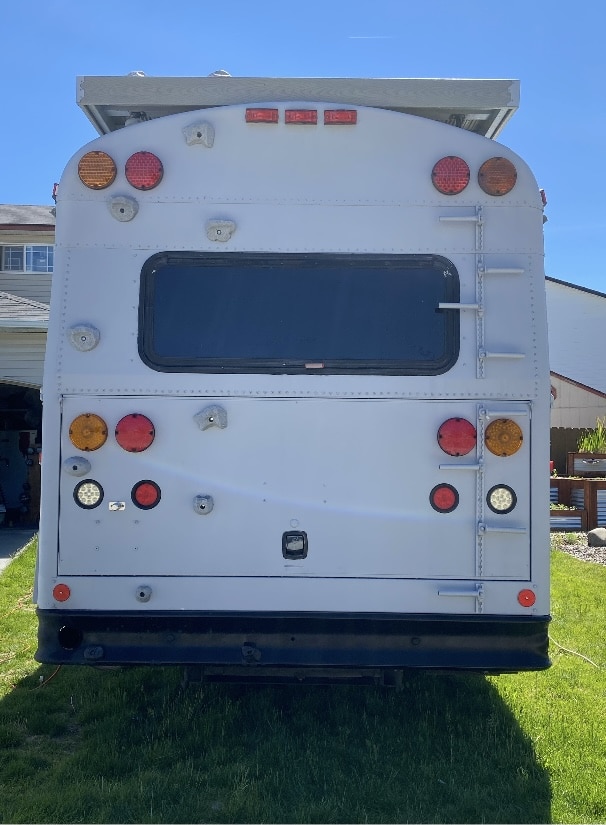
Remove the stop sign arm, the flashing red lights, and any “SCHOOL BUS” text before you go to the DMV. Some states require this by law regardless of registration status — in many places it’s illegal to operate a vehicle with school bus markings if it’s not actually being used as a school bus.
The insurance and registration chicken-and-egg problem
I touched on this earlier but it deserves its own section because it’s the part where people get genuinely stuck.
You need insurance to register. You need an RV title to get proper insurance. You need the bus registered to legally drive it. But you can’t register it until you’ve converted it enough to qualify as an RV. And you can’t convert it if you can’t get it to your build location because you can’t drive it without registration and insurance. (See our guide on Can You Legally Live in a Converted School Bus? for more on this.)
See the problem?
Here’s the order that works for most people:
- Buy the bus. Get the title and bill of sale.
- Call a specialty insurer (National General, Roamly, Good Sam) and get a policy on it as-is. Some will insure it as a “bus in conversion.”
- Drive it to your build location (with your insurance and bill of sale in hand).
- Install the minimum RV amenities.
- Go to the DMV, re-title as an RV.
- Update your insurance to reflect the RV title.
- Finish your build at your own pace.
Not everyone follows this exact order, and some people skip steps or do things in a different sequence. But this is the path of least resistance based on what I’ve seen work for the most people. If you want more details on the insurance side, we’ve got a full article on insuring a converted school bus.
—
So that’s the whole picture. Registration and titling isn’t glamorous, it’s not going to make a good Instagram post, and nobody’s going to congratulate you when you walk out of the DMV with your new RV title. But it’s the step that makes everything else possible — insurance, legal driving, parking at RV parks, crossing state lines without worrying.
My biggest piece of advice? Don’t put it off. The longer you drive around on a school bus title, the more problems stack up. Get the minimum conversion done, get it re-titled, and move on to the fun part of actually building your home. The DMV will still be there, and it will still be annoying, but once it’s done it’s done and you don’t have to think about it again until renewal time.
cjvw7g