
You’ve got a bus, you’re planning a roof raise, and now you’re wondering if there’s some magic number that makes your build illegal. Or maybe you’ve already done the raise and you’re second-guessing whether you can actually drive this thing across the country without getting pulled over.
In the United States, there is no single federal maximum height for vehicles on public roads. The general guideline is 13 feet 6 inches, which is the minimum clearance required for interstate highway overpasses, but individual states set their own legal maximums. Most states cap vehicle height between 13 feet 6 inches and 14 feet, with a few allowing up to 14 feet 6 inches. A standard school bus is about 10 feet 6 inches tall, and even with an 18-inch roof raise plus a rooftop AC unit, you’re typically landing around 13 feet to 13 feet 2 inches — well within legal limits in every state. So the short answer is, your skoolie is almost certainly legal. Bridge clearances are the real thing to worry about, not the law.
“Is that height legal? What’s the max height in the US?”
So when I started digging into this, I expected to find one clear federal number. Like a speed limit sign but for how tall your vehicle can be. Turns out it doesn’t work that way at all.
The Federal Highway Administration doesn’t set a maximum vehicle height. What they do set is a minimum clearance for interstate bridges, which is 16 feet on the Interstate Highway System (though the practical minimum you’ll encounter on older sections is closer to 14 feet). States are the ones who actually regulate vehicle height, and it varies.
Here’s what I found when I went state by state. Most states land on 13 feet 6 inches as their max. That includes big travel states like California, Texas, Florida, and most of the eastern seaboard. A handful of states allow 14 feet, and a few go up to 14 feet 6 inches. Some states, and this is the weird part, don’t actually have a specific height limit on the books at all. They just say your vehicle can’t exceed the height that’s “safe for the roadways” or something equally vague.
I made a spreadsheet at one point trying to track all this and honestly gave up halfway through because the regulations were scattered across different state DOT websites, some of which hadn’t been updated since the early 2000s. The practical takeaway is this — if your converted bus is under 13 feet 6 inches total height, you’re legal everywhere in the continental US. Period. And most skoolies, even with a roof raise, come in under that. (See our guide on Can You Legally Live in a Converted School Bus? for more on this.)
The guys running into height issues aren’t skoolie owners. They’re the people hauling oversized loads on flatbeds or driving double-decker tour buses. Commercial carriers with vehicles over 13’6″ need permits in many states. But a converted school bus? You’re not even close to the threshold that triggers that kind of scrutiny. (See our guide on Do You Need a CDL to Drive a Skoolie? for more on this.)
“Are you in the states? If so how tall is your home? I only ask because me and my husband have been tossing the idea around for years of living the nomadic lifestyle and the legality of the heights and specs on all of it”
I love questions like this because it tells me somebody is genuinely in the research phase and wants to get it right before committing. That’s smart. Too many people buy a bus, do a roof raise, and then panic about whether it’s legal. Better to figure it out upfront.
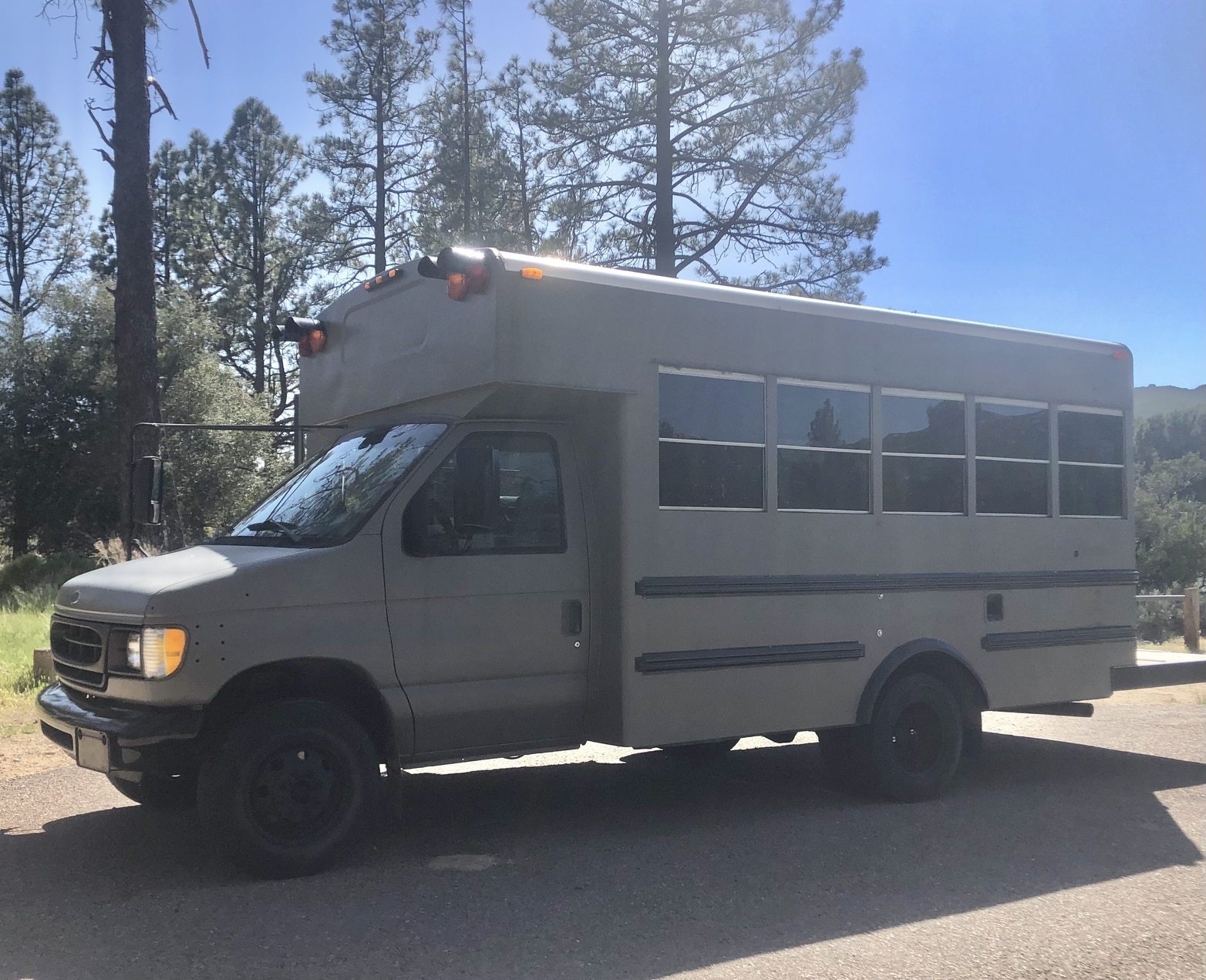
So here’s the math on a typical build. A stock full-size school bus (Type C or Type D) sits at roughly 10 feet to 10 feet 6 inches in overall exterior height. That’s from the ground to the very top of the roof. If you do a common 18-inch roof raise, you’re adding 1.5 feet, which puts you at about 11 feet 6 inches to 12 feet. Then if you mount a rooftop air conditioner, that adds another 12 to 14 inches. So your total height with a raise and an AC is somewhere around 12 feet 6 inches to 13 feet 2 inches.
That’s legal everywhere. Not even close to the limit in most states.
Now here’s a thing I didn’t think about until I was chatting with a guy at a skoolie meetup last year. He’d done a 24-inch roof raise on a Type D flat-nose, which is already one of the taller bus types. Then he put a rooftop AC on it, and then he added a roof deck with a railing. His total height was pushing 13 feet 8 inches. He said he’d never been pulled over for it, but he was constantly stressed about it because he knew he was over the limit in certain states. He ended up removing the roof deck railing and just using it as a flat observation platform, which brought him back down to about 13 feet 2 inches. Problem solved, but it was an expensive lesson in measuring before you build.
For most couples looking at getting into this lifestyle though, you’re not going to have an issue. A standard roof raise with normal rooftop accessories keeps you well under 13’6″. The legality concern is valid to research, but it shouldn’t be what stops you from starting. I’ve found that the specs and legality stuff sounds way more intimidating on paper than it actually is once you start digging into the numbers.
“How did you go when you came across bridges? I am going to see if I could legally do such a high roof raise in Australia.”
Bridges are the real concern, not the law. I keep saying this because it’s true. You could build a perfectly legal 13-foot bus and still rip the roof off on a 12-foot bridge in some small town in Kentucky. The law says you can be that tall. Physics doesn’t care what the law says.
In the US, interstate highways maintain a minimum 14-foot clearance on overpasses. So if you stick to interstates and major highways, you’re fine. The problems show up on city streets, rural back roads, old railroad overpasses, and downtown areas in older cities. I came across a database once that had thousands of low-clearance bridges listed across the country. Some were as low as 9 feet. Nine. You wouldn’t even clear that in a stock bus.
What most skoolie owners do, and I think this is really the most important practical advice in this whole article, is they use trucker GPS apps. CoPilot, Hammer, and a few others let you input your vehicle height and they route you around low bridges. Regular Google Maps does not do this. I read a post from a guy who trusted Google Maps, took a shortcut through a small town in Ohio, and came within about 4 inches of a railroad overpass. He made it through, but he said he could hear the AC unit scraping. After that he switched to trucker GPS and never looked back.
Now for Australia, which the original question mentions, it’s a completely different situation. Australia has a national maximum vehicle height of 4.3 meters, which is about 14 feet 1 inch. That’s actually pretty close to the US standard. But from what I’ve read, individual states and territories in Australia can have their own restrictions, and some roads have specific height limits posted. The other thing about Australia is the road infrastructure in the Outback. You might not have bridge clearance issues, but you’ve got other concerns like road width, fuel range between stops, and weight limits on remote roads. I didn’t dive as deep into Australian regulations because it’s a different world over there, but the starting point would be checking with your state transport authority before doing any roof raise work.
One trick I read about that I thought was brilliant. A builder in Queensland welded a PVC pipe to his front bumper, cut to the exact height of his bus. The pipe hits anything before the roof does. Basically a $10 early warning system. I’ve seen US builders do the same thing actually, and it’s one of those simple ideas that could save you thousands in damage.
Related: Can You Get Insurance for a Converted School Bus?
Related: How Do You Register a Converted School Bus as an RV?
Related: The Complete Guide to Insuring a Converted School Bus
“Your home height is travel safe?”
This question is really getting at something different than legality. It’s asking whether a tall bus is practical for everyday life on the road. And honestly, I think the answer depends on how you travel.
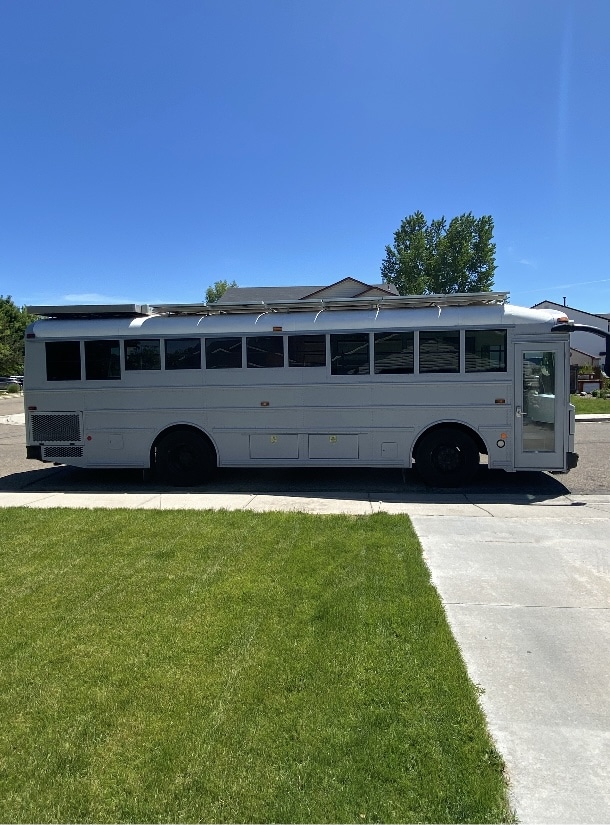
If you’re someone who sticks mainly to interstates, campgrounds, and RV parks, a raised-roof bus is totally travel safe. The routes are designed for large vehicles, the campground entrances are built for rigs, and you’re not going to encounter any surprises. I talked to several full-timers who said they never once had a height scare in years of traveling, because they planned their routes and used trucker navigation.
Where it gets sketchy is when you want to be spontaneous. Pulling into a random gas station in a small town, taking a scenic route through a mountain pass, driving into an older downtown area to check out a restaurant somebody recommended. That’s when height becomes something you have to think about every single time. It’s not unsafe exactly, but it adds a layer of mental effort to every driving decision. Some people are fine with that. Others find it exhausting after a while.
I read a comment from a woman who had a stock-height bus, no roof raise, and she said the freedom of not worrying about height was one of her favorite things about her build. She could pull into any gas station, any drive-through, any parking garage without a second thought. Her husband is 5’7″ and she’s 5’4″, so the stock ceiling height worked fine for them. Meanwhile another builder with a 20-inch raise said he wouldn’t trade the interior space for anything, even though he has to plan routes more carefully. It really comes down to priorities.
The one thing everyone agrees on, and I mean everyone I’ve talked to or read comments from, is this — know your exact height. Not an estimate. Not “about 13 feet.” Measure it precisely, write it on a piece of tape on your dashboard, and check every single bridge before you go under it. A guy I was reading about mounted a sticker on his windshield right at eye level that said “12’11” — YOUR HEIGHT” so he’d never forget and never have to do mental math under pressure. That’s the kind of small thing that makes a tall bus completely travel safe.
After digging into all of this, here’s what it comes down to. The legal height limit is almost never going to be your problem. Even aggressive roof raises keep you under the limit in every state. The real issue is infrastructure, specifically low bridges, and the solution is simple — measure your bus, use a trucker GPS, and don’t wing it. I spent way more time worrying about the legal side of this than I needed to, and I think most people do. The law is on your side. Just respect the bridges and you’ll be fine.