
You’ve done the math on bus life, and somewhere between insurance quotes and registration fees, you started wondering what happens when tax season rolls around. Does the government see your skoolie as a house or a vehicle?
No, you don’t pay property tax on a converted school bus. Your bus is classified as a vehicle, not real estate, so it falls under vehicle registration fees and, in some states, personal property tax on vehicles — which is a completely different thing than the property tax you’d pay on a house. Even if your bus is parked on a piece of land permanently, the bus itself is still a vehicle in the eyes of the law. You might owe property tax on the land if you own it, but the bus? It gets taxed like a car. This is honestly one of the biggest financial perks of bus life that people don’t talk about enough.
“Do they pay car bills or house bills?”
This is one of those questions that I kept running into when I was first researching the financial side of living in a bus, and I think the confusion makes total sense. You’re living in the thing. It has a kitchen, a bathroom, a bed. It feels like a home. But the government doesn’t care about your feelings on this one. They care about the title.
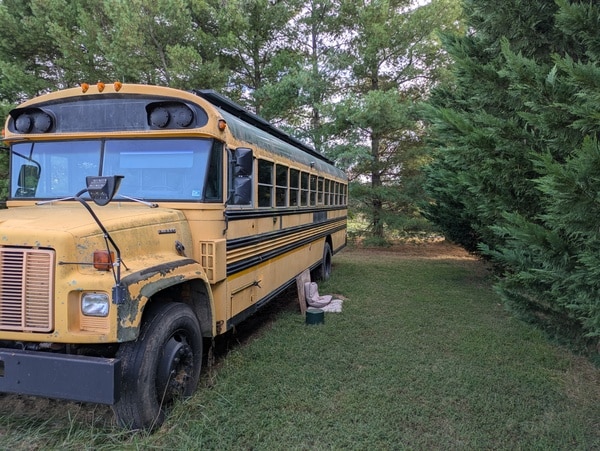
A converted school bus, once you re-title it as an RV or motorhome, is a vehicle. Full stop. So you pay vehicle bills. That means registration fees, vehicle insurance, and whatever your state charges annually to keep it road legal. In most states, you’re looking at $100 to $500 a year for registration depending on the weight and age of the bus. Insurance runs $1,000 to $2,500 a year for most full-time skoolie dwellers, though I’ve seen it go higher for people with expensive builds.
What you don’t pay is a mortgage, homeowner’s insurance, or property tax. No monthly housing payment going to a bank. No annual property tax bill showing up in December. No HOA fees. None of that.
I was talking to a couple at a campground last year who had just moved out of a house in suburban Virginia. They told me their property tax alone had been over $4,000 a year. Their homeowner’s insurance was another $1,800. When they added it up, just those two line items were costing them almost $500 a month before the mortgage payment even kicked in. Now they pay registration on their bus and an insurance policy, and the total is maybe $200 a month. They couldn’t believe how much they’d been spending on what basically amounts to permission to own a building.
Now here’s the one wrinkle. Some states charge what’s called personal property tax on vehicles. Virginia is the big one — they tax your vehicles annually based on their assessed value. A few other states do this too. But even in those states, you’re paying a fraction of what a house costs. We’re talking maybe $200 to $800 a year on a bus, depending on its assessed value and your local tax rate. Not fun, but not $4,000 either.
“Do you still have to pay house tax?”
Nope. And this was the thing that really clicked for me when I was digging into the numbers on bus life versus traditional housing.
Property tax, what most people call “house tax,” only applies to real property. That means land and anything permanently attached to the land. A house. A cabin. A manufactured home that’s been set on a foundation and had the wheels removed. Your bus doesn’t fall into this category because it has wheels, an engine, and a vehicle title. It can drive away. It’s not real property.
Even if you park your bus in the same spot for ten years, it’s still a vehicle as long as it’s titled as one. I read about a situation where a county tried to reclassify a permanently parked RV as a structure for tax purposes, and the owner fought it and won because the RV maintained its vehicle title and registration. The courts sided with the owner. The vehicle title is basically your proof that it’s not real estate.
There is one scenario where this gets complicated though. If you buy land and park your bus on it, you’ll owe property tax on the land itself. The land is real property. You own dirt, you pay tax on dirt. But the bus sitting on top of that dirt? Still a vehicle. Still taxed as a vehicle if your state does personal property tax on vehicles, and not taxed at all in states that don’t.
I found this weirdly freeing when I first figured it out. The whole homeownership model comes with this annual tax that never goes away, even after you’ve paid off the mortgage. You never truly “own” a house free and clear because the government can always come collect. With a bus, once you’ve paid for it, you’re done. Registration and insurance are your only ongoing costs for the vehicle itself. Where you park is a separate expense.
“Why not just buy a regular house since you’re spending lots of money buying all the supplies for the school bus?”
Alright so this one comes up constantly, and I get why. From the outside looking in, people see someone spend $30,000 or $40,000 on a bus conversion and think, why not just put that toward a house? And on the surface it sounds logical. But I’ll be honest, the more I looked at the actual numbers, the more that argument fell apart.
Let’s say you spend $40,000 total on a skoolie — bus, materials, everything, top to bottom, nice build. That’s on the higher end for most DIY conversions. With a house, $40,000 doesn’t even cover the down payment in most markets. The median home price in the US right now is over $400,000. A 10% down payment is $40,000, and then you still owe $360,000 on a mortgage at 7% interest. That’s roughly $2,400 a month for 30 years. Add property tax, homeowner’s insurance, maintenance, and you’re easily at $3,000 a month.
With the bus, you spent $40,000 once and you’re done. Your monthly housing costs drop to parking ($400-$800 at an RV park, or free if you’re boondocking), insurance, registration, and maybe a phone bill for internet. We’re talking $500 to $1,000 a month total, on the high end. Versus $3,000 plus for the house, every month, for 30 years.
And here’s the part nobody mentions. After 30 years of mortgage payments on that $400,000 house, you’ll have paid over $860,000 when you include interest. Then you still owe property tax every year for as long as you own it. You’re never done paying for a house. With the bus, you paid $40,000 and the ongoing costs are minimal.
There’s also the mobility thing that people overlook when they ask this question. A house locks you to one place. If your town’s job market tanks, if you want to be closer to family, if you just get bored and want to see the country, too bad. You’ve got a mortgage tying you down. The bus goes where you go. I met a guy who followed seasonal work around the country, welding in North Dakota during summer and doing maintenance work in Arizona during winter. He was making good money in both places and spending almost nothing on housing. Try doing that with a house.
The comparison just doesn’t hold up when you actually run the numbers. The bus isn’t a compromise. For a lot of people it’s a genuinely smarter financial move, especially if you’re young or if you’re not settled on where you want to be long-term. The people asking this question are usually thinking about it from the traditional homeownership mindset where buying a house is always the smart play. And 20 years ago that might’ve been closer to true. But with housing prices where they are now and interest rates doing what they’re doing, the math has shifted in a big way.
So after digging into all of this, here’s where I landed. You don’t pay property tax on a converted school bus. You pay vehicle taxes, and those are dramatically cheaper. The people who go the bus route end up saving thousands every year compared to homeowners, and the gap only grows over time. The one thing to watch out for is personal property tax on vehicles in certain states, and even that is a minor hit compared to real estate taxes. If someone tries to tell you that bus life is secretly just as expensive as owning a house, ask them to show you the math. Because I’ve looked at the math from every angle I could find, and it’s not even close.
a1lle9
pn5ddr
92ab5n