
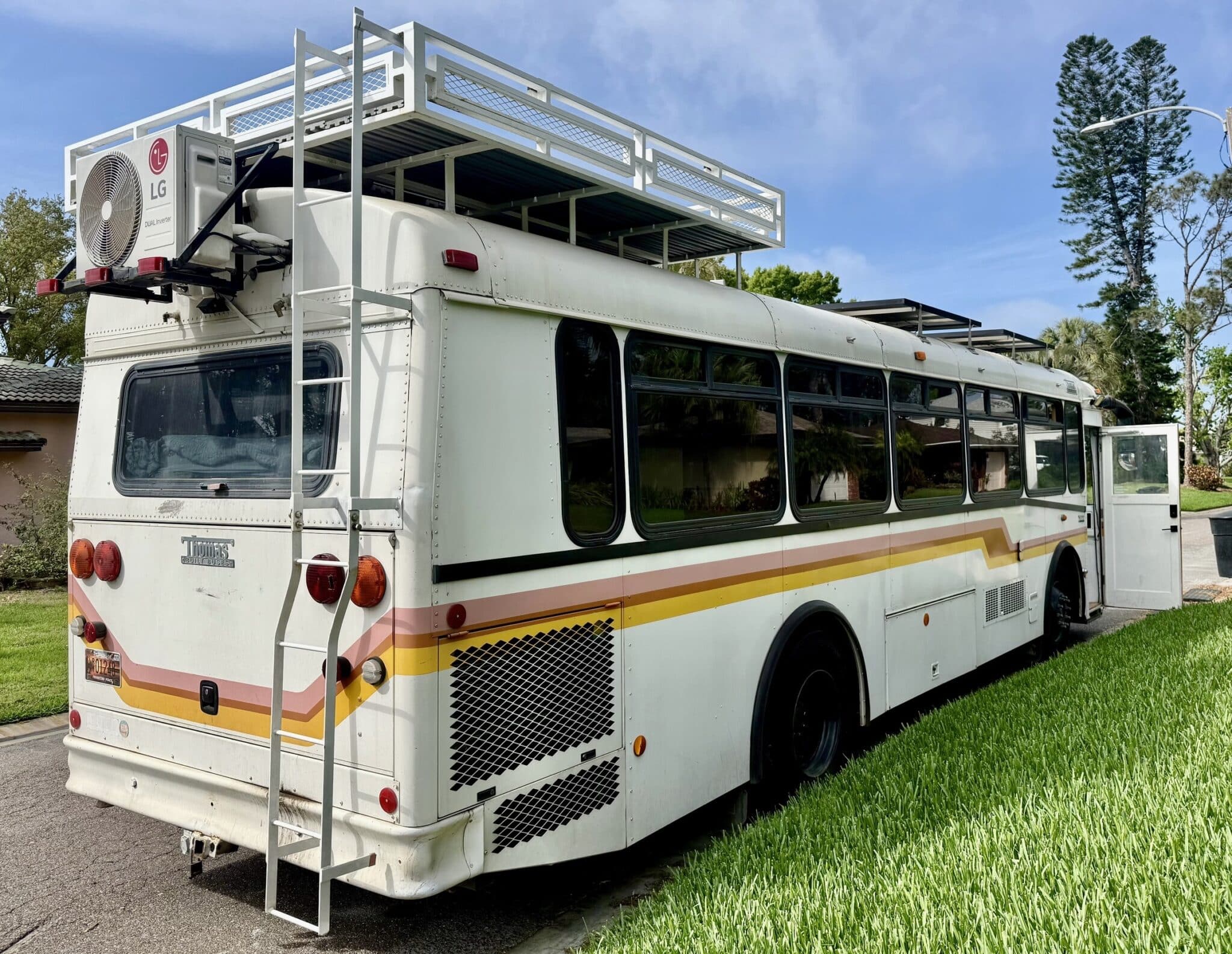
I didn’t plan to write a guide this long about living with animals in a bus. But the more I dug into it, the more I realized how much there is to cover, and how many people are getting tripped up by stuff that’s pretty easy to solve if you know about it ahead of time. Dogs, cats, even some less conventional pets — they all show up in the skoolie world, and the people who plan for it tend to love it. The ones who wing it tend to have a bad time. (See our guide on How Do You Get a Mailing Address Living in a Bus? for more on this.)
Living full-time in a converted bus with pets is absolutely doable, but it touches every part of your build and your daily routine. You need to think about temperature management (this is life or death, not comfort), floor plans that work for animals, securing pets while the bus is moving, vet care across state lines, pet-friendly places to park, exercise routines, food storage, cleaning systems, and breed-specific considerations. This guide covers all of it — every question I’ve been asked, every problem I’ve seen people run into, and every solution that actually works in practice.
“How do your dogs handle living in a bus?”
This is probably the most common question I get, and the answer is genuinely surprising to most people. Dogs, as a general rule, handle bus life really well. Better than you’d expect. Better than most humans handle it, honestly.
Here’s why. Dogs don’t care about square footage. They care about being near you. A dog in a 2,000 square foot house where the owner works 10 hours a day is lonelier than a dog in a 250 square foot bus where the owner is right there all day. I talked to a woman at a bus meetup in Arizona who had a 90-pound German shepherd in a short bus. She said the dog was calmer, more relaxed, and better behaved on the road than he’d ever been at home. Her theory was that the constant stimulation of new places, new smells, new environments — it tired him out mentally in a way that a backyard never could.
Now that doesn’t mean every dog adjusts instantly. There’s usually a transition period, especially for adult dogs who’ve spent their whole lives in a house. The first week or two can be rough. Some dogs pace. Some whine. Some won’t eat. I heard from one guy who said his pit bull mix refused to step onto the bus for the first three days and had to be physically carried inside. By week two she was sleeping on the couch like she owned the place.
Puppies and younger dogs tend to adapt faster because they don’t have as much to unlearn. If you’re thinking about getting a dog specifically for bus life, starting young is easier. But older dogs can and do adjust. It just takes patience and routine.
The key thing I kept hearing from people who’ve done this for years is that dogs thrive on routine, and bus life actually makes routine easier in some ways. Same walk time every morning. Same feeding schedule. Same person around all day. The bus moves, the scenery changes, but the dog’s daily structure stays the same. That’s what matters to them. (See our guide on 11 Ways to Make Money While Living in a Bus for more on this.)
Cats are a different story, and I’ll get into that more below, but the short version is: some cats adapt beautifully and some never stop being annoyed about it. It’s more individual with cats than it is with dogs.
Dogs vs Cats vs Other Pets in Bus Life
I wanted to break this down because people always ask “which pet is best for bus life?” and the answer depends on your setup and your lifestyle way more than it depends on the animal.
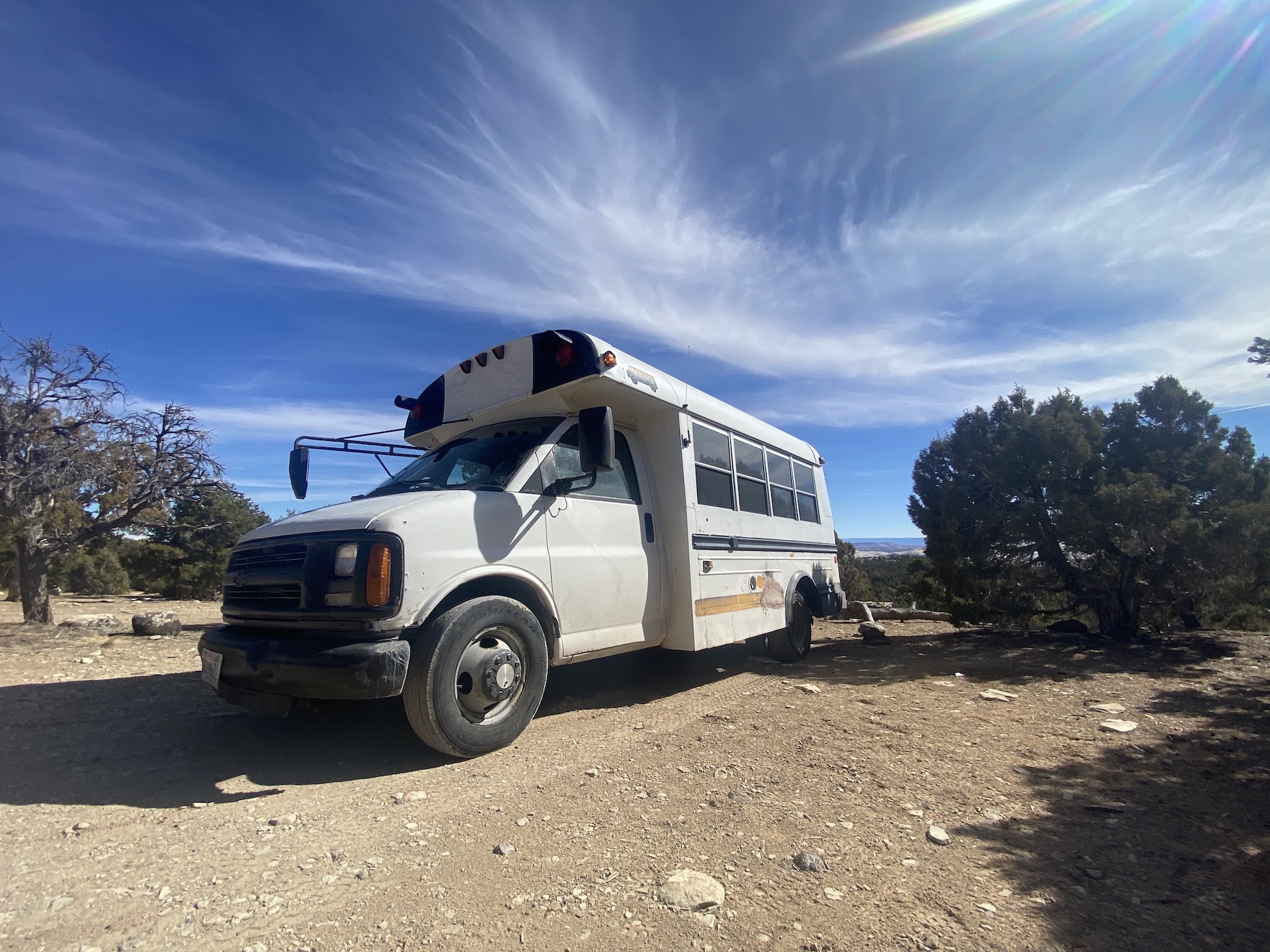
Dogs in a bus
Dogs are the most common pet in the skoolie community by a huge margin. They need the most work, but the payoff is arguably the biggest. A dog gets you outside. A dog gives you a reason to explore trails and parks and beaches you wouldn’t have found otherwise. A dog makes solo bus life feel less lonely, which multiple people told me was actually the main reason they got one.
The downsides are real though. Dogs limit where you can go. Some campgrounds won’t take them. National park trails usually ban them. You can’t leave them in a hot bus. They track in mud and hair and smell. They need exercise every single day regardless of weather or how tired you are. If you’re the kind of person who wants maximum flexibility with zero obligations, a dog complicates that.
Cats in a bus
Cats take up less space, don’t need walks, don’t bark at people walking past the bus at midnight, and are generally lower maintenance on the road. A lot of bus lifers with cats tell me they’re the perfect bus pet for those reasons.
The challenges are different though. Cats need a litter box, which in 200 square feet is going to make its presence known no matter what you do. Cats can also be escape artists — one open door or window and they’re gone. In an unfamiliar area, a lost cat is a nightmare scenario. I talked to a couple in Oregon who lost their cat at a rest stop in Nevada. Took them four days of searching before the cat turned up under a dumpster. They now have a GPS tracker on the cat’s collar at all times. $30 device. Worth every penny.
The motion sickness thing is bigger with cats too. Dogs usually get used to driving within a few weeks. Some cats never fully adjust and will yowl for hours on travel days. Not all of them, but enough that you should be prepared for it.
Other pets
I’ve seen rabbits, guinea pigs, birds, reptiles, and even a ferret in bus builds. Small caged or enclosed animals can actually work well because their space requirements are predictable. A bearded dragon in a terrarium doesn’t care that the bus is moving. A rabbit in a properly secured hutch is content as long as it gets out for floor time when you’re parked.
Birds are tricky because they’re sensitive to fumes and temperature changes. The Teflon off-gassing issue from nonstick cookware is a real concern — it can kill a bird in minutes. If you have a bird in the bus, you need to be very deliberate about what cookware and cleaning products you use.
Fish are basically a non-starter. Sloshing tanks, temperature fluctuation, no way to maintain water quality on the road. I saw one person try it with a small betta tank and it was a constant headache.
Space Considerations and Pet-Friendly Floor Plans
This is where planning during the build phase pays off massively. Retrofitting a bus for a pet after the build is done is possible, but it’s way harder than designing for it from the start.
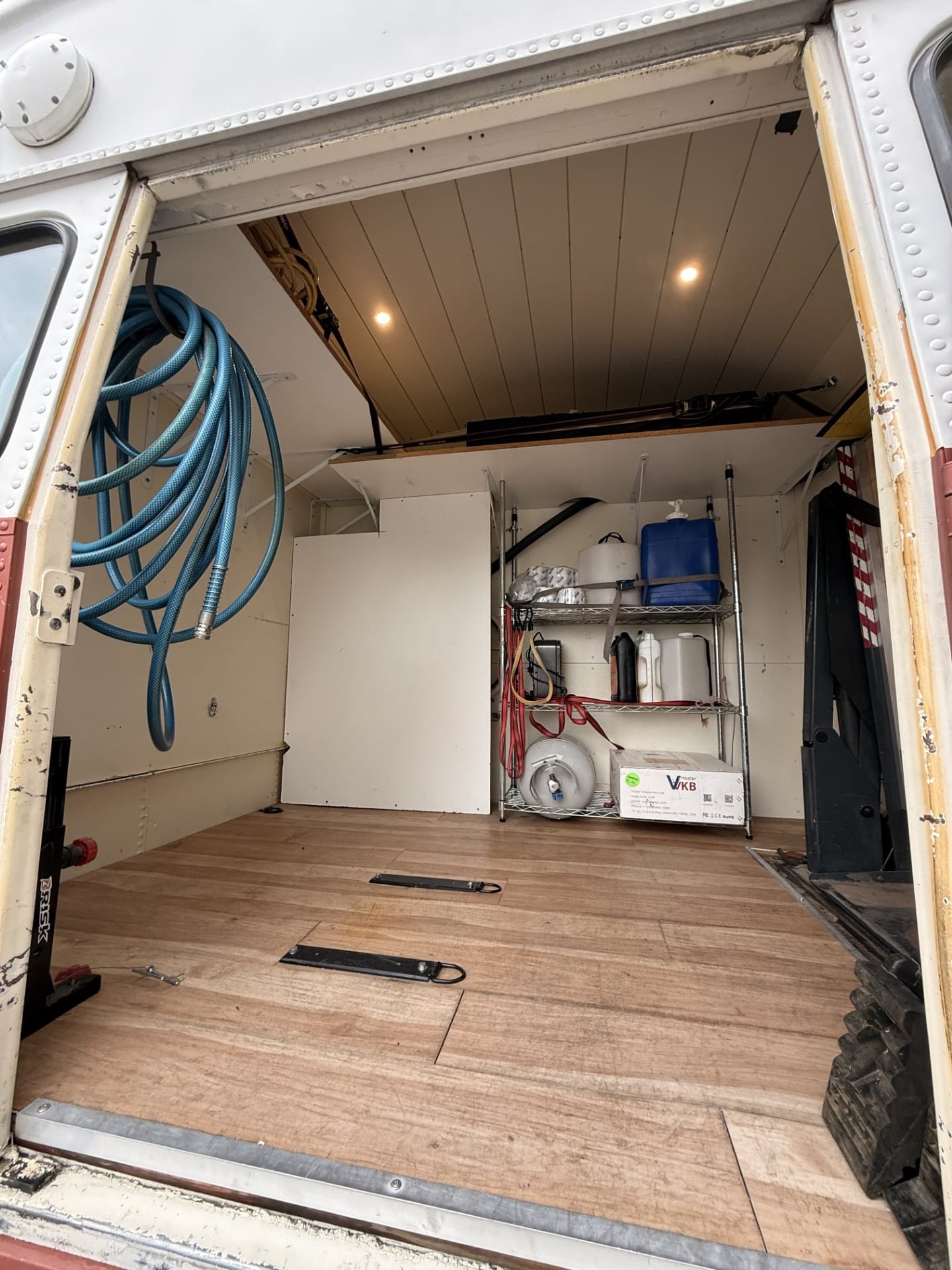
Where does the pet actually go?
In most bus layouts, dogs just exist wherever the humans exist. They sleep on the bed, sit on the couch, lay on the floor. But you need to think about dedicated space too. A dog bed or crate that’s always in the same spot gives the dog a sense of home within the home. I found that people who gave their dog a specific “spot” — under the desk, in a built-in nook, a crate that slides under the bed — had dogs that were calmer and more settled.
For cats, vertical space is everything. Cats need to climb. In a bus, that means shelves, perches, or cat trees. Some builds I’ve seen incorporate cat walkways near the ceiling — basically a shelf that runs the length of the bus up high where the cat can patrol. Sounds excessive but cats use that kind of stuff constantly. One builder told me the cat highway was the cheapest thing he built and the thing that made the biggest difference in the cat’s behavior.
Litter box solutions for cats
This deserves its own section because it’s genuinely one of the hardest logistical problems in bus life with cats. Where do you put a litter box in a tiny space where you can also smell everything?
I’ve seen people solve this in a few different ways:
Under the bed is the most common spot. You build a small access panel or curtain so the cat can get in, and the enclosed space keeps the mess somewhat contained. Ventilation is critical here — cut a small hole behind the box, install a cheap 12V computer fan, and vent it to the outside. Without airflow, the ammonia builds up fast.
In the bathroom is another option if your layout supports it. Some people put the litter box where you’d normally store towels or under the sink. The downside is your bathroom already has moisture issues in a bus, and adding cat litter to the equation makes it worse.
A modified storage compartment works in some builds. I saw one where the builder converted one of the exterior storage bays (the ones accessible from outside the bus) into a cat box compartment with a pet door through the floor. The cat goes down through the bus floor into the bay, does its business, and comes back up. The smell stays outside. Cleaning means opening the bay door from outside. Honestly it was one of the most clever solutions I’ve come across.
Pine pellet litter over clay litter is almost universally recommended by bus lifers with cats. It’s lighter to carry, controls odor better, and doesn’t track as badly. World’s Best Cat Litter (the corn-based one) gets mentioned a lot too. Whatever you do, skip the cheap clay litter. The dust alone will drive you insane in a small space.
Floor plan adjustments
If you’re still in the build phase and you know you’ll have pets, here are the things I’d plan around: (See our guide on 15 Things Nobody Tells You About Living in a School Bus for more on this.)
Easy-to-clean floors. Vinyl plank is the standard and it’s even more important with animals. No carpet, no rugs you can’t wash. Pet accidents on porous flooring are permanent.
A “mud room” entry area. Even if it’s just 18 inches of open floor by the door with a hook for towels and a boot tray. Every dog owner in a bus told me this was essential. Wipe the paws before they hit the main floor. Every time.
Built-in pet food storage. A dedicated bin or cabinet for kibble keeps it fresh and keeps critters out. Some people use airtight containers that slide under a bench seat. Others built pull-out drawers in the kitchen specifically for pet food.
Water bowl placement that won’t spill while driving. Suction cup bowls, weighted bowls, or a bowl built into a recessed section of the counter. A regular bowl on the floor of a moving bus becomes a splash zone fast.
Securing Pets While Driving
This is a safety issue that I think a lot of people don’t take seriously enough. When you hit the brakes hard in a 30,000-pound bus, everything that isn’t secured becomes a projectile. Including your pets.
Dogs while driving
The safest option is a crash-tested crate or kennel that’s strapped down to the floor or a solid attachment point. Sleepypod and Gunner make crates that have actually been crash tested, which is more than you can say for most of them. Yes, they’re expensive. A Gunner kennel runs $400-700 depending on size. But it’s the most protection you can give your dog.
A lot of bus lifers use seat belt harnesses instead, which clip into the seat belt receivers on passenger seats (if you kept any) or to anchor points on the floor. The Kurgo Enhanced Tru-Fit harness is one I kept seeing recommended. It’s not crash tested to the same standard as a crate, but it keeps the dog from flying forward.
What you don’t want is a dog loose in the bus while you’re driving. I know plenty of people who do it. Their dog lays on the couch or the bed while they drive and it’s fine until the day it isn’t. One panic stop and a 60-pound dog goes through the windshield, or hits you in the back of the head, or breaks a leg slamming into the cabinets. I’m not trying to be dramatic but I talked to a guy who had his dog’s hip fractured during an emergency stop because the dog was sleeping loose on the bed. He said it was the worst day of his life and the most avoidable mistake he’d ever made.
Cats while driving
Cats should be in a carrier while the bus is in motion. Period. A loose cat in a moving bus is a recipe for disaster. They can get under the brake pedal. They can freak out and scratch the driver. They can hide in some crevice you didn’t even know existed and you won’t find them for hours.
Get a carrier that’s big enough for the cat to stand up and turn around in, strap it to something solid, and put a familiar blanket inside. Most cats settle down after a few minutes in a carrier. The ones who don’t will let you know about it vocally, but at least they’re safe.
“Where do you walk your dog when you’re parked somewhere?”
So this is context dependent, but here’s what I found from talking to a bunch of people who’ve been doing this for a while.
When you’re boondocking on BLM land or in a national forest, you’ve usually got plenty of space. Open the door and the dog can explore. Most dispersed camping areas allow dogs off-leash as long as they’re under voice control. This is where bus life with a dog really shines — you’re essentially parked in the dog’s dream playground.
When you’re at an RV park or campground, it’s more structured. Most parks have rules about keeping dogs on leashes. Some have designated dog runs or fenced areas, but don’t count on it. A long lead (30-50 feet) staked into the ground gives the dog room to move around the campsite. I’d carry at least two stakes and a long cable for exactly this purpose.
City parking is the hardest. If you’re parked in a Walmart lot or an urban area, you’re walking the dog on sidewalks and hoping there’s a park nearby. Google Maps is your friend here. Search “dog park” wherever you’re headed and know where it is before you arrive. The BarkHappy app is another one I found useful — shows dog-friendly businesses, parks, and trails by location.
One thing that surprised me was how many bus lifers said their dogs actually got more exercise on the road than they ever did at home. When your whole life is outside and every new location has new trails to explore, the dog’s quality of life goes way up. The couple with Australian shepherds I mentioned before said those dogs were in the best shape of their lives after two years of bus travel. Better than when they had a big backyard in Colorado.
“How do you keep pets cool in summer?”
I could write an entire article just on this topic and honestly I probably should. But here’s the comprehensive breakdown.
A bus is a metal box. That’s the fundamental problem. In direct sun on an 85-degree day, the interior of an unventilated bus can reach 130+ degrees within an hour. That’s lethal for any pet. And it happens faster than people think.
Never leave pets in a hot bus without active cooling
I cannot stress this enough, so I’m going to be blunt about it. Do not leave your pet in the bus without air conditioning running if it’s above 75 degrees outside. Not with windows cracked. Not with a fan. Not in the shade. Not for “just 15 minutes.” The math doesn’t work. The temperature rises too fast.
I’ve heard the stories. People who thought their setup was good enough and it wasn’t. I don’t want to dwell on it but it needs to be said clearly: if your electrical system can’t run AC while you’re gone, you take the pet with you or you don’t leave. Those are your two options when it’s hot.
Active cooling solutions
A mini-split AC unit is the gold standard. A 9,000 BTU mini-split can keep a bus comfortable in 100-degree heat and runs on roughly 400-600 watts. With a solid lithium battery bank (400Ah or more) and a good solar array (800+ watts), you can run it for hours without shore power or a generator.
Portable AC units are cheaper upfront — $300-500 for a decent one — but they’re less efficient and they take up floor space. They also need to vent somewhere, which means a window hose or a dedicated vent hole.
Roof vent fans (MaxxAir is the one everyone uses) help move air but they don’t actually cool it. On a mildly warm day they might be enough. On a genuinely hot day they just blow hot air around. Think of them as a supplement to AC, not a replacement.
Monitoring while you’re away
Here’s the tech setup I’d recommend at minimum:
A temperature sensor with phone alerts. Temp Stick and SensorPush both work well. Set an alert for anything above 80 degrees inside the bus. If you get that alert, you head back immediately.
A battery monitor you can check remotely. Victron’s app lets you see your battery state of charge from your phone, so you know if the AC is still running or if the batteries are about to die.
A pet camera. Wyze cameras are $30 and let you check on your pet visually from anywhere. Some people use them to watch for signs of distress. If the dog is panting hard and pacing, something’s wrong.
Winter is easier but not free
Cold is less immediately dangerous than heat for most pets, but a bus in sub-freezing temperatures without a heater running isn’t comfortable for anyone. Most dogs do fine down to about 40-50 degrees inside. Below that, you need a diesel heater or propane heater running. Cats are more cold-sensitive than dogs in my experience — they start looking miserable around 55 degrees.
The good news is heaters draw way less power than AC. A diesel heater like the Webasto or a Chinese knock-off runs on about 10-20 watts. Your batteries can handle that all day.
“Do campgrounds and RV parks allow pets?”
The short answer is most do, but with caveats. And those caveats can ruin your day if you don’t know about them ahead of time.
RV parks and private campgrounds
Most RV parks allow dogs. But “allow” comes with asterisks. Here’s what I found when I called around and talked to people:
Breed restrictions are common. Pit bulls, Rottweilers, German shepherds, Dobermans, and other breeds on the “aggressive” list get banned at a lot of parks. It doesn’t matter how sweet your dog is. If the park has a policy, they’ll enforce it.
Weight limits show up more than you’d expect. Some parks cap it at 40 or 50 pounds per dog. That rules out most of the popular bus life breeds.
Pet fees range from $3-10 per night per pet. Over a month, that adds up.
Maximum number of pets is usually two. If you’ve got three dogs, finding parks that’ll take all of them gets harder.
Leash rules are universal. Your dog must be on a leash outside your campsite, period.
Noise complaints will get you kicked out. If your dog barks all day while you’re gone, you won’t last long in most parks. This is actually one of the biggest practical concerns for bus lifers with dogs, because a lot of dogs develop separation anxiety in a small space and bark when left alone.
Public land and dispersed camping
BLM land and national forests are generally the most pet-friendly option. Most dispersed camping areas allow dogs, often off-leash. There are exceptions — some areas have leash requirements during certain seasons for wildlife protection — but as a rule, this is where dogs have the most freedom.
National parks are restrictive. Most trails prohibit dogs entirely. Dogs are usually only allowed in developed campgrounds, on paved roads, and in parking areas. That’s basically useless for a dog that needs to run. I’ve talked to people who planned entire routes around national parks and then realized their dog couldn’t go anywhere. Plan ahead and know the rules before you drive 300 miles to a park that won’t let your dog on any trail.
State parks vary wildly. Some are great for dogs, some have severe restrictions. Always call ahead or check the park website. AllTrails has a “dog-friendly” filter that’s pretty reliable.
Apps and resources for finding pet-friendly spots
I found these genuinely useful when I was researching:
BringFido has the most comprehensive database of pet-friendly hotels, campgrounds, restaurants, and activities. The reviews are helpful too.
Campendium lets you filter for pet-friendly campgrounds and has real user reviews that often mention pet policies specifically.
iOverlander is free and user-updated. People note whether spots are pet-friendly in the comments.
Hipcamp and Harvest Hosts are membership programs ($80-100/year) where you stay on private property. Most hosts are pet-friendly because they’re farms, ranches, and rural properties. These are some of the best options for dogs that need room to run.
Exercise and Outdoor Time
I touched on this earlier, but I want to go deeper because exercise is probably the single biggest factor in whether bus life works with a dog or turns into a nightmare.

A bored, under-exercised dog in a small space becomes destructive, anxious, and loud. They chew things. They bark. They pace. They make your life miserable and theirs too. A tired dog in a small space is a happy dog who sleeps all day and doesn’t care that the bus is 250 square feet.
Building exercise into the routine
The people who do this best treat dog exercise like brushing their teeth — it just happens every day, no exceptions. Twenty to thirty minutes of active exercise in the morning before anything else. Fetch, a trail walk, swimming, whatever gets the energy out. Then a calmer walk in the evening.
For high-energy breeds — huskies, shepherds, border collies, labs under age five — you might need an hour or more of hard exercise per day. If that sounds like a lot, it is. And it’s why breed choice matters so much, which I’ll cover below.
The long lead setup
Almost every dog owner in a bus I’ve talked to carries a 30-50 foot lead and some kind of ground stake or tie-out. When you’re parked, you stake the lead near the bus, clip the dog on, and they’ve got a big circle to explore. It’s not a fenced yard but it works. You can sit outside with your coffee and the dog can sniff around and lay in the grass. This is the daily reality for most bus dogs and it’s honestly a pretty good life.
For cats
Cats don’t need walks but they do need stimulation. Window perches are huge — a cat that can watch birds and squirrels from a window stays entertained for hours. Some bus lifers harness-train their cats, which takes patience but opens up a lot of possibilities. Others build small screened enclosures (catios) that attach to the bus door or a window. The cat gets fresh air and outdoor stimulation without the risk of running off.
Interactive toys, puzzle feeders, and regular play sessions matter more in a small space. A bored cat in a bus will destroy things. A stimulated cat in a bus will nap contentedly for most of the day.
Vet Care on the Road
Finding vets as you travel
This is easier than it used to be, but it still requires planning. You can’t just show up at a vet clinic without records and expect to be seen same-day. Well, you can in an emergency, but for routine stuff, you need a system.
Banfield Pet Hospitals (inside PetSmart locations) and VCA Animal Hospitals are nationwide chains that can pull up your records at any location. If you establish care at one, your records follow you. This is probably the most convenient option for routine stuff.
For emergencies, the ASPCA has a poison control hotline (888-426-4435, $75 per case) and an emergency vet locator. Keep these in your phone, not just bookmarked but actually saved in your contacts. When your dog eats something at 2 AM, you don’t want to be fumbling with Google.
Telehealth for pets has gotten surprisingly good. Vetster and PetCoach do video consultations with licensed vets for $50-75. Great for “should I be worried about this?” questions when you’re in the middle of nowhere. Won’t help if your dog needs stitches, but it can save you a two-hour drive to the nearest clinic for something that turns out to be minor.
Keeping records organized
I talked to a couple who’d been on the road with three dogs for four years. Their biggest tip was keeping a physical binder of pet records in the bus. Vaccination records, rabies certificates, recent bloodwork, medication lists. Some campgrounds want to see vaccination records. Some states require proof of rabies vaccination. Boarding facilities definitely need it. If you’re somewhere with bad cell service and can’t pull up records digitally, the binder saves you.
Keep digital copies too. Take photos of everything and store them in Google Drive or Dropbox so you can access them from any device.
State-to-state vaccine requirements
This is one of those things I didn’t even know was a thing until I started researching bus life. Different states have different requirements for pets crossing their borders. It’s mainly about rabies, but some states require a Certificate of Veterinary Inspection (CVI, also called a health certificate) for pets entering the state.
Hawaii is the extreme example — they have a 120-day quarantine for pets or you need to complete a strict pre-arrival testing and vaccination protocol. Most people just skip Hawaii.
For the continental US, the general rule is: keep your pet’s rabies vaccine current and carry proof. Some states require the vaccine to be administered by a licensed vet (not self-administered from a farm store). A few states require a health certificate dated within 30 days or less for pets entering the state.
I found the USDA APHIS website to be the most reliable source for current state-by-state requirements. The rules change, so don’t rely on a blog post from 2019. Check before you cross a state line with your pet, especially if you’re heading to states like Hawaii, California, or any state with active wildlife disease concerns.
Practically speaking, most people never get asked for any of this. You’re not going through checkpoints between states with your dog. But if you get pulled over, or if you need emergency vet care in a new state, having current vaccinations and documentation makes everything smoother.
Pet Insurance
I went back and forth on whether this deserved its own section, but after looking at the numbers, yeah, it does.
A dog emergency — bloat, a broken bone, eating something toxic, a snake bite — can run $2,000-8,000 or more depending on the situation. On the road, you might not have the option of waiting or shopping around for a cheaper vet. You go to whoever is closest and you pay what they charge.
Pet insurance runs $30-60 per month for a dog and $15-30 for a cat, depending on breed, age, and the plan you choose. For a full-time traveler, I’d call it close to essential. You don’t have a regular vet who might give you a payment plan. You don’t have family nearby who can help. You’re in some random town with a sick dog and you need to pay upfront.
Companies that consistently get recommended in the bus life community:
Healthy Paws covers you nationwide, has no caps on payouts, and reimburses at 70-90% depending on the plan. Premiums are reasonable for most breeds.
Embrace covers accident and illness, offers a wellness plan add-on, and has good reviews for claims processing speed.
Lemonade Pet is newer but cheaper, app-based, and popular with younger bus lifers.
The key thing is to get insurance before your pet has any pre-existing conditions, because nothing covers those. Sign up while your pet is young and healthy. If you wait until something goes wrong, it’s too late for that condition.
Food Storage
Seems like a minor detail until you’re dealing with it daily. Kibble bags are big, heavy, and attract pests if not stored properly. In a bus, you don’t have a pantry to shove a 30-pound bag in the corner.

Airtight containers are non-negotiable. Gamma2 Vittles Vault and IRIS containers are the ones I see most in bus builds. They keep food fresh, keep moisture out, and keep ants and mice from getting in. Mice are a real concern when you’re parked in rural areas, and an open bag of dog food is basically a neon welcome sign.
Most bus lifers buy smaller bags more frequently rather than stocking up. A 15-pound bag every two weeks instead of a 40-pound bag once a month. Takes up less space and stays fresher.
For raw feeders — and there are some in the bus community — you need serious fridge or freezer space, which most buses don’t have. A dedicated chest freezer is an option if you’ve got the power and the room, but it’s a big commitment. Most raw feeders I’ve talked to switched to freeze-dried raw (Stella & Chewy’s is the popular one) while on the road because it doesn’t need refrigeration and weighs almost nothing.
Water bowls while driving are a spill hazard. Weighted bowls or bowls that mount to a surface work best. Some people only put water down when the bus is parked and pick it up before they drive. Not ideal for long travel days, so keep some water available in a spill-proof format — a lick bottle mounted to the wall works for some dogs.
Cleaning and Hair Management
I’m going to be straight with you. If you have a dog that sheds and you live in a bus, you are going to vacuum every day. Possibly twice a day. There is no way around this. A golden retriever in 250 square feet produces visible tumbleweeds of hair within hours. (See our guide on Can You Legally Live in a Converted School Bus? for more on this.)
The daily routine
A cordless stick vacuum is the most important tool in a pet-owning bus. More important than your drill. More important than your inverter. I’m barely exaggerating. Dyson makes the best ones but they’re expensive ($300-600). Tineco and Shark make solid budget alternatives around $150-200. Get one with good suction and a motorized brush head specifically designed for pet hair.
A lint roller by every seating area. Seat covers on anything fabric. A doormat inside and outside the bus door. Enzyme cleaner (Nature’s Miracle is the standard) for accidents. These are the basics.
Flooring matters
Vinyl plank flooring is the right choice for a bus with pets. It’s waterproof, doesn’t hold odors, and cleans up easily. I’ve talked to people who had other flooring and wished they’d gone with vinyl.
Carpet is a disaster with pets. If you have carpet in your bus and you’re bringing an animal, rip it out. Dog pee in carpet in a small space will make the bus unlivable within weeks. Cat litter tracked across carpet never comes fully clean. Just don’t do it.
Odor control
Wet dog smell in 250 square feet is… an experience. Here’s what actually works:
Good ventilation. MaxxAir fans running whenever the weather allows. Open windows when you can. Stale air plus pet smell equals misery.
Enzyme cleaners for any organic mess. Regular cleaners mask the smell. Enzyme cleaners break down the proteins that cause the smell. Different thing entirely.
Baking soda on fabric surfaces. Sprinkle it on, let it sit for 20 minutes, vacuum it up. Old trick but it works.
Wash pet bedding weekly at minimum. If you’re doing laundromat runs anyway, throw the dog bed cover in every time.
Grooming your pet regularly. Brushing outside the bus keeps loose hair from ending up inside. Baths as needed, though not too frequently or you’ll dry out their skin. Every 4-6 weeks for most dogs unless they roll in something awful.
Breed Considerations for Bus Life
Not every dog is a great bus dog, and I wish more people thought about this before committing. The breed you choose, or the breed you already have, significantly affects how well bus life goes.
Breeds that tend to do well
Medium energy dogs that are adaptable and people-focused tend to thrive. Think:
Labs and goldens (with enough exercise). They’re velcro dogs who just want to be near you. Downsides are shedding and size, but their temperament is ideal.
Mutts and mixed breeds. Honestly some of the best bus dogs I’ve seen have been shelter dogs of indeterminate breed. They tend to be adaptable and grateful.
Smaller breeds like French bulldogs, pugs, and cavalier King Charles spaniels. Low exercise needs, small footprint, content to lay on the couch. The brachycephalic (flat-faced) breeds do have heat sensitivity issues though, which is extra concerning in a bus.
Pit bull mixes. Great temperament for bus life — calm, people-focused, moderate energy. The problem isn’t the dog, it’s the breed restrictions at campgrounds and RV parks.
Breeds that struggle
High-energy working breeds without a job to do. Border collies, Australian cattle dogs, Belgian Malinois. These dogs need a LOT of exercise and mental stimulation. If you can provide two hours a day of intense activity, they can work. Most people can’t sustain that.
Giant breeds. Great Danes, Saint Bernards, Newfoundlands. They physically don’t fit well in a bus. A 150-pound dog takes up a shocking amount of floor space.
Breeds with heavy grooming requirements. Standard poodles, Old English sheepdogs, Bernese mountain dogs. Without regular professional grooming, which is hard to maintain on the road, these breeds become matted messes.
Anxious or noise-sensitive breeds. Some dogs just don’t handle the road noise, the vibration, the constant change of environment. If your dog is already anxious in a house, bus life probably won’t improve that.
Cat breeds
Most domestic cats adapt to bus life regardless of breed. But some are better suited:
Ragdolls and Ragamuffins are calm, adaptable, and don’t mind being handled or carried.
American Shorthairs and Domestic Shorthairs (basically mutts) are hardy, adaptable, and low maintenance.
Bengals and Abyssinians are high-energy and need a lot of stimulation. They can work in a bus but they need enrichment or they’ll destroy your upholstery.
Siamese cats are vocal. In a bus, that means everyone in the campground knows your cat is unhappy. Something to consider.
Pet Insurance for Travel (Expanded)
I covered the basics of pet insurance earlier, but there are travel-specific considerations worth noting.
Make sure your policy covers you in every state. Most do, but read the fine print. Some policies have network restrictions that don’t apply well to someone who changes states every month.
Look at the reimbursement process. Some companies require you to submit claims manually with receipts. Others have a vet direct-pay option. On the road, the direct-pay option is way more convenient because you don’t have to float thousands of dollars waiting for reimbursement.
Wellness plans (annual checkups, vaccines, flea meds) are usually add-ons. Whether they’re worth it depends on how much you spend on routine care. For a young, healthy dog, they often break even. For an older dog with regular medication needs, they can save money.
The Emotional Side of Bus Life with Pets
I wanted to end on something that doesn’t get talked about much in the practical guides. Living in a bus with a pet changes the experience in ways that are hard to quantify. (See our guide on How Do You Get Internet and WiFi Living in a Bus? for more on this.)

Solo bus lifers consistently told me their pet was the thing that made the lifestyle sustainable. When you’re parked alone on BLM land in the middle of nowhere and it’s dark and quiet and you haven’t talked to another human in three days, having a dog curled up next to you changes everything. It’s companionship. It’s security — a dog that barks at strangers is a better alarm system than anything you can buy. It’s a reason to get up and go outside when you might otherwise just sit in the bus all day.
For families, pets give kids a sense of normalcy and routine that’s grounding when everything else is changing. New state, new campground, new scenery every week. But the dog is the same. The cat is the same. There’s comfort in that.
I talked to a retired couple in New Mexico who’d been traveling in their bus for three years with two small dogs. The wife said something that stuck with me. She said, “We’ve seen 40 states and met hundreds of people, but the dogs are the reason we keep going. They make every place feel like home.”
The flip side is that pets make bus life logistically harder. Every decision runs through the filter of “what about the dog?” Where to park, how long to stay, what time to leave, whether you can go into that restaurant. It’s a constraint. But for most people I’ve talked to, it’s a constraint they wouldn’t trade.
If you’re on the fence about bringing your pet into bus life, I’d say this. If you’re willing to build your systems around them — the cooling, the exercise, the cleaning, the vet care — it works. It works really well, actually. The people who struggle are the ones who treat the pet as an afterthought and then get frustrated when reality hits. Plan for it, budget for it, build for it, and your pet will probably love this life even more than you do.
That’s the honest truth from everything I’ve dug into, everyone I’ve talked to, and every bus I’ve walked through. Pets in a skoolie aren’t just possible. For a lot of people, they’re the whole point.