

Living in a bus with two people is cozy. Living in a bus with five or more is a whole different game, and it’s the thing I get asked about more than almost anything else. (See our guide on How Do You Get a Mailing Address Living in a Bus? for more on this.)
Big families can and do live full-time in converted buses, but it requires a larger bus, a smarter floor plan, and a willingness to rethink how your family uses space. The families who make this work long-term aren’t the ones with the prettiest builds — they’re the ones who planned for growth, built modular sleeping solutions, and accepted that privacy would take effort instead of square footage. This article covers the real decisions big families face, from bus size to bunk layouts to the stuff that’s genuinely hard.
Choosing the Right Bus Size for a Big Family
I talked to a dad at a bus meetup outside Knoxville who had four kids crammed into a 30-foot bus. He was honest about it. Said the first three months were fine, kids thought it was an adventure, everyone was on their best behavior. By month five the older two were at each other’s throats and he was doing his work sitting in the driver’s seat with the curtain pulled because there was literally nowhere else to go. They upgraded to a 40-footer, and he told me that single change saved the whole thing.
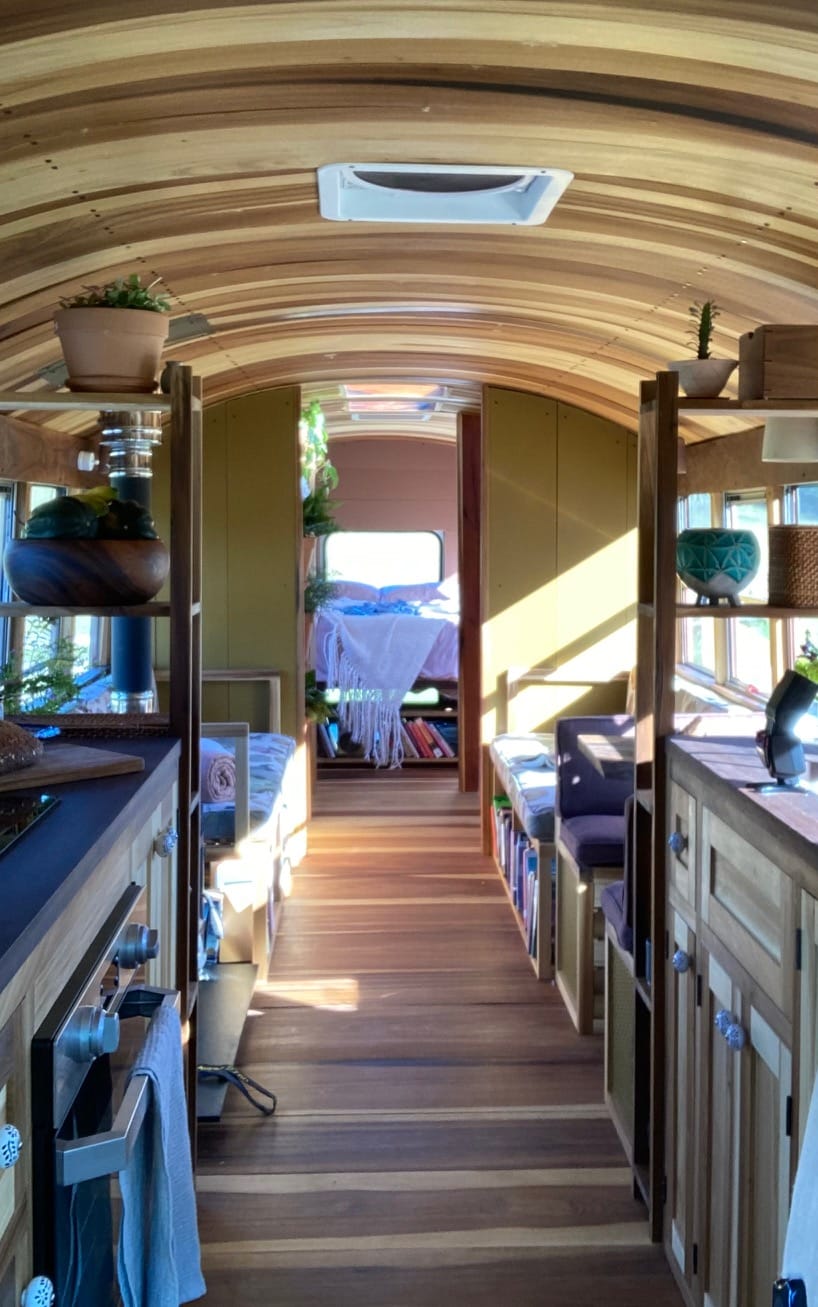
So here’s where the math matters. A full-size school bus — the classic flat-nose 40-footer — gives you roughly 245-280 square feet of interior space. A 35-footer gives you about 200-220. And a short bus gets you maybe 80-120.
For a family of five, you can technically make a 35-footer work. But every family I’ve talked to who did it said the same thing — they wished they’d gone bigger. The extra five feet between a 35 and a 40-footer isn’t just five feet of floor space, it’s the difference between having a workable bunk area and having kids sleeping in what amounts to a shelf. (See our guide on 11 Ways to Make Money While Living in a Bus for more on this.)
For six or more? You really need a full-size 40-foot bus. Some families look at transit buses or coach buses, which can be wider and sometimes longer. But the standard 40-foot school bus is the starting point for big family builds, and most families with five-plus people end up there.
One thing that doesn’t get talked about enough is weight. More people means more stuff, more water, more food, heavier build overall. You’ve gotta keep an eye on your GVWR and make sure your bus can handle the load. Check out our guide on how to choose the right school bus if you’re still in the buying phase.
Floor Plans That Work for 5+ People
When I was researching floor plans for bigger families, I noticed something interesting. The builds that work best for five-plus people almost always follow one of two basic templates, and pretty much everything else is a variation on those.
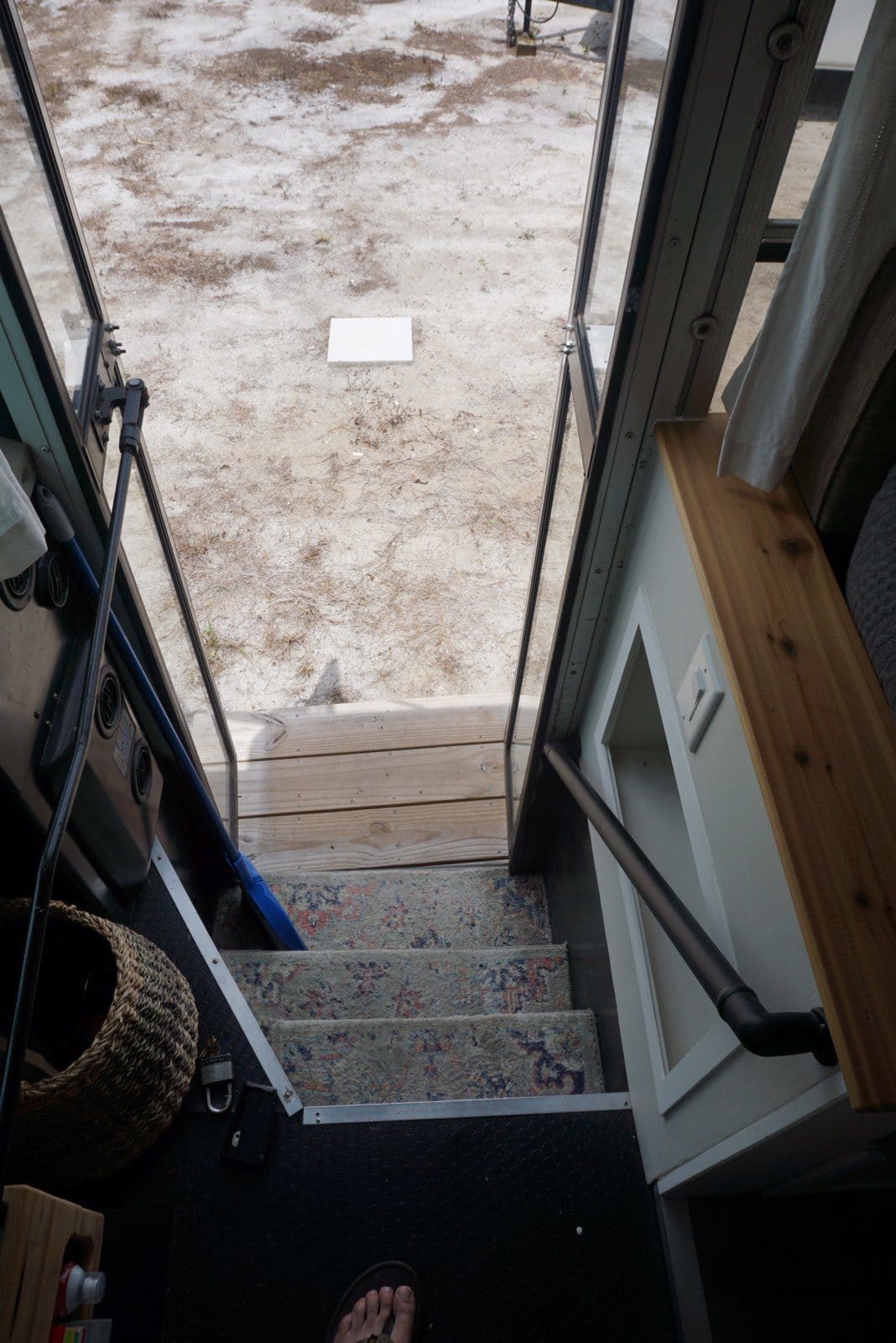
The first is what I’d call the train layout. Master bedroom in the very back, separated by a real door or at least a heavy curtain. Then the bunk zone in the middle section. Then bathroom. Then kitchen and living area up front. Everything flows in a line, back to front, and the zones are clearly defined. This is the most common layout I’ve come across for family builds and there’s a reason for that — it puts the parents as far from the noise as possible and groups the kids together where they can be monitored. (See our guide on How Do You Get Internet and WiFi Living in a Bus? for more on this.)
The second layout flips the kitchen and bunks. Kitchen goes toward the middle, bunks go behind the cab area, master bedroom stays in the rear. The advantage is that when the kids are sleeping up front, you and your partner have the entire back half — kitchen, living area, bedroom. The downside is you’re walking past sleeping kids every time you need the bathroom at night.
“Can you inform how a family of 5 can do a realistic build?” This keeps coming up, and realistic is the key word. Not Instagram-perfect, not $80,000 in custom cabinetry.
A realistic five-person layout on a 40-footer: keep 2-3 rows of original seats behind the driver for road travel (every person needs a proper seatbelt). That leaves roughly 25-28 feet of buildable space. Master bedroom takes the rear 6-7 feet. Bunk area takes 6-8 feet. Bathroom gets 3-4 feet. The remaining 10-12 feet is your kitchen, dining, and living space. Tight, but it works.
For a more detailed look at different layouts, we’ve got a whole article on skoolie floor plan ideas that breaks down layouts by bus size.
Sleeping Arrangements (Bunks, Lofts, and Creative Solutions)
This is where it gets both fun and complicated. Where does everyone sleep? What happens when the kids grow? Is anyone actually comfortable?

Most families with three or more kids go with some version of bunk beds. The most straightforward approach is two or three bunks stacked vertically along one wall. Each bunk is 28-32 inches wide and 72-75 inches long, basically a narrow twin. Stack two and you’re using about 4 feet of wall space. Stack three and you need at least 7 feet of ceiling height, which means a roof raise on most buses or you’re giving kids about 20 inches of headroom per bunk. Doable for small kids. Not great for a 12-year-old.
The loft approach is what I keep seeing in builds that last longer. Instead of stacking bunks against a wall, some families build a loft platform that spans the full bus width, maybe 4-5 feet deep, raised about 4 feet off the floor. Two or three kids share the loft, and it feels more like a treehouse than a bunk. Underneath is either storage, a play area, or a fold-out couch.
“What is your plan for when the littles need larger beds?” and “Looks beautiful but what will you do when the youngest needs more sleeping space?” — these come up constantly, and they’re not wrong to worry about it. Kids grow. That’s literally the one thing you can count on.
The families who handle this best build with bolts, not screws. Sounds like a small detail but it changes everything. Bolted bunk frames can be unbolted, reconfigured, extended, or removed without destroying anything. Screws strip out, wood splits. Bolts come apart clean and go back together clean.
Some families start with adult twin dimensions from day one — 38 inches wide by 75 inches long. The little kids have tons of room, and the bunks still work when they’re teenagers. You fit fewer bunks this way, but each one has a longer lifespan. Other families accept they’ll do a mini renovation every couple of years as kids hit growth spurts. It’s work, but it’s a weekend of work, not a month.
One more option worth mentioning — the convertible dinette as a swing bed. During the day it’s the school table and eating area. At night the table drops down and becomes a sleeping surface for one kid. Not ideal, but for the family that needs one more spot and doesn’t have another inch of wall space, it works.
Privacy and Personal Space (It’s Possible, Barely)
“What do yall do for privacy?” This question shows up on every single bus life video with a family, and for good reason. Five people in 250 square feet is not a situation where privacy just happens naturally. You have to manufacture it.
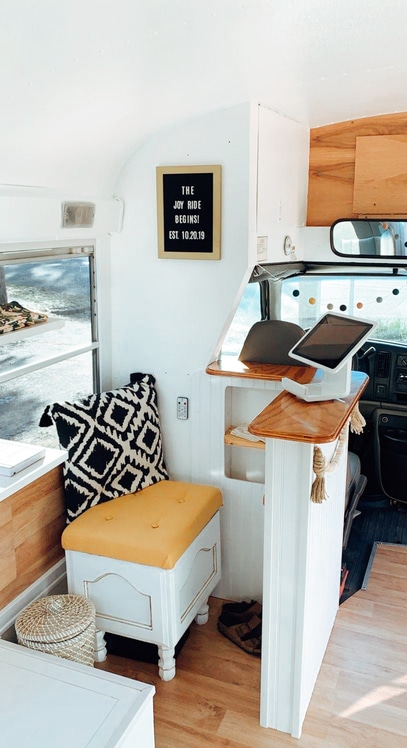
So here’s what I found. The number one tool is curtains, but not the kind you’re picturing. Heavy blackout curtains on ceiling-mounted hospital-style tracks. These slide on a rail and create real visual barriers between zones. Most family builds have at least three curtain zones — master bedroom, bunk area, and main living space. Some families give each bunk its own curtain, so when a kid pulls theirs closed they’ve got a little cave that’s theirs.
For the adults, the honest truth is that privacy is mostly a scheduling thing. I talked to one mom at a campground in Arizona who had three kids under ten, and she said the most important thing they did was establish a firm bedtime. Kids in bed by 8:30, no exceptions. From 8:30 on, the front of the bus belongs to the adults. That’s when they talk, watch something on the laptop, or just sit in quiet for the first time all day. She said that two hours of adult-only time every night was what made it sustainable.
“I wonder how they will adjust to the kids growing older and ultimately needing more space of their own?” Yeah. This is the question that doesn’t have a neat answer, and I’m not going to pretend it does. A 7-year-old doesn’t care about privacy the way a 13-year-old does. When kids hit that age where they need to close a door and be alone with their thoughts, a curtained bunk might not cut it anymore.
Some families build a partition wall with a pocket door for older kids — not a full room, but a sectioned-off area that gives the teenager a sense of their own space. Others bought a small cargo trailer that the oldest kid basically claimed as their own. And some families accept that bus life has a season, and when the kids need real privacy, it might be time for the next chapter.
The families who stress about this the least are the ones who spend more time outside the bus than in it. When you’re at a campground with trails or parked near a beach, the bus is just where you sleep and eat. The living happens outside.
Storage for a Family’s Worth of Stuff
Five people generate a lot of stuff. Clothes, shoes, school materials, toys, food, toiletries, outdoor gear, tools. And in a bus, there is no closet down the hall, no garage to throw things in, no attic to forget about. (See our guide on 15 Things Nobody Tells You About Living in a School Bus for more on this.)

When I started looking into how big families handle storage, the consistent thing was that successful families ruthlessly edit what they own. One family had a rule: every item in the bus had to have a home. If something didn’t have a specific place where it lived, it didn’t stay. They’d been on the road three years with four kids and the bus wasn’t a disaster zone, so clearly it worked.
Here’s where the actual storage goes. Under the bunks is prime real estate — each platform should have at least 10-12 inches of clearance underneath for bins or drawers. That’s where each kid’s clothes and personal items live. Under the master bed platform is the biggest storage area in the bus, and most families raise it 24-30 inches to create a full garage underneath. (See our guide on Can You Legally Live in a Converted School Bus? for more on this.)
Overhead cabinets are standard, but more cabinets means more weight up high, which affects your center of gravity and how the bus handles in crosswinds. Keep the overhead cabinets for light stuff — towels, first aid kit, spices, paper goods. Heavy items go down low, always.
Some families add a cargo box on the rear bumper for another 10-20 cubic feet that doesn’t eat into living space. And a few families build a “mud room” area right inside the door — hooks, a shoe tray, shelf for jackets. When you’ve got five people tracking in dirt and rain, that landing zone saves the rest of the bus.
Kitchen storage is its own challenge. Feeding five people means more food, and your pantry is probably a couple of narrow cabinets. Most big families batch-shop every 7-10 days and plan meals tightly. Impulse buys at the grocery store become a luxury you literally don’t have room for.
The Honest Truth About What’s Hard
Alright, so I’ve spent most of this article talking about solutions. Here’s where I want to be straight about the stuff that doesn’t have a clean fix, because I think it matters and I don’t think enough people talk about it before they commit.

The noise is relentless. Five people in a metal tube means somebody is always making sound. A toddler screaming, two kids arguing over a tablet, someone on a work call, someone cooking. There’s no room in a bus where you can go and not hear everything. Noise-canceling headphones become essential gear. Every family I talked to mentioned headphones within the first five minutes. They’re not a luxury, they’re sanity equipment.
The bathroom situation is harder with five people than anyone admits upfront. Composting toilet? You’re emptying the urine bottle every day or every other day. Shower time has to be rationed — military showers, two minutes max, and you’re running through 40-60 gallons of fresh water per day between cooking, cleaning, drinking, and washing. That means filling your tank every 1-2 days without a hookup. Manageable, but constant.
Sick days are brutal. When one kid gets a stomach bug in 250 square feet, everyone’s getting it. There’s no isolating someone in their bedroom and keeping the rest of the family separate. You’re all in it together, for better or worse, and in this case it’s definitely worse.
And then there’s the relationship strain nobody puts on Instagram. Being with the same people 24 hours a day tests even strong family dynamics. Kids fight, parents snap, everyone has bad days. In a house you go to another room. In a bus, the other room is three feet away and you can still hear the argument you walked away from. The families who last build routines, have honest conversations, and give each other permission to have a bad day without it meaning the whole experiment is a failure.
I don’t say any of this to talk people out of it. The hard parts are part of the deal, and every family who sticks with it says the good outweighs the hard by a wide margin. The kids see places most adults haven’t been. The family gets closer in a way that wouldn’t happen in a house where everyone’s in separate rooms on separate screens.
But going in with your eyes open matters. The families who flame out in three months are almost always the ones who thought it would be all sunsets and campfires. The ones who make it years? They knew it would be hard and decided it was worth it anyway.
After digging into all of this, here’s what I keep coming back to. The bus is just a box. What matters is whether your family can solve problems together, laugh at the absurd parts, and adapt when something isn’t working. If that’s you, the size of the box matters a lot less than you think. And if you’re a family of five or six or seven wondering if it’s actually possible — it is. People are doing it right now, figuring it out as they go. You will too.