

Living in a bus with pets is one of those things that sounds either perfect or completely insane, and honestly it lands somewhere in the middle most days. Dogs, cats, even the occasional rabbit — they all show up in bus builds, and the people who make it work will tell you it’s the best decision they ever made. The people who didn’t plan for it will tell you something very different. (See our guide on How Do You Get a Mailing Address Living in a Bus? for more on this.)
Traveling full-time in a converted bus with pets is absolutely doable, but it requires real planning around temperature control, vet access, exercise, cleanliness, and your animal’s mental health. The biggest concerns — keeping pets safe when you leave the bus, finding vets on the road, and dealing with motion sickness — all have practical solutions that thousands of bus lifers are already using. This guide covers the real challenges and what actually works.
Temperature Control When You Leave the Bus
This is the number one concern I hear from people who are thinking about bus life with dogs, and for good reason. A bus is a giant metal box. In direct sun, the interior temperature can climb 20-30 degrees above the outside temp in under 30 minutes. I’m not exaggerating. I left a thermometer on the dash once on an 85-degree day in July and came back to it reading 127 degrees. That’s lethal for a dog.

So the question everyone asks is real:
“How do you keep the dogs cool when you have to leave them in the bus while you’re at the farmers market?”
The short answer is you need air conditioning running while you’re gone. There’s no getting around it. Cracking the windows, leaving a fan on, parking in the shade — none of that is enough on a hot day. You need active cooling.
Most bus lifers I’ve talked to run a mini-split AC unit powered by their solar and battery setup. A good lithium battery bank (400-600 amp hours) with a decent solar array (800+ watts) can keep a mini-split running for several hours while you’re away. Some people use a portable AC unit instead, cheaper upfront but less efficient. Either way, your electrical system needs to be sized for it.
“So I will be mostly in the pnw but my dog will sometimes have to be in the bus without me so I figure I probably do need an a/c ya?”
Yeah, you do. Even in the Pacific Northwest. People hear “PNW” and think mild weather year round, but that’s not the full picture. Portland hit 116 degrees in the summer of 2021. Seattle broke 100 multiple times. Those weren’t normal, sure, but you don’t need a record heatwave to make a bus dangerous for a pet. Anything above 75 outside and you’re in risky territory inside a metal bus. (See our guide on 11 Ways to Make Money While Living in a Bus for more on this.)
I’d say the minimum setup for leaving pets in the bus is a mini-split or window AC unit, a battery monitor you can check from your phone (Victron makes a good one), and a temperature sensor with alerts. Some people use Wyze cameras so they can check on their pets while they’re out. Worth the $30 for the peace of mind.
If your electrical system can’t handle running AC while you’re away, you either need to upgrade or take the dog with you. There’s no middle ground. I know people who lost pets in vehicles because they thought a fan and some water was enough. It wasn’t.
Finding Pet-Friendly Camping and Parking
Here’s something I didn’t fully appreciate until I started digging into it. Not every campground, RV park, or boondocking spot is pet-friendly. And even the ones that say they are sometimes have restrictions that make it complicated.
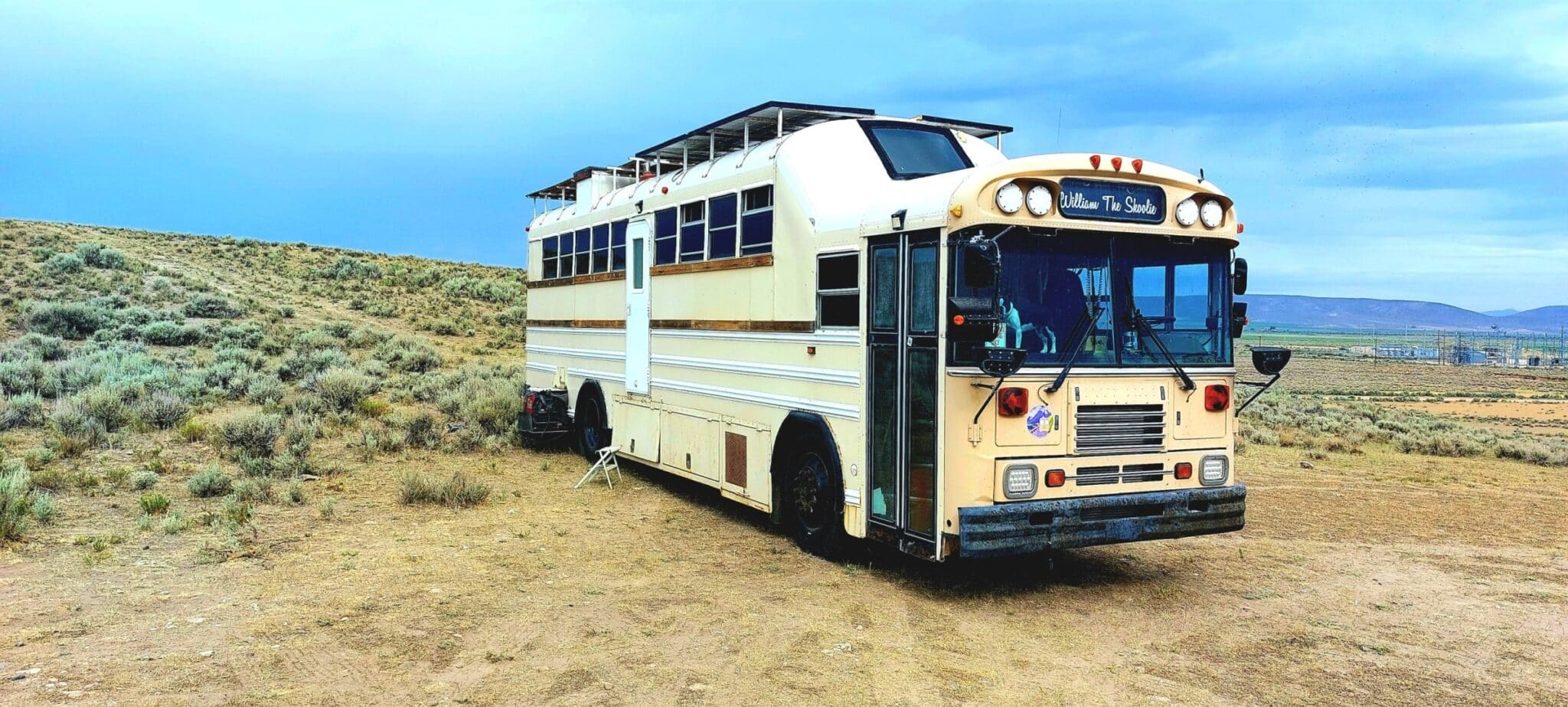
Most national forests and BLM land are great for pets. Dogs can usually be off-leash in dispersed camping areas as long as they’re under voice control. National parks are the opposite — most trails don’t allow dogs at all, and where they do allow them it’s leash-only. That’s a rude awakening for people who planned their whole route around national parks and have a high-energy dog that needs to run.
RV parks are hit or miss. Some welcome pets, some have breed restrictions (pit bulls and “aggressive breeds” get banned a lot), and some charge pet fees of $5-10 per night per animal. A few I looked into had weight limits — no dogs over 50 pounds. That rules out a lot of the breeds you see in bus life. Labs, shepherds, huskies. Not exactly toy poodles.
What works best, honestly, is Harvest Hosts and Boondockers Welcome. Both are membership programs where you stay on private property — farms, wineries, breweries — and most of them are pet-friendly because they’re rural properties where dogs are just part of the landscape. Hipcamp is another good one. The iOverlander app is free and has user reviews that usually mention whether a spot is pet-friendly. When I was researching this, I noticed that experienced bus lifers with dogs tend to plan their routes around outdoor access rather than specific destinations. The sightseeing works around the dog, not the other way around.
Vet Care on the Road
“So questions what do you do for veterinary care, especially if theres an emergency or illnesses?”
This one worried me more than I expected when I first started looking into it. At home, you’ve got your regular vet, you know where the emergency clinic is, your records are all in one place. On the road, none of that exists unless you build it.

For routine stuff — annual checkups, vaccinations, flea and tick meds — most bus lifers just find a local vet wherever they happen to be parked. You can call ahead, send over your pet’s records digitally, and get an appointment within a few days. Banfield (inside PetSmart) and VCA are chains that can pull up your records at any location if you’ve been to one before. Pretty convenient.
Emergencies are the scary part. When your dog eats something weird at 11pm and starts vomiting, you need to know where the nearest emergency vet is. I’d recommend keeping a running note on your phone with the emergency vet clinics near wherever you’re parked. The ASPCA app has a locator for this, and Google Maps is obvious, but don’t wait until the emergency to search.
Telehealth for pets is a thing now too. Vetster and PetCoach let you do video calls with licensed vets. It won’t help if your dog needs surgery, but for “should I be worried about this?” type questions, it’s a game changer on the road. Most consultations run $50-75.
One thing I learned from talking to a couple who’d been on the road with three dogs for four years — keep a physical copy of vaccination records in the bus. Not just digital. Some campgrounds and boarding facilities want paper records, and if you’re somewhere with bad cell service, you can’t pull anything up. They also kept a basic pet first aid kit with Benadryl, hydrogen peroxide (to induce vomiting if a vet tells you to), bandages, and a muzzle. Their vet recommended all of it before they left. (See our guide on 15 Things Nobody Tells You About Living in a School Bus for more on this.)
Pet insurance is the other big one. Healthy Paws, Embrace, and a few others cover you regardless of where you are in the country. Monthly premiums run $30-60 for a dog depending on breed and age. If your dog needs an emergency surgery that runs $4,000-6,000, that insurance pays for itself instantly. I’d call it borderline essential for full-time travelers.
Exercise and Outdoor Space
This is the part that actually works in your favor with bus life. Most bus lifers end up spending way more time outside than they did in a house or apartment. You’re parked in nature half the time. The dog’s life arguably gets better, not worse.

But it takes intentionality, especially on travel days or when you’re parked in a city. A 70-pound lab doesn’t care that you drove six hours and you’re tired — that dog needs to move. So the people who do this well build exercise into the daily schedule no matter what.
Long leads are huge in bus life. A 30-foot leash or a tie-out cable gives your dog room to move around outside the bus without you holding the leash. Stake it in the ground, clip the dog on, and they’ve got a circle of space to sniff around in. Not the same as a yard, but it works surprisingly well.
I talked to a woman at a bus meetup in Colorado who had two Australian shepherds — about the highest energy breed you can pick. She said the key was finding a spot to throw a ball every single morning before anything else happened. Didn’t matter where they were. Parking lot, field, trailhead. Twenty minutes of hard fetch and those dogs were calm for the rest of the day. She’d been doing it for two years and said the dogs were actually calmer on the road than they’d been at home with a backyard, because they were getting more focused exercise and more stimulation from new environments.
For cats, it’s a different game. Some bus cats are indoor-only and do fine because the bus is moving and there are windows to watch. Others use a harness and leash outside, which takes training but works. A few people build catios — small screened enclosures that attach to the bus door so the cat can be “outside” without running off. Sounds ridiculous but the cats love it.
One thing to watch out for is wildlife. Depending on where you’re boondocking, your dog might encounter coyotes, porcupines, rattlesnakes, or skunks. A recall command that your dog actually listens to is non-negotiable. If your dog doesn’t have reliable recall, keep them on a leash. Always. One porcupine encounter and you’re looking at a $500 vet bill and a traumatized dog.
Keeping the Bus Clean with Animals
Alright, let’s be real about this one. A bus is small. Somewhere between 150 and 300 square feet depending on the build. Now put a dog or two in there. Hair gets everywhere. Mud gets tracked in. Wet dog smell in a small enclosed space is something else entirely.
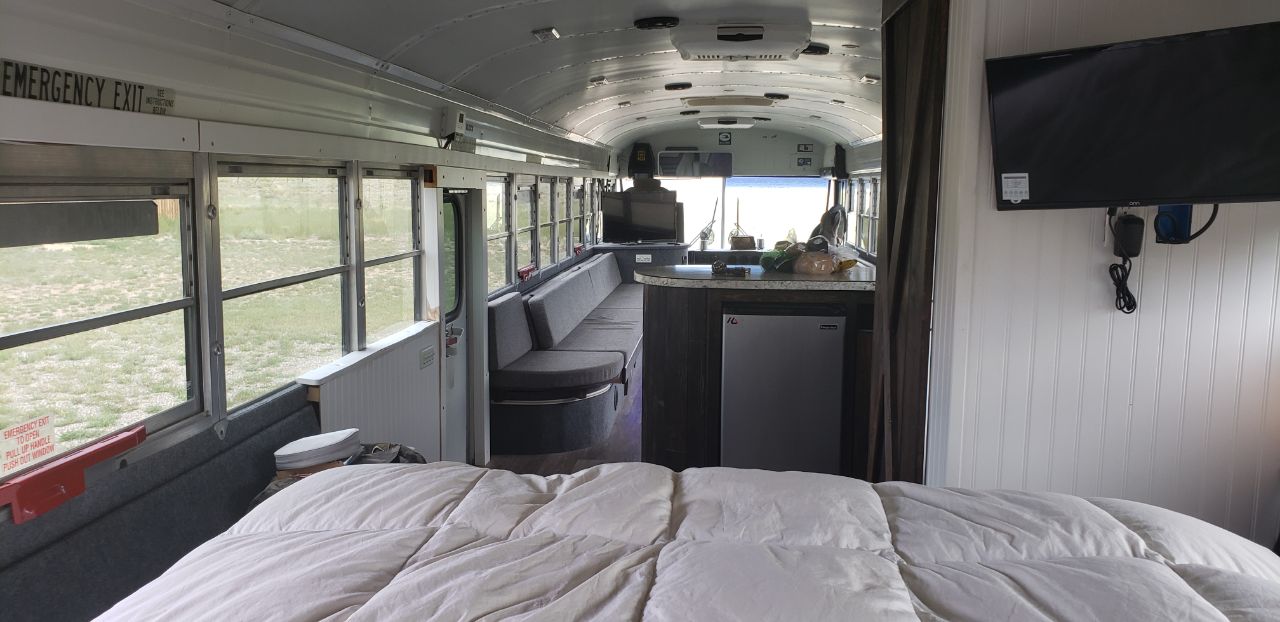
The people who keep it together have systems. Most of them vacuum every single day, sometimes twice. A cordless stick vacuum (Dyson or one of the cheaper knockoffs) is basically mandatory. Some people I talked to said their vacuum is the single most important tool they own, above the drill, above everything. That says something.
Floor material matters more than you’d think. Vinyl plank flooring is the most popular choice in bus builds, and it’s even more important with pets. Waterproof, easy to clean, doesn’t hold odors. Carpet is a disaster. If you have carpet and you’re bringing an animal, rip it out. It’ll smell within a month and you’ll never get it clean.
A towel station by the door is something almost every bus lifer with dogs ends up creating. Just a hook or a basket right inside the door with old towels. Dog comes in from outside, wipe the paws. Every time. Sounds tedious but it beats mopping the entire floor every day.
For cats, the litter box situation is the big challenge. A litter box in 200 square feet is going to make its presence known. Enclosed litter boxes help. Some people vent them — cut a small hole in the wall behind the box and put a computer fan on it to pull air outside. Sounds janky but it works. Others use pine pellet litter instead of clay because it controls odor better and is lighter to carry.
Seat covers on anything fabric, a good enzyme cleaner for accidents (Nature’s Miracle is the standard), and opening the windows whenever possible. That’s the formula. Not glamorous but it keeps the bus from turning into a kennel.
Related: Can You Legally Live in a Converted School Bus?
Travel Anxiety and Motion Sickness
Not every pet handles the road well, and this is the thing that catches people off guard because they assume their dog loves car rides. Yeah, your dog loves a 20-minute trip to the park. A six-hour drive through mountain switchbacks is a completely different experience.

Motion sickness in dogs is pretty common, especially in younger dogs. The signs are drooling, whining, pacing, and eventually vomiting. Cats tend to just vocalize — meowing nonstop for the first hour and then either settling down or escalating. I heard from one couple that their cat screamed for the first three months of travel and then suddenly stopped and never made a sound again. Animals are weird.
What actually helps with motion sickness? First, don’t feed your pet right before driving. An empty stomach handles motion way better than a full one. Feed them a couple hours before you leave, or wait until you’ve stopped for the day. Second, keep the bus cool while driving — heat makes nausea worse. Third, give them a spot where they can see out a window. Just like humans, being able to see the horizon helps the brain reconcile the motion.
For dogs with serious anxiety, not just mild nervousness but full-on panic, there are options. ThunderShirts work for some dogs — basically a compression wrap that calms the nervous system. CBD treats formulated for dogs have gotten popular, though I’d talk to a vet first. For severe cases, your vet can prescribe anti-anxiety medication like trazodone or gabapentin for travel days.
The most important thing, and this came up in almost every conversation I had with bus lifers who have pets, is that most animals adapt. The first few trips are rough. There might be vomit. There might be crying. But after a few weeks, most dogs and cats figure out that this is just what happens now, and they chill out. The dogs who grew up in a bus sleep through everything. It’s the adult dogs making the transition that struggle, and even most of them come around within a month or two.
One practical tip. A family I met in New Mexico started doing short 30-minute drives every day for two weeks before their first big trip. Just around town. Got the dogs used to the bus moving without the stress of a long haul. By the time they hit the road for real, the dogs curled up on the couch and passed out. Conditioning works.
Living in a bus with pets isn’t always easy. There are days when the dog tracks mud across your freshly cleaned floor and the cat knocks something off the counter for the 400th time and you wonder why you didn’t just get a house with a yard. But then you’re parked on BLM land in Utah with the door open, the dog laying in the sun, the cat watching birds from the window, and you realize this is a pretty incredible life for all of you. You just gotta plan for the hard parts so you can enjoy the good ones. (See our guide on How Do You Get Internet and WiFi Living in a Bus? for more on this.)