

If you’ve got kids and you’re thinking about full-time bus life, the education question is probably the one keeping you up at night. Not the plumbing. Not the parking. The school stuff.
Homeschooling on a bus is not only doable, it’s become one of the strongest arguments for this lifestyle. State requirements vary wildly but are manageable once you know which rules apply to you. Between online programs, structured curriculum kits, and the kind of real-world learning you get from traveling the country, bus life families have more educational options than most people sitting in one zip code. The hard parts are scheduling, record-keeping, and making sure your kids still have friends. All solvable. All worth the effort.
State Requirements for Homeschooling (They Vary More Than You’d Think)
This was the first thing I had to untangle when I started researching homeschooling for bus life, and honestly it almost made me give up before I even started. Every state has its own rules, and they range from “basically do whatever you want” to “submit a curriculum plan, get it approved, test annually, and file quarterly reports.”
The good news is that homeschooling is legal in all 50 states. The confusing part is figuring out which state’s rules you actually follow.
Most bus families handle this by establishing a domicile state — the same state where you’ve got your driver’s license, vehicle registration, and mailing address. That’s the state whose homeschool laws apply to you, no matter where you’re physically parked at the time. So if your domicile is Texas, you follow Texas homeschool rules whether you’re camped outside Yellowstone or parked in a friend’s driveway in Florida. (See our guide on How Do You Get a Mailing Address Living in a Bus? for more on this.)
Now here’s where it gets interesting. States like Texas, Alaska, and Idaho are about as hands-off as it gets. You basically declare you’re homeschooling and that’s it. No registration, no testing, no annual review. On the other end, states like New York, Pennsylvania, and Massachusetts want detailed plans, standardized test results, and sometimes evaluations by a certified teacher. I talked to a bus mom in Vermont who told me she spent more time on paperwork for the state than she did actually teaching her kids some weeks. She eventually switched her domicile to South Dakota and said the difference was night and day.
The Homeschool Legal Defense Association (HSLDA) has a state-by-state breakdown on their website that’s genuinely useful. I’d recommend looking at that before you pick your domicile state, because this one decision affects how much bureaucratic overhead you’re dealing with for years. Some families specifically choose low-regulation states as their domicile for this exact reason, and there’s nothing wrong with that.
One thing people worry about is whether they’ll get hassled by officials in other states while traveling. I couldn’t find a single documented case of this happening to a bus family. The laws follow your domicile, not your GPS coordinates. As long as you’re compliant in your home state, you’re good.
Online Programs and Curriculum Options
“What homeschool program do you use?” is probably the most common question I see in bus life groups, and the answer is always “it depends.” Which I know is annoying, but it’s true.

The programs that come up over and over in the community fall into a few buckets. First, you’ve got full boxed curriculum programs like Abeka, Sonlight, and BJU Press. These ship you everything — textbooks, workbooks, tests, teacher guides. You open the box and follow the plan. For parents who want structure and don’t want to figure out what to teach each day, these are gold. Abeka runs about $500-$800 per grade per year depending on how many subjects you bundle.
Then there’s the online school route. Connections Academy and K12 (now called Stride) are fully accredited online schools. Your kid logs in, attends virtual classes on a schedule, does homework, gets grades and report cards. It functions almost exactly like regular school but through a laptop. This is the safest bet if you think your kids might transition back to public school eventually, because the credits transfer cleanly. The downside is it ties you to a wifi connection and a daily schedule, which kind of defeats the flexibility of bus life.
The middle ground is where most bus families I’ve talked to end up landing. They mix and match. Khan Academy for math (free, self-paced, surprisingly good). Time4Learning for language arts and science ($20-$35 a month per kid). Outschool for specific subjects they don’t want to teach themselves — live classes taught by real teachers, usually $10-$50 per session. One dad I met at a gathering in Flagstaff told me his daughter takes a weekly creative writing class on Outschool and an astronomy class, and he handles everything else with library books and Khan Academy. Spends maybe $80 a month total. (See our guide on Can You Legally Live in a Converted School Bus? for more on this.)
I found that the families who’ve been at this the longest are the ones who stopped trying to replicate a traditional school day and started building something that fits their life instead. Some weeks are heavy on structured learning. Other weeks the kids are knee-deep in a national park and the “curriculum” is whatever they’re experiencing. Both count.
Roadschooling: Using Travel as the Classroom
This is the part that gets people excited, and honestly it should. Because roadschooling — using your travel as the primary educational experience — is the one thing bus families can offer that brick-and-mortar schools literally cannot.
I met a family at a bus meetup outside Albuquerque who told me something that stuck with me. They’d been on the road for two years with a 9-year-old and a 12-year-old. The mom said her kids learned more about geology in three weeks camping near the Grand Canyon than in an entire semester from a textbook. The 9-year-old could identify sedimentary layers by sight. The 12-year-old wrote a six-page paper about erosion patterns because she wanted to, not because someone assigned it. Nobody made her do that. (See our guide on 15 Things Nobody Tells You About Living in a School Bus for more on this.)
That’s what roadschooling looks like in practice. You visit Gettysburg and suddenly the Civil War isn’t an abstract chapter in a book. You drive through the Redwoods and photosynthesis becomes something you can see and touch. You stop at a farm stand in Georgia and your kid learns about agriculture, small business, and regional economics all in one conversation with the farmer.
“What about the kids’ education? How does that work? Are they homeschooled or doing online classes?” The answer for roadschooling families is kind of “neither and both.” They use travel as the primary driver and fill gaps with structured materials where needed. Math still needs a curriculum for most kids — you can’t really learn long division by visiting a monument. But history, science, geography, social studies, writing? The road handles a massive chunk of that if you’re intentional about it.
The key word there is intentional. Roadschooling isn’t just dragging your kids to tourist spots and hoping they absorb something. The families doing it well plan their routes around educational opportunities. They keep journals. They assign projects connected to where they are. They ask the kids questions and have real conversations about what they’re seeing. It takes more effort than handing a kid a worksheet, but the retention is on a completely different level.
Setting Up a Study Space in a Bus
You’re working with maybe 250 square feet total, so the idea of a dedicated “classroom” is kind of laughable. But you still need somewhere for the kids to actually sit down and do focused work.
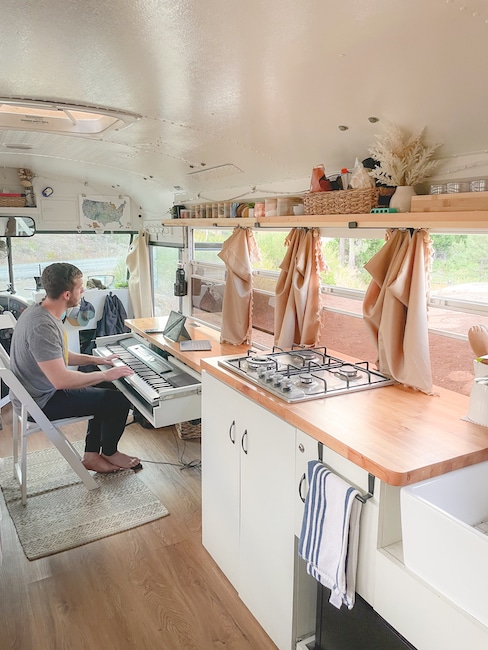
Most bus families I’ve talked to use the dinette table as the default school space. If you’ve got a convertible dinette — the kind that folds down into a bed — that doubles as school during the day and sleeping space at night. Some families build a fold-down desk along one wall. I saw one build where the dad put a narrow shelf with a piano hinge along the passenger side that folded flat against the wall when not in use. Took up almost zero space and gave both kids a writing surface.
“When do you have time to teach the kids and drive the bus and do your other job?” This is the logistics question that makes people’s heads spin. The secret is that most bus families don’t drive every day. You drive for a day or two, then park for a week or two. School happens during those parked stretches, usually in the mornings. A common rhythm I kept hearing was three to four hours of focused school time in the morning, Monday through Thursday, with Fridays saved for field trips or catch-up.
Storage matters too. You don’t have room for a bookshelf full of textbooks. Tablets and laptops carry an entire library’s worth of curriculum in something that fits in a drawer. Most families keep a small bin of physical supplies — pencils, notebooks, a few workbooks, art supplies — and do everything else digitally. One mom told me she keeps exactly one physical book per kid at a time, and they swap at every library they pass. Smart system.
The internet piece is critical for online programs. If you’re relying on Outschool or Connections Academy, you need reliable wifi. Starlink has been a game changer for bus families running online school. Before that, people were chasing coffee shop wifi and library parking lots trying to get their kids logged into class on time. Starlink costs around $120 a month, but if education depends on it, that’s money well spent. (See our guide on How Do You Get Internet and WiFi Living in a Bus? for more on this.)
Keeping Records and Staying Compliant
This is the boring part that nobody wants to talk about, but it’ll save you a massive headache if you take it seriously from day one.

What you need to keep depends entirely on your domicile state. Low-regulation states like Texas might require nothing at all. High-regulation states might want attendance records, curriculum descriptions, standardized test scores, and portfolio reviews. I found that even families in low-regulation states tend to keep records anyway, just in case. You never know when you might need to prove your kid’s educational history — maybe they want to enroll in community college classes, or you move to a stricter state, or there’s a custody situation where education comes up.
At minimum, keep a portfolio for each kid. This doesn’t have to be fancy. A folder (physical or digital) with samples of their work from each subject, a log of what you covered and when, and any test results. Some families use apps like Homeschool Tracker or even just a Google Doc. I talked to a couple who keeps a simple spreadsheet — date, subject, what they did, time spent. Takes them about five minutes a day to update and they’ve got a complete record going back three years.
For standardized testing, most states that require it accept nationally recognized tests like the Iowa Assessments or the Stanford Achievement Test. You can order these and administer them yourself in many states, or find a local testing center. Some states also accept portfolio reviews where a certified teacher looks at your kid’s work and signs off. That option tends to be less stressful for kids who don’t test well.
The biggest mistake I see families make is ignoring this stuff until it becomes a problem. Set up your system in the first week, keep it updated, and you’ll never have to scramble. (See our guide on 11 Ways to Make Money While Living in a Bus for more on this.)
Socialization on the Road
“How do you socialize your kids on the road?” People ask this like bus kids are locked in a metal box with no human contact. The reality is pretty much the opposite, but it does take effort.

The bus life and RV communities are full of families with kids. Meetups, caravans, rallies — these events happen constantly and they’re basically instant social networks for road kids. I watched a group of maybe fifteen kids ranging from age 4 to 16 run around together at a bus gathering in east Texas like they’d known each other their whole lives. They’d met that morning. Kids are just better at that than adults are.
Homeschool co-ops exist in pretty much every mid-sized city in the country. These are groups of homeschooling families that meet regularly for group classes, field trips, and social events. Most are welcoming to traveling families, even if you’re only in town for a few weeks. I found directories for these on local homeschool association websites and Facebook groups. Some families plan their routes specifically around co-op schedules, staying in an area for a month or two so their kids can plug into a group.
Sports and activities are more available than you’d think. YMCA programs, community rec leagues, and drop-in classes are everywhere. Some states even allow homeschooled kids to participate in public school athletics and extracurriculars — look up the “Tim Tebow laws” if you want to know which ones. Libraries run free programs for kids. Museums, nature centers, and community centers all have youth activities.
The honest truth is that socialization on the road requires more intentionality than it does in a traditional setup. You can’t just send your kid to school and let it happen naturally. But the flip side is that bus kids tend to develop social skills that a lot of traditionally schooled kids don’t. They’re used to meeting new people constantly. They’re comfortable talking to adults. They’ve interacted with kids from all kinds of backgrounds across the country. That’s not nothing.
So here’s where I landed after looking into all of this. Homeschooling on a bus isn’t the obstacle most people think it is. It’s a different approach, and it demands more from the parents than dropping your kids off at school every morning. But the families doing it aren’t just getting by — a lot of them are genuinely thriving. Pick a domicile state with manageable requirements, find a curriculum approach that fits your family, keep your records clean, and be intentional about creating social opportunities. The education part of bus life is one of the things that actually gets easier the longer you do it, not harder. If you’re thinking through the bigger picture of raising kids on a bus, check out our complete guide on bus life with kids for the full breakdown.
q5wl4c