

So you’ve been watching the YouTube tours. You’ve seen the couples with the gorgeous wood-paneled interiors parked next to a lake somewhere in Colorado. You’ve seen the family of six who sold everything and hit the road in a yellow school bus they bought for $4,000. And now there’s a part of your brain that won’t shut up about it. I know the feeling. When I first stumbled into this world, I spent about two straight weeks going down the rabbit hole, and I came out the other side with more questions than I started with.
Bus life is exactly what it sounds like — converting a bus into a livable home and either traveling in it or parking it somewhere as your primary residence. It’s not just a trend or a social media aesthetic. Real people, families, couples, solo travelers, and retirees, are doing this every single day as a practical, affordable, and genuinely fulfilling way to live. But it’s not for everyone, and the gap between what you see online and what it actually takes is wider than most people expect. This guide covers everything from choosing a bus and budgeting a build to the daily realities of parking, mail, healthcare, and work, so you can figure out if this life actually makes sense for you before you spend a dime.
What Bus Life Actually Is (And What It Isn’t)
Let me get something out of the way first. Bus life is not a vacation. It’s not glamping. It’s not an extended road trip with better aesthetics. I mean, it can include all of those things, but at its core, bus life is just… living. You wake up, make coffee, go to work (remotely or otherwise), cook meals, do dishes, argue about what to watch, and go to bed. You just happen to do all of that inside 200-300 square feet of converted school bus. (See our guide on How Do You Get a Mailing Address Living in a Bus? for more on this.)
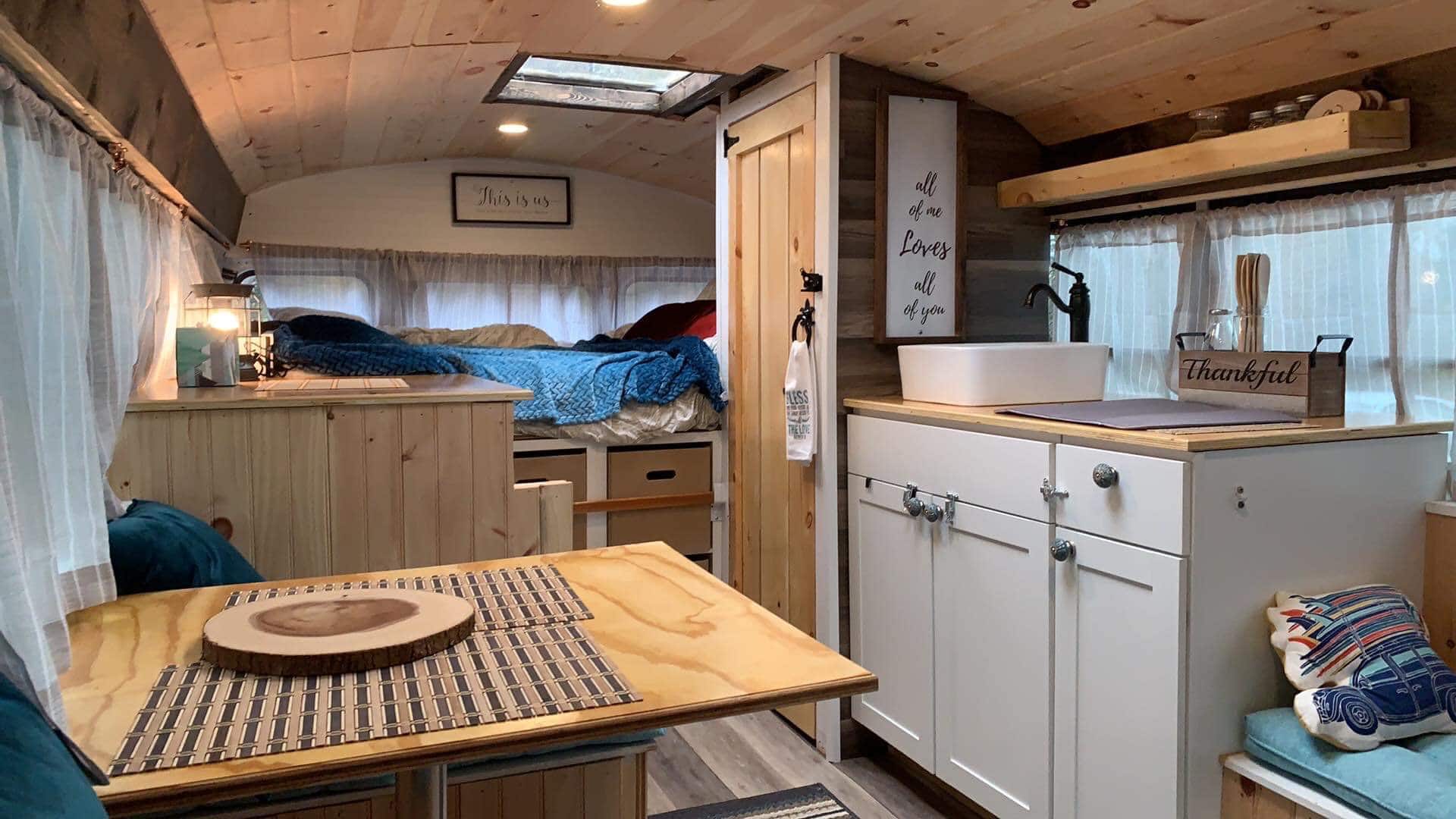
The “conversion” part is the thing that separates this from RV life or van life. You’re taking a vehicle that was designed to shuttle kids to school and turning it into a home. That means ripping out seats, insulating walls, building a kitchen, running plumbing, wiring electrical, and figuring out where to put a toilet. Some people spend $5,000 and three months. Others spend $60,000 and two years. The range is enormous, and that’s actually one of the things that makes it appealing. You can build exactly what you need. (See our guide on 15 Things Nobody Tells You About Living in a School Bus for more on this.)
When I started researching bus conversions, I assumed it was mostly young couples with no kids and a trust fund. I was wrong. The community is way more diverse than the algorithm shows you. There are retired couples who sold their house at 65 and haven’t looked back. Single moms who figured out that a paid-off bus beats a $1,400/month apartment. Families with four or five kids who homeschool on the road. Veterans. Tradespeople. Teachers. People on disability. The common thread isn’t demographics, it’s the desire to live differently and own your space outright. (See our guide on Can You Legally Live in a Converted School Bus? for more on this.)
“How do y’all get mail? Is it a PO Box? I’m very curious about the legal logistics of living like this.”
This is the kind of question that tells me someone is actually thinking about doing it, not just daydreaming. And yeah, the logistics of bus life are a whole thing. Mail, domicile, taxes, healthcare, insurance — all of it has to be figured out. But here’s what I want you to understand right now, before we go deeper: none of these problems are unsolvable. Thousands of people have already solved them. You’re not pioneering anything. You’re following a well-worn path with a lot of people willing to help you along the way.
We’ll get into each of those logistics later in this guide. For now, just know that bus life isn’t just about building a cool bus. It’s about restructuring your entire life around a different set of systems. And that’s the part most people underestimate.
Who Is Bus Life Actually For?
I used to think there was a “type” of person who does this. Turns out there’s not. But there are some patterns I’ve noticed.

Families are the biggest surprise for most people. You see a school bus and think “that’s too small for kids,” but then you meet a family of five who’s been on the road for three years and their kids are thriving. Families do this to homeschool on the road, to spend more time together, to get out of the cycle of mortgage-daycare-commute-repeat. It takes more planning than a couple’s build, but it absolutely works. We have a whole guide on bus life with kids if that’s your situation.
Couples are probably the most visible group in the community because they make the most content. Two people in a 30-foot bus have plenty of room. A couple’s build is the simplest version of bus life — you can get away with a smaller bus, a simpler layout, and a lower budget.
Solo travelers are more common than people think. A single person in a short bus or even a shuttle bus has more space per person than a studio apartment in most cities. I talked to a guy who converted a 24-foot short bus by himself over about four months, and he said it was the most satisfying project he’d ever done. Solo builds tend to be leaner and more creative because you don’t have to compromise with anyone.
Retirees are the group nobody talks about enough. A retired couple on Social Security can live comfortably in a bus for a fraction of what it costs to maintain a house. No mortgage, no property tax, no $300 utility bills. I’ve read stories from people in their late 60s and 70s who said bus life gave them a second act they didn’t think they’d get. We cover the financial side in detail in our guide to living on a fixed income.
“How much yall paid for that big bus? Me and my husband getting old now. He 72 and im 67. And we wanted to buy a Rv and sell everything.”
This question came from a real YouTube comment and it stopped me. Because this is exactly who bus life can help the most — people who are being crushed by the cost of traditional housing on a fixed income. A couple on SSI spending $1,200/month on rent and $400 on utilities could be spending $400-800/month total living in a paid-off bus. That’s not a fantasy number. That’s what people actually report. (See our guide on How Do You Get Internet and WiFi Living in a Bus? for more on this.)
The Big Decisions You’ll Make Early On
Before you buy anything, before you watch one more YouTube tour, there are a handful of decisions that shape everything else. Get these right and the rest flows. Get them wrong and you’ll be backtracking.
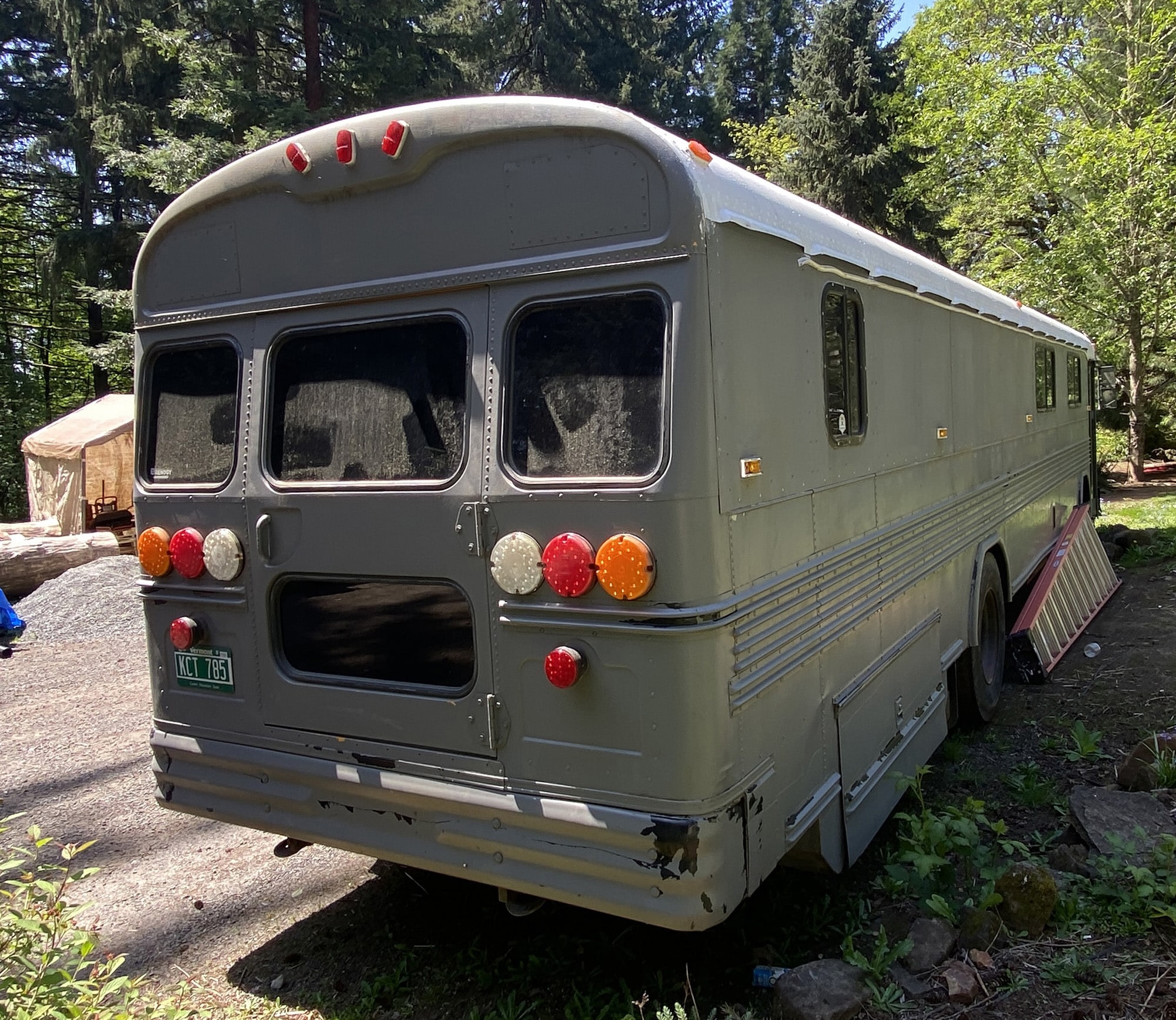
What type of bus should you get?
This is where most people start, and it’s the right place to start. Your options are basically: full-size school bus (35-42 feet), short bus (20-25 feet), transit bus, coach bus, shuttle bus, church bus, or even a double-decker if you’re feeling ambitious. Each has tradeoffs.
Full-size school buses are the most popular for a reason. They’re cheap ($3,000-8,000), they’re built like tanks, diesel engines last forever, and you get 200-300 square feet of interior space. The downsides are fuel economy (6-10 mpg), height restrictions, and the fact that not every campground will take them.
Short buses are great for solos and couples who want something more maneuverable. You can park them in more places, they get better mileage (10-14 mpg), and they’re less intimidating to drive. The tradeoff is space. You’re working with maybe 100-120 square feet.
I’ve written detailed breakdowns on every type of bus you can convert, short bus conversions, and how to choose the right bus if you want to go deep on this.
What’s your budget, honestly?
I say “honestly” because this is where people lie to themselves the most. The bus itself might only cost $5,000. But the conversion materials, tools, unexpected repairs, registration, insurance, and all the little stuff that adds up? A realistic all-in budget for a DIY build looks like this:
- Bare bones build: $10,000-15,000 total (bus + basic conversion)
- Solid mid-range build: $20,000-35,000 total (bus + full conversion with solar, bathroom, decent finishes)
- High-end build: $40,000-60,000+ total (bus + professional-quality finishes, full solar system, mini-split, washer/dryer, the works)
Those numbers assume you’re doing the work yourself. If you hire a builder, double or triple the labor portion. We break all of this down with real numbers in our cost breakdown guide and our budgeting guide.
Full-time or part-time?
Not everyone who builds a bus lives in it full-time. Some people keep a home base and use the bus for extended trips, summer travel, or weekend getaways. Others sell everything and go full-time from day one.
Full-time bus life means you need to solve every system — water, power, waste, mail, domicile, healthcare, income. Part-time means you can lean on your existing infrastructure and use the bus as a supplement. Neither is better. But the builds look different, the budgets look different, and the lifestyle planning looks very different.
“It’s cool, I’ll admit that. But wouldn’t it have been way cheaper to just buy a used RV?”
I hear this one constantly, and I’ve spent a lot of time digging into the actual numbers. The short answer is: cheaper upfront? Sometimes. Cheaper in total value? Almost never.
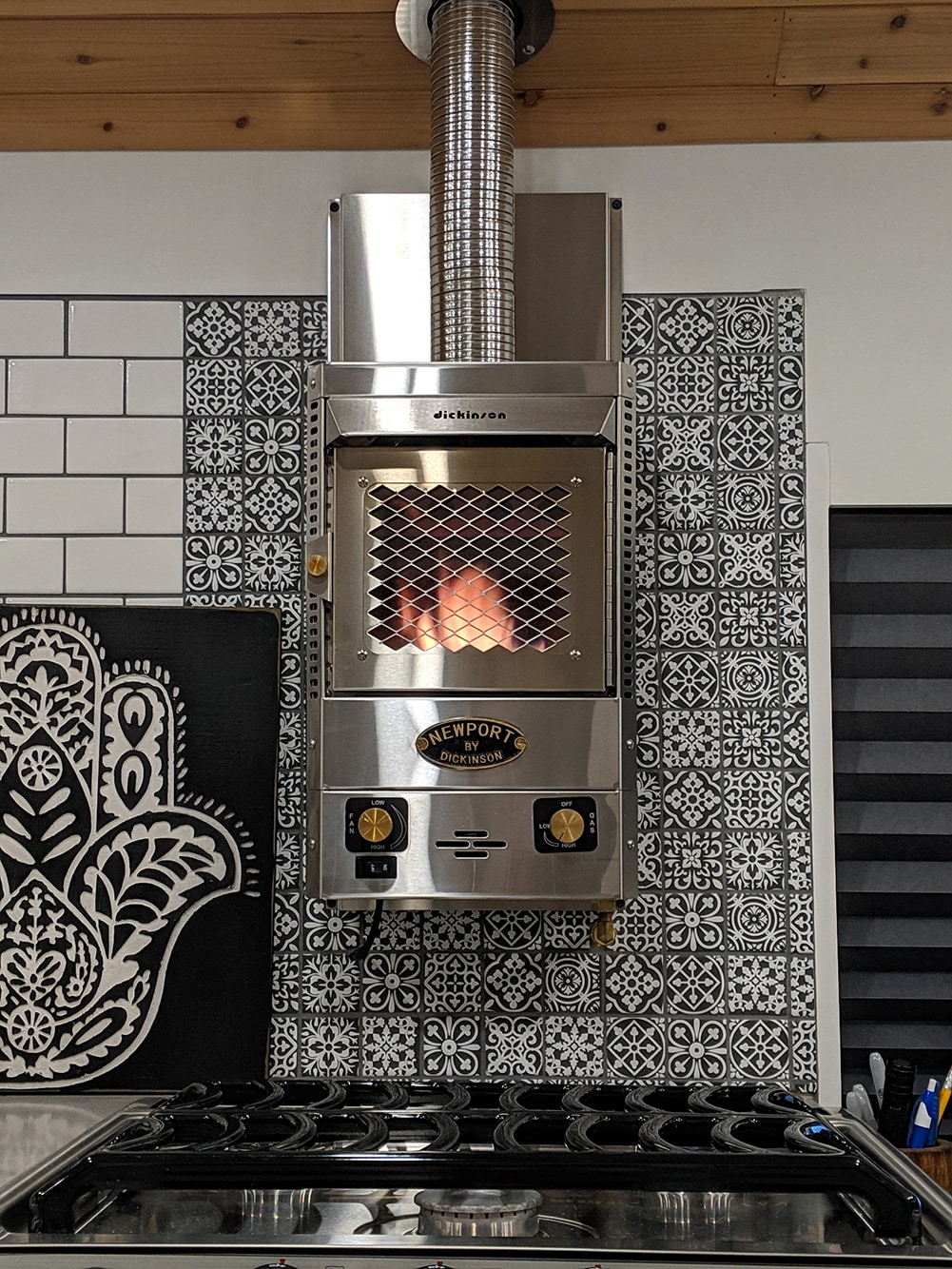
A used Class A motorhome with similar living space to a 40-foot school bus runs $40,000-80,000 for something in decent shape. And “decent shape” in the RV world is relative, because RV construction quality is, well, not great. We’re talking stapled trim, particle board cabinets, thin fiberglass walls with a layer of styrofoam. These things are built to be lightweight and sell on a showroom floor, not to last 20 years on rough roads.
A school bus costs $3,000-8,000. A solid DIY conversion runs $15,000-30,000 in materials. So you’re looking at $20,000-35,000 all-in for a skoolie versus $40,000-80,000 for a used Class A. The skoolie is built on a commercial-grade chassis with a diesel engine designed to run 300,000+ miles. The RV is built on a consumer chassis with consumer components.
But I want to be fair about this. An RV is ready to go. You drive it off the lot and you have a kitchen, a bathroom, a bed, AC, a generator, everything. A bus conversion takes months or years. Time has value. If you don’t want to build anything and you have the budget, an RV might make more sense for you. There’s nothing wrong with that.
Where the bus wins, and wins big, is durability, customization, and cost per square foot. You design the layout you want. You choose the materials. You end up with something that’s yours in a way a factory RV never will be. And skoolies hold their value weirdly well compared to RVs, which depreciate 20-30% the moment you drive off the lot.
“Can you inform how a family of 5 can do a realistic build?”
A family of five needs a full-size bus. That’s the starting point. You need the length for dedicated sleeping areas, a functional kitchen, a bathroom, and enough storage that you’re not tripping over each other. A 35-40 foot bus gives you roughly 200-250 usable square feet after the driver area and mechanical systems.
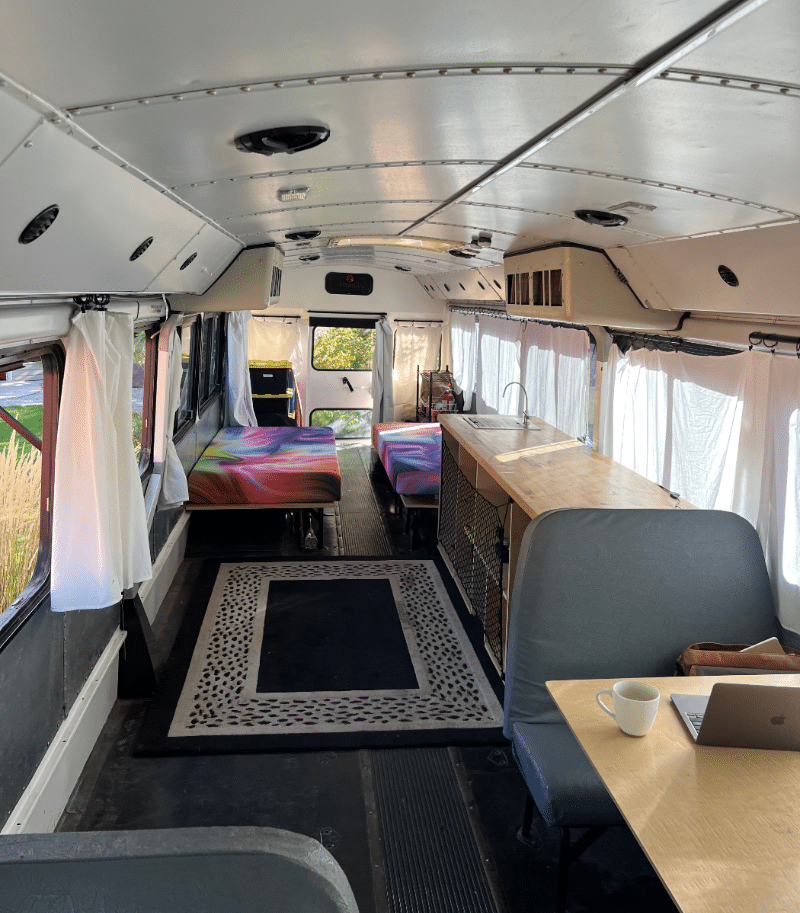
Here’s what a realistic family-of-five build looks like in terms of layout: the front section behind the driver becomes the living/dining area, often with a dinette that converts to a bed. The midsection is the kitchen and bathroom. The back section is the bedroom area — usually a master bed (often a queen on a platform with storage underneath) and bunks for the three kids.
Budget-wise, a family build typically runs higher than a couple’s build because you need more of everything. More water capacity, bigger electrical system, more insulation for more bodies generating heat and moisture, more durable finishes because kids are hard on stuff. I’d say $25,000-40,000 is realistic for a solid family-of-five build where you’re doing the work yourselves.
The biggest thing I’ve noticed from families who’ve done this successfully is that they involve the kids in the build. Even young kids can sand, paint, and hand tools. It becomes a family project, not just a parent project. And there’s something about building the walls you sleep in together that creates a bond people keep talking about.
Timeline? For a family doing this on weekends while still working, expect 6-12 months. Some families take longer because life happens. The ones who finish fastest are the ones who plan their layout completely before touching a single tool. We’ve got floor plan ideas and a guide specifically for big families that go deeper on this.
“Would a camper van be better to start with?”
This question came from a 19-year-old with limited funds, and I think it’s a really smart question to ask. The honest answer is: maybe, depending on your situation.

A camper van (think Sprinter, Transit, or even a minivan conversion) is smaller, cheaper to buy, cheaper to fuel, easier to park, easier to drive, and faster to build. You can convert a basic van in a few weekends for under $5,000. You can park it in a normal parking spot. Insurance is straightforward. You don’t need to worry about CDL questions or campgrounds turning you away.
The tradeoff is space. A van gives you maybe 60-80 square feet. That’s enough for a solo person or a very cozy couple, but there’s no real bathroom (maybe a portable toilet), no real kitchen (maybe a camp stove), and no standing room in most vans unless you do a roof raise or buy a high-top model.
I’ve seen a lot of people start in a van, figure out what they like and don’t like about mobile living, and then graduate to a bus when they’re ready for more space. That’s actually a really smart progression. You learn the lifestyle without committing to a massive build. If you hate it, you sell the van and you’re out a few thousand bucks. If you love it, you’ve got firsthand experience that will make your bus build ten times better. (See our guide on 11 Ways to Make Money While Living in a Bus for more on this.)
For a 19-year-old specifically? I’d say a van is the move. You’re still figuring out what you want, your needs will change a lot in the next few years, and you can always upgrade later. We compare the two lifestyles in detail in our van life vs bus life guide.
“How does one get into converting a school bus into a home with no experience?”
This is the question that holds most people back, and I get it. The idea of tearing apart a bus and building a home inside it when you’ve never done plumbing, electrical, or construction sounds overwhelming. When I was first looking into this, I felt the same way. I couldn’t tell you the difference between Romex and PEX.
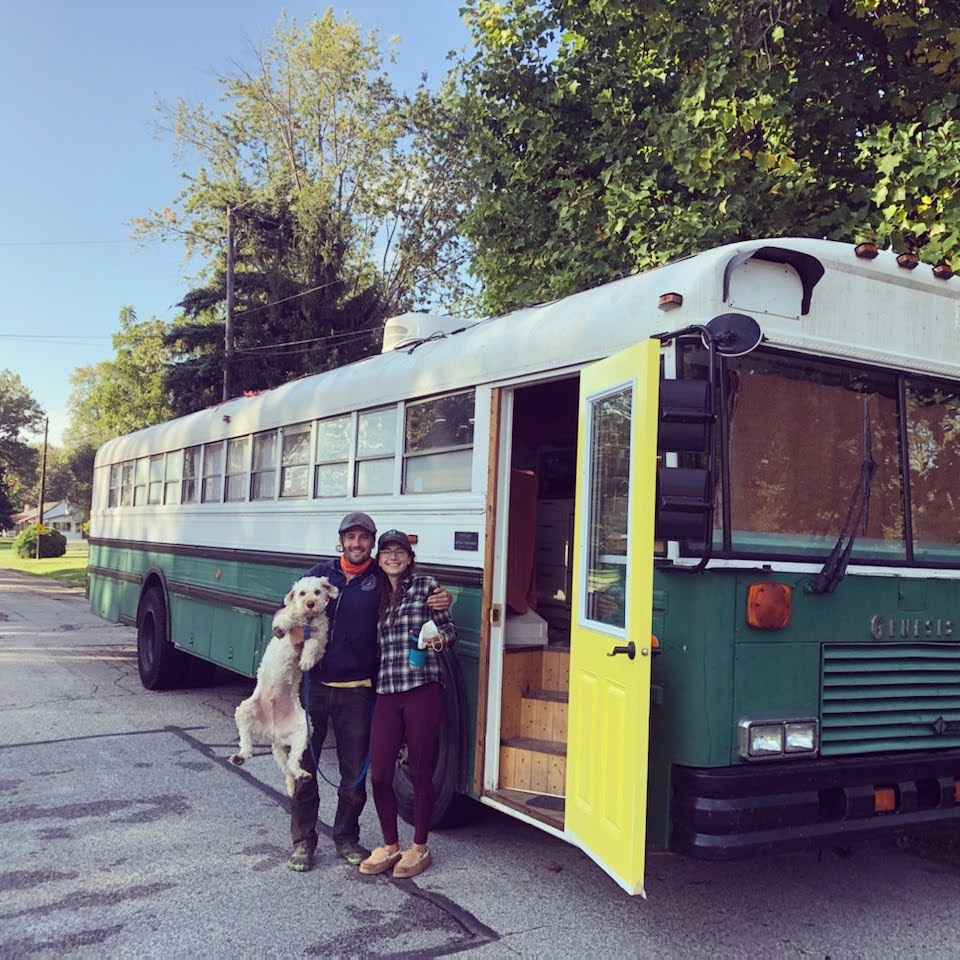
But here’s what I found out. Most people who convert buses have zero prior experience. That’s not an exaggeration. The skoolie community is full of former teachers, office workers, retail employees, artists, and tech people who learned everything from YouTube and trial and error. The skills you need — framing, insulation, basic wiring, basic plumbing, painting — are all learnable. None of them require years of training. They require patience, willingness to make mistakes, and access to YouTube.
The rough order of a conversion goes like this:
- Strip the bus — Remove seats, flooring, ceiling panels. This is pure labor. No skill required.
- Rust treatment and repair — Sand, treat, and seal any rust. You can learn this in an afternoon.
- Subfloor — Lay down vapor barrier, insulation, and plywood. Basic carpentry.
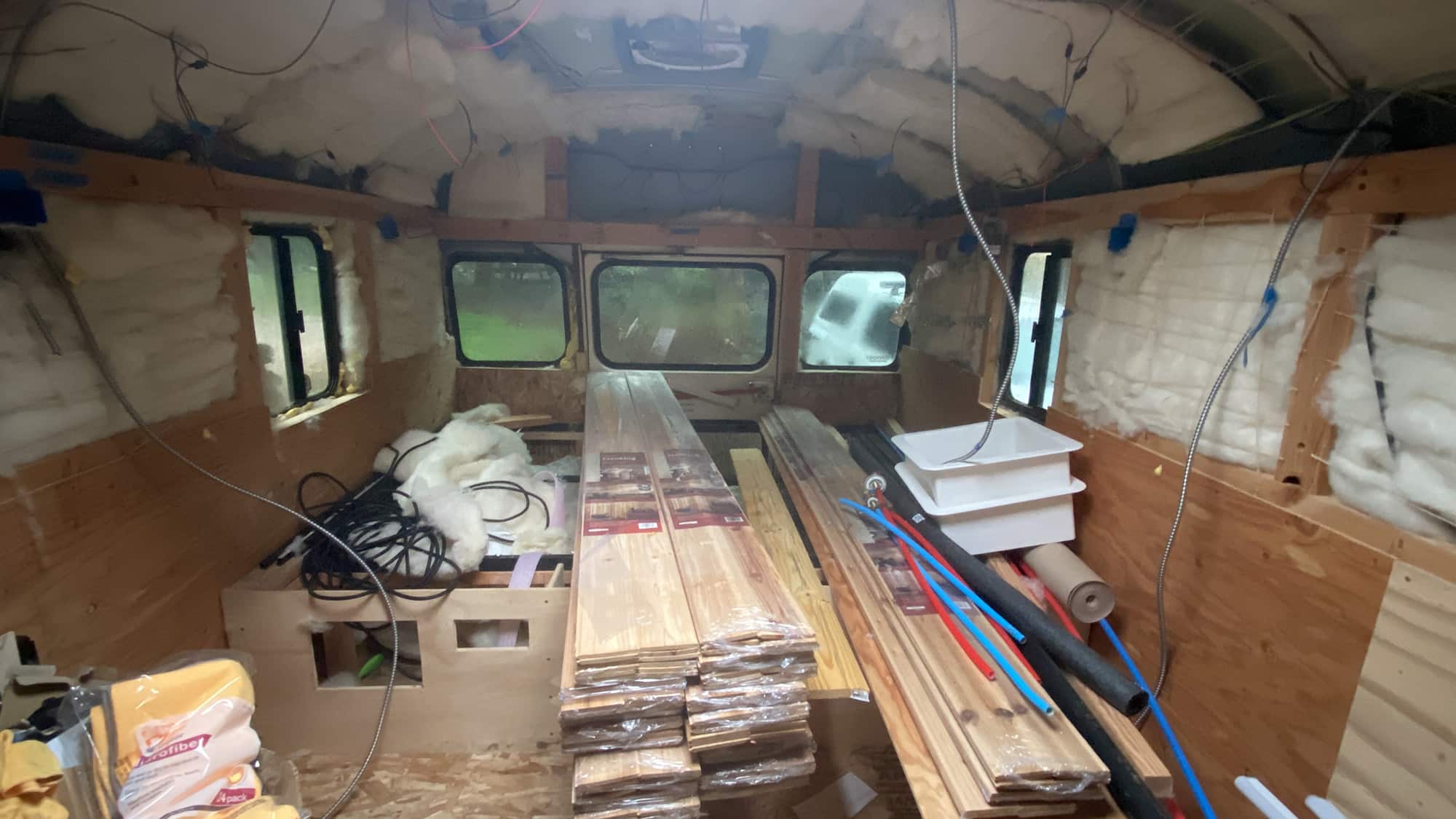
- Insulation — Walls and ceiling. Spray foam, rigid board, or wool. Tedious but straightforward.
- Framing — Build wall frames and ceiling structure. This is where your layout comes to life.
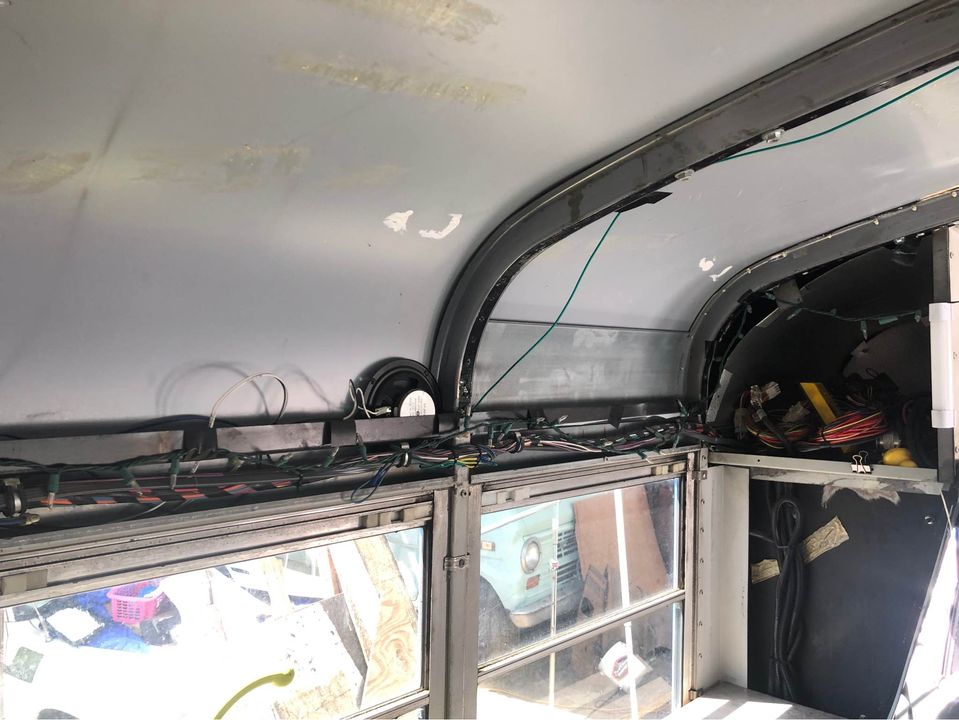
- Electrical — Run wiring for lights, outlets, solar, batteries. This is the most technical step and the one where I’d recommend watching the most tutorials or getting one consult from an electrician.
- Plumbing — Water tank, pump, lines, sink, shower, drain. PEX plumbing is actually pretty forgiving for beginners.
- Walls and ceiling finish — Tongue and groove, plywood, whatever you choose.
- Flooring — Vinyl plank is the most popular because it’s durable, waterproof, and easy to install.
- Furniture and fixtures — Kitchen, bathroom, bed, storage. This is the fun part.
- Systems — Solar panels, batteries, inverter, water heater, propane lines.
- Paint the exterior — Last step for most people.
Is it a lot of work? Yes. Will you mess things up? Absolutely. I read a forum post from a guy who framed his entire bedroom section, finished it, and then realized he’d miscalculated the bed dimensions by three inches. He had to tear it out and redo it. That’s just part of it. You learn, you fix, you move on.
We have detailed guides for almost every step of this process — insulation, electrical and solar, plumbing, flooring, kitchens, bathrooms. Start reading. Start watching. And when you feel about 60% ready, start building. You’ll never feel 100% ready. Nobody does.
The Honest Pros and Cons
I’m not going to sugarcoat this. Bus life has real advantages and real drawbacks. Anyone who tells you it’s all sunsets and freedom is selling you something. Anyone who tells you it’s miserable is probably scared of their own comfort zone. The truth is somewhere in the middle.
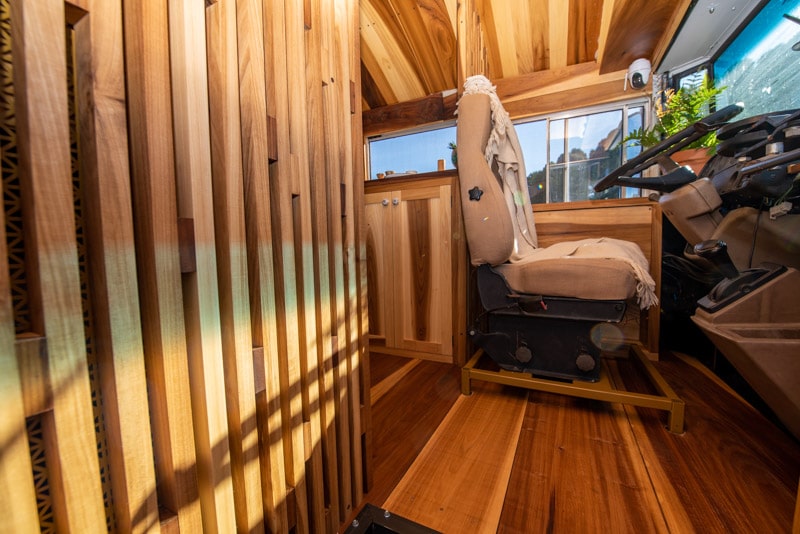
What’s genuinely great about bus life
Financial freedom. A paid-off bus means no mortgage, no rent, no property tax. Monthly living costs for full-timers typically run $800-1,500 for everything — fuel, insurance, food, campground fees, maintenance. That’s less than rent alone in most cities. I’ve talked to people who were able to quit jobs they hated, start businesses, or just stop worrying about money for the first time in their adult lives.
Flexibility. You can be in the mountains this week and the desert next month. You’re not tied to a lease, a mortgage, or a zip code. If you don’t like where you are, you literally drive somewhere else. That sounds simple but it changes your relationship with your life in ways I didn’t expect.
Simplicity. Living in 250 square feet forces you to own less, want less, and focus on what matters. Most bus dwellers say the decluttering process was one of the most liberating parts of the transition.
The build itself. This sounds weird to list as a pro, but the conversion process is genuinely one of the most fulfilling projects you can take on. You learn real skills, you solve real problems, and you end up with something you built with your own hands. I’ve talked to builders who said the six months they spent on their bus were the most satisfying six months of their adult life.
What’s genuinely hard about bus life
Parking. This is the number one daily stressor for most full-timers. Finding places to park, figuring out time limits, dealing with campgrounds that won’t accept buses, scouting grocery store lots — it never fully goes away. You get better at it, but it’s always a factor.
Maintenance. School buses are durable but they’re old commercial vehicles with a lot of miles. Things break. Budget $1,500-3,000 per year minimum for maintenance, and know that finding a mechanic who’ll work on a bus isn’t always easy. We cover this in our mechanic guide.
Weather. A bus is a metal box. In summer it’s an oven. In winter it’s a freezer. Good insulation, a diesel heater, and a mini-split AC solve most of this, but the first season in either extreme will test you. Check out our guides on staying warm and staying cool.
Privacy. If you’re a couple, close the curtains and you’re fine. If you’ve got kids, you’re living in a space with zero soundproofing between “rooms.” You adapt, but it takes adjustment.
Social isolation. This one doesn’t get talked about enough. The road can be lonely. Especially for solo travelers. You have to be intentional about building community, whether that’s through rallies, meetups, caravan groups, or just parking near other bus people.
The stigma. Not everyone understands why you’d want to live in a bus. Family, friends, strangers, some of them will think you’re crazy. You develop a thick skin, but those early conversations can be rough.
The Lifestyle Realities Nobody Puts in the Thumbnail
“How do y’all get mail? What do you do for work? Do you homeschool your kids?”
This question from a YouTube comment pretty much covers the three big lifestyle logistics everyone worries about. Let me hit each one.
Mail. Most full-timers use a mail forwarding service like Escapees, Americas Mailbox, or Traveling Mailbox. You get a physical address (usually in a tax-friendly state like South Dakota, Texas, or Florida), they receive your mail, scan the envelopes, and you tell them what to forward, open, or shred. Cost is about $10-20/month. This also becomes your legal domicile address for voting, taxes, and vehicle registration. Our mailing address guide and domicile setup guide cover this in detail.
Work. Remote work is the most common answer, and the explosion of remote jobs since 2020 has made this way more viable than it was five years ago. But people also work seasonal jobs (campground hosts, farm work, Amazon warehouse during holidays), freelance, run online businesses, do trade work, or work in healthcare travel positions. If you have a laptop and decent internet, you can make it work. We have a whole article on making money while living in a bus.
Internet. Cell hotspots and mobile routers are the backbone. Most full-timers carry two or three carrier SIMs (T-Mobile, Verizon, AT&T) and use a signal booster like a WeBoost. Starlink has been a game-changer for people who boondock in rural areas. It’s not perfect, but you can reliably work remotely from most places. More details in our internet and wifi guide.
Healthcare. This one scares people the most, and honestly it scared me too when I was first looking into it. But the options are real. Marketplace (ACA) plans work anywhere in the country. Telehealth has exploded. Some people use health sharing ministries. Veterans have the VA system. If your income is low enough, you qualify for subsidies that make marketplace plans affordable. Our healthcare guide walks through all the options.
Education. If you have kids, homeschooling is the most common approach, and it looks nothing like what it did 20 years ago. Online programs, curriculum kits, unschooling, hybrid approaches — there’s a method for every family. Check our homeschooling guide for the full breakdown.
“Why everyone sells the home instead of renting it to someone? What if you want to settle for a while again?”
Smart question. Some people do keep their house and rent it out. That gives you a safety net and rental income. The downside is you’re still a landlord, still paying a mortgage, still tied to a property. And if something goes wrong with the rental, you might be 1,500 miles away.
Most people who sell do it because they want a clean break and because the sale funds the build. A house that sells for $200,000 with $80,000 in equity gives you enough to build a nice bus, pay off debt, and have a financial cushion. That’s the math that makes it click for most families.
If you want to settle again later? You can. People exit bus life all the time. Some buy a house again. Some buy land and park the bus. Some transition to a traditional RV or tiny house. It’s not a one-way door.
Common Misconceptions About Bus Life
“You must be rich to do this.” The opposite is actually true for most people. Bus life is how a lot of people escape financial pressure, not a luxury hobby for people with money to burn. The average DIY build costs less than a new car.
“It’s basically just being homeless.” No. You own your home. It has a kitchen, a bathroom, a bed, heat, AC, running water, and electricity. It’s registered, insured, and titled. It’s an unconventional home, but it’s a home.
“You can’t do this with kids.” Thousands of families already do. Kids are more adaptable than adults give them credit for. The education, socialization, and safety questions all have proven solutions.
“The bus is going to break down constantly.” School bus diesel engines are designed to last 250,000-500,000 miles with proper maintenance. These are commercial vehicles built to run every day for 15+ years. Are they maintenance-free? No. But “constantly breaking down” is not the reality for most well-maintained buses.
“It’s illegal to live in a bus.” In most states, once you re-register your bus as an RV or motorhome, it’s treated exactly like any other RV. There are zoning restrictions in some areas, but you can legally live in a converted bus in the vast majority of the country.
“You need a CDL.” In most states, if you remove the passenger seats and re-register as an RV, you do not need a CDL. There are exceptions based on weight and air brakes, and we cover all of them in our CDL guide.
The Legal and Logistics Side (Quick Overview)
I won’t go deep on each of these here because we have full guides for all of them, but you should know these exist before you start.
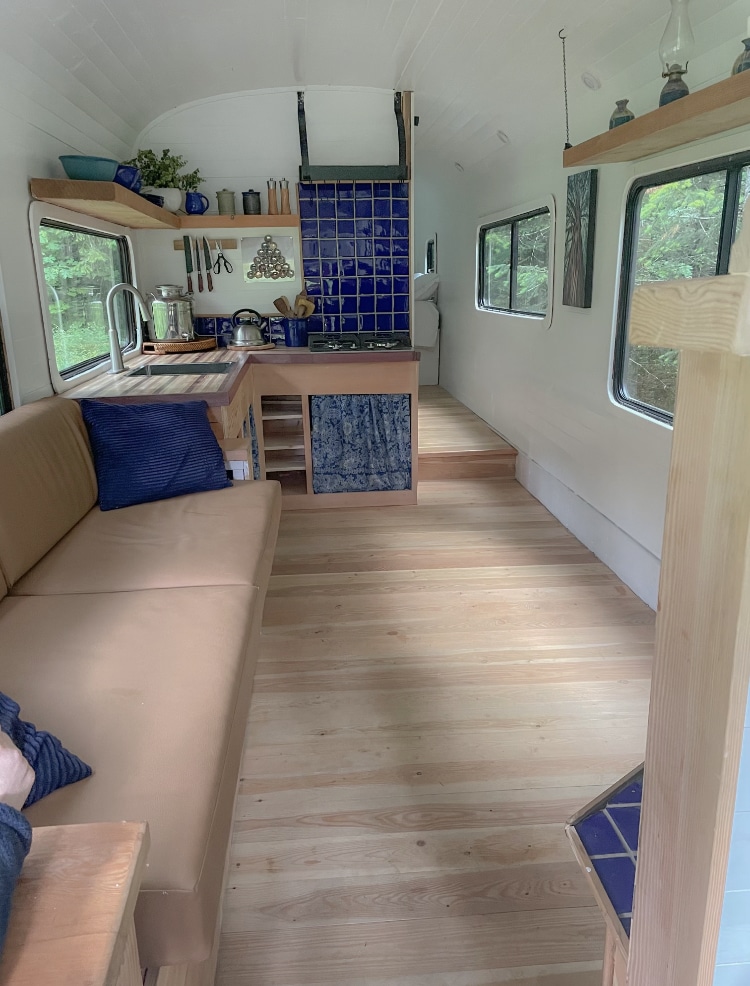
Registration and titling. You’ll need to re-title your bus from a commercial vehicle to an RV or motorhome. The process varies by state but generally involves removing the seats, completing your conversion to a certain point, and passing an inspection. Some states are easier than others. Full guide: registering and titling your bus.
Insurance. You can absolutely get insurance for a converted bus, but not every company writes these policies. National General, Progressive, and a few specialty RV insurers are the most common. Expect to pay $100-250/month for full coverage. Full guide: insuring your bus.
CDL. The short version: if it’s under 26,001 lbs GVWR and registered as an RV with no passenger seats, most states don’t require a CDL. But check your state. Full guide: CDL requirements.
Domicile and taxes. You need a legal address for taxes, voting, and vehicle registration. Most full-timers establish domicile in South Dakota, Texas, or Florida because of favorable tax and registration laws. This is not a loophole, it’s a well-established practice used by tens of thousands of full-time RVers.
Community and Resources
One of the things that surprised me most when I started digging into bus life was how generous the community is. People share everything — their builds, their mistakes, their exact costs, their floor plans. There are Facebook groups with 100,000+ members where people answer questions all day long. There are Instagram accounts documenting every step of a build. There are subreddits, Discord servers, and forums dedicated to every aspect of this lifestyle.

In-person community exists too. Skoolie Swarm, Descend on Bend, and various regional meetups bring hundreds of bus people together every year. People caravan together, help each other with repairs, and form genuine friendships on the road. If loneliness is a concern, and it should be because the road can be isolating, plugging into this community is the single best thing you can do.
For learning the build process, YouTube is your best friend. Channels from actual builders walking through every step of their conversion are essentially free trade school. Watch five different people insulate a bus and you’ll know more than enough to do it yourself.
“How is the insurance on a schoolie conversion?”
Insurance costs less than most people expect. A converted bus registered as an RV typically runs $100-250/month for full coverage, depending on the value of your build, your driving record, and the insurer. Liability-only can be as low as $50-75/month.

The tricky part is finding an insurer who’ll write the policy. Not every company does. National General is probably the most commonly cited in the community. Progressive covers some conversions. There are also specialty insurers like Good Sam that work with non-traditional RVs.
I’d recommend getting quotes from at least three companies before committing. And make sure you’re insuring for the replacement value of your build, not just the book value of the bus itself. A bus worth $5,000 with a $30,000 build should be insured for $35,000. Our insurance comparison guide breaks down the specific companies and what to expect.
Is Bus Life Right for You?
I can’t answer this for you. Nobody can. But I can give you some honest filters.
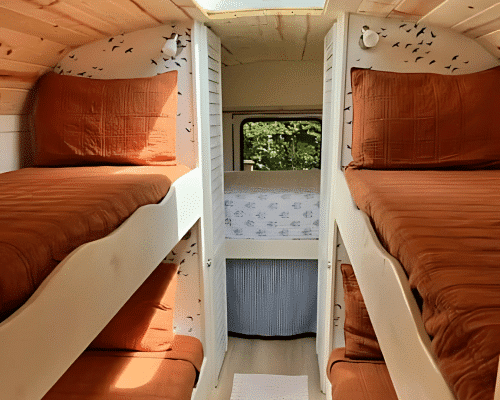
Bus life might be for you if:
- You’re spending more on housing than you can comfortably afford
- You want more flexibility in where you live and how you spend your time
- You’re handy or willing to learn (even from zero)
- You don’t need a lot of stuff to be happy
- You’re okay with uncertainty and problem-solving on the fly
- You’ve genuinely thought about the daily realities, not just the highlight reel
Bus life might not be for you if:
- You need a lot of personal space and can’t compromise on that
- You’re doing it to escape problems that will follow you anywhere
- You hate maintenance, repairs, and dealing with mechanical issues
- You need a stable, consistent daily routine with no disruptions
- You’re expecting it to be cheaper and easier than it actually is
The people who do best in bus life are the ones who go in with realistic expectations and a willingness to adapt. The ones who struggle most are the ones who expected the Instagram version and got the reality version instead.
Where to Go From Here
If you’ve read this far and you’re still interested, good. That’s a better filter than any quiz or checklist. Here’s how I’d suggest you proceed.
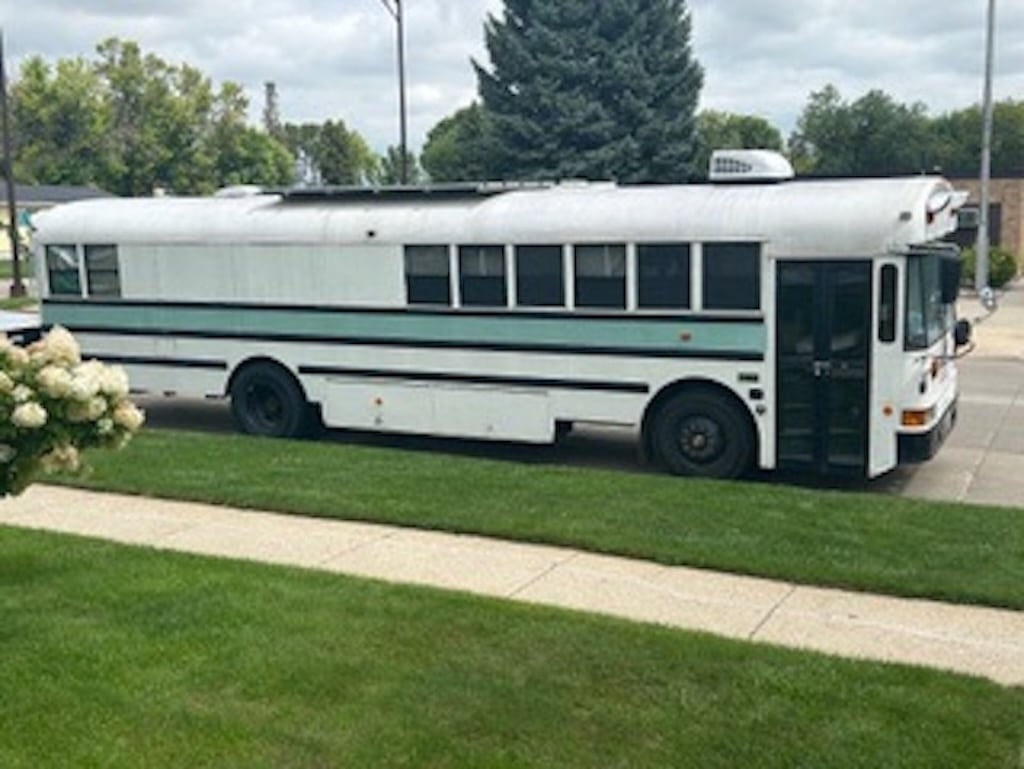
First, figure out your “why.” Not “buses are cool” — your actual reason. Financial freedom? Travel? More family time? Escaping a housing market that doesn’t work for you? Your why shapes every decision after it.
Second, start reading the specific guides that match your situation. If you’re a family, start with bus life with kids. If budget is your primary concern, start with the cost breakdown. If you’re not sure what kind of bus to get, start with how to choose the right bus.
Third, join a community. Seriously. The Facebook groups, the subreddits, the local meetups. Lurk for a while. Ask questions. You’ll learn more from real people’s experiences than from any single article, including this one.
And fourth, go look at a bus in person. I know that sounds basic, but the difference between watching a tour online and actually standing inside a converted school bus is enormous. Find a bus meetup near you or ask someone in a local group if you can check out their build. Once you’re inside one, you’ll know pretty quickly whether this feels exciting or claustrophobic. Trust that gut reaction.
I won’t wrap this up with some motivational one-liner about chasing your dreams. Bus life is practical, sometimes frustrating, occasionally magical, and always real. If it’s for you, you’ll know. And when you’re ready, everything you need to figure it out is already here.