

You’re shopping for a bus and you keep seeing the same engine names pop up in every listing. Cummins this, DT466 that, something about a Cat 3126. But which one do you actually want under that hood, and which ones should you walk away from? (See our guide on Should You Buy a Gas or Diesel School Bus? for more on this.)
The top diesel engines for skoolie builds are the Cummins 5.9L (ISB), Cummins 8.3L (ISC), International DT466, and the International T444E. These are commercial-grade engines that routinely last 300,000-500,000 miles, parts are everywhere, and any diesel mechanic has worked on at least one. For gas buses, the Ford 6.8L V10 and GM 8.1L Vortec are the best options, though they won’t match diesel longevity. If I had to pick one engine for a full-time build, it’d be the DT466 or the Cummins 5.9 — both are proven million-mile platforms with the right maintenance.
Cummins 5.9L (ISB)
I kept running into the Cummins 5.9 when I was first researching bus engines, and there’s a reason for that. This is the same basic engine that made the Dodge Ram Cummins trucks legendary. In school bus form, it’s a 5.9-liter inline six-cylinder turbodiesel that puts out around 190-215 horsepower and roughly 420-460 lb-ft of torque depending on the tune.
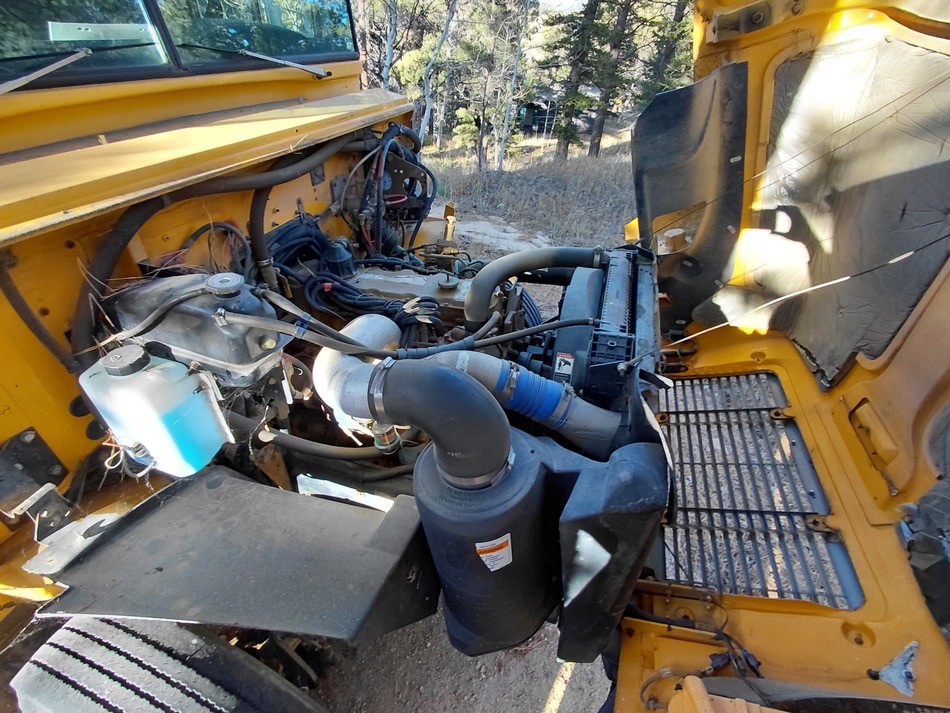
You’ll find the 5.9 ISB in a ton of Blue Bird and Thomas buses from the mid-90s through the mid-2000s. It’s a workhorse that doesn’t ask for much — regular oil changes, fuel filter swaps, and coolant service and it’ll keep chugging along well past 300,000 miles. I talked to a diesel tech at a truck shop once who told me he’d seen multiple 5.9 Cummins engines roll past 500,000 miles with nothing more than injectors and a water pump along the way. That stuck with me. (See our guide on Can You Get a School Bus with a Manual Transmission? for more on this.)
It’s also a relatively compact engine, easier to work on than the bigger diesels. You can reach most components without tearing half the engine bay apart. And because Cummins engines were used in trucks, buses, industrial equipment, marine — parts are everywhere and cheap.
Thanks for the tips! Looking for that million mile engine! What are the top 3 to look for?
The “million mile engine” thing comes up constantly, and honestly it depends on maintenance. But if I’m picking the top three with the best shot at absurd mileage:
- DT466 — this is the one most experienced bus people will point you toward first. Mechanically simple, parts are dirt cheap, and there are documented cases of these going 600,000+ miles without a rebuild.
- Cummins 5.9 ISB — the one we’re talking about right now. It’s got the same DNA as the engines running in Class 8 semis. The bottom end of this engine is nearly indestructible.
- Cummins 8.3 ISC — a bigger version of the 5.9 with more displacement and more torque. Slightly less common in buses but just as tough.
All three of these are inline six-cylinder designs, which is important. Inline sixes are inherently balanced engines — less vibration, less wear on internal components over time. That’s not a coincidence, it’s physics.
Cummins 8.3L (ISC)
The 8.3 is basically the Cummins 5.9’s bigger brother. Same design philosophy, same reliability reputation, just more of everything. You’re looking at about 250-300 horsepower and 660-800 lb-ft of torque. That’s a LOT of pulling power for a school bus.

What size engine is pulling all that weight? Suspension too?
This is actually a great question because it gets at something people don’t think about enough. When you’re building out a skoolie, you’re adding weight. Cabinets, water tanks, batteries, a bathroom, tile if you’re doing that — it adds up fast. Some finished builds come in 5,000-8,000 lbs heavier than the empty bus.
The 8.3 Cummins handles that extra weight without breaking a sweat. Where a smaller engine might be working at 70-80% capacity hauling a loaded build up a mountain grade, the 8.3 is cruising at maybe 50-60%. That matters for longevity. An engine that’s loafing along at partial load lasts a whole lot longer than one that’s constantly being pushed hard.
For suspension, school buses already come with heavy-duty leaf springs and commercial-grade axles. But the weight of your build still matters. I’d recommend weighing your bus at a truck scale (CAT scale) after the build is done. You want to know your actual loaded weight versus your GVWR. If you’re close to the limit, you might need helper springs or airbag assists on the rear axle. That runs $300-$800 installed.
You’ll find the 8.3 in full-size Type C and Type D buses from the late 90s through the mid-2000s. Less common than the 5.9, so you might have to hunt a bit. But the extra displacement means a more relaxed engine at highway speeds, better fuel economy under load, and a quieter ride.
International DT466
Alright, this is the one. If there’s a single engine that more experienced skoolie owners recommend above everything else, it’s the DT466. I can’t tell you how many times I’ve seen this engine come up in forums, Facebook groups, and conversations with people who’ve actually lived in buses for years. (See our guide on How Many Miles Is Too Many When Buying a School Bus? for more on this.)

The DT466 is a 7.6-liter inline six-cylinder diesel that International (Navistar) produced from the early 80s all the way through 2004 in its mechanical form. It makes around 195-250 horsepower depending on the year and configuration, with about 520-620 lb-ft of torque. Not flashy numbers, but more than enough for anything a school bus needs to do.
What makes the DT466 special is its simplicity. The mechanical versions (pre-1994 or so) don’t even have electronic controls. No computer to throw codes, no sensors to fail. It’s a fuel pump, injectors, and a turbo. I read a forum post once from a guy who replaced his injectors in a Walmart parking lot with hand tools. Try that with a modern electronically controlled diesel.
The electronic DT466E (1994-2004) added electronic fuel injection but kept the same tough bottom end. Still a great engine, just slightly more complex.
Parts availability is insane. Millions of these engines were made for buses, box trucks, dump trucks, farm equipment. Oil filters are $8. Fuel filters are $12. An injector rebuild kit is under $200.
International T444E
Here’s where things get interesting, because this engine has a dual identity. The T444E is a 7.3-liter V8 diesel that you’ll find in mid-90s to early-2000s school buses — and it’s essentially the same engine as the Ford 7.3L Power Stroke that truck guys worship. Same block, same heads, same internals. International built the engine and Ford put it in their Super Duty trucks.
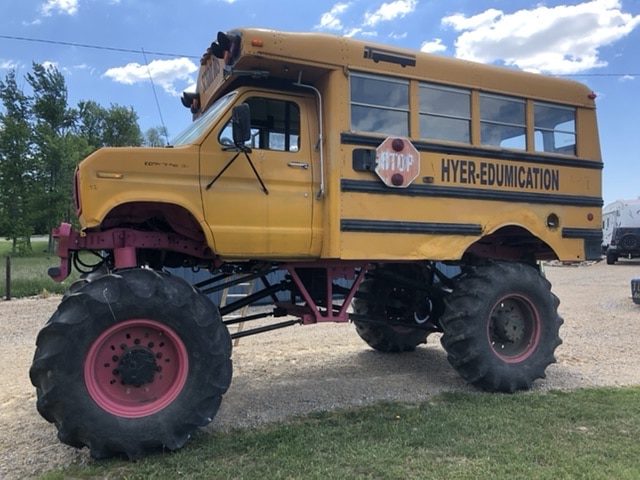
Thoughts on 7.3 Navistar turbo diesel (detuned Power Stroke) 1998 Blue Bird?
I get why this question comes up so much. The 7.3 Power Stroke has an almost cult following in the truck world, so when people find out it’s in school buses too, they get excited. And they should be — it’s a great engine.
In bus form, the T444E is usually “detuned” compared to the truck version. Where a Ford truck might make 235 horsepower, the bus version is dialed down to around 175-195 hp. That sounds like a downgrade but it’s actually a benefit. Lower power output means lower stress on the internals, which means longer life. The engine isn’t working as hard, and it was already overbuilt for the application.
A 1998 Blue Bird with a 7.3 Navistar is a solid find. That era gets you the improved direct-injection version without the complexity of later electronic systems. You’re looking at a hydraulic electronic unit injection (HEUI) system, which is reliable but does have a known weak point — the high-pressure oil pump. Budget $500-$1,000 for the pump if it hasn’t been replaced already. Other than that, these engines are tanks.
The one thing I’d caution on with a 1998 — that’s a 28-year-old bus at this point. The engine will probably outlive the body. Check the frame rails, rocker panels, and floor pans carefully. Rust is what kills these buses, not the engine.
The other thing that makes the T444E attractive — it shares parts with the Ford 7.3 Power Stroke, so you get access to the entire Ford truck aftermarket. Injectors, turbos, oil coolers, you name it. The truck guys have already figured it all out and you benefit from that.
Caterpillar 3116/3126
I’ve got mixed feelings about the Cat engines and I’ll be upfront about that. The 3116 and 3126 are solid power plants — 6.6 and 7.2 liters respectively, inline six-cylinders, 215-300 horsepower — and they’ll run for a long time. Cat built these engines for construction equipment, generators, marine applications, and buses. They’re tough. (See our guide on How Long Does a School Bus Engine Last? for more on this.)
But they’ve got a reputation. The 3126 especially is known for injector problems. The HEUI injectors in the 3126 can fail prematurely, and replacing a full set runs $2,000-$4,000 depending on whether you go remanufactured or new. Some buses need injectors at 150,000 miles, some make it to 300,000. It’s a bit of a lottery.
The 3116 is the earlier, simpler engine and generally has fewer issues. If you find a bus with a 3116, that’s actually a decent find. They’re mechanical injection, which means no electronic headaches. The 3126 can still be a good engine — just go into it knowing the injectors are a when-not-if replacement item and budget accordingly.
Here’s the other thing about Cat engines that nobody mentions upfront. Caterpillar exited the on-highway engine market in 2010 and they’ve been slowly winding down parts support since then. Parts are still available, but they’re getting more expensive and harder to find compared to the Cummins and International stuff. It’s not a crisis right now, but it’s worth thinking about if you’re planning to keep your bus for 10+ years.
How well would the 4 cyl perform at highway speeds VS the 8 cyl?
There might be some confusion here because you won’t find a 4-cylinder diesel in a standard school bus, they’re all sixes and eights. But the highway performance question is a good one.
The Cat 3126 does fine at highway speeds. You’re cruising at 60-65 mph comfortably on a full-size bus. Mountain grades will slow you down to 45-55 mph depending on load, but it gets the job done. Where you feel the difference is long sustained climbs — the 8.3 Cummins or DT466 pull away there. Fuel economy runs about 7-10 MPG, right in line with the other diesels.
Ford 6.8L V10 (Gas)
Alright let’s talk about the gas engines because not every bus on the market is diesel, and not everybody needs a diesel. The Ford 6.8L Triton V10 is the most common gas engine you’ll find in school buses, especially short buses and mid-size Type C buses. It makes around 305 horsepower and 420 lb-ft of torque.
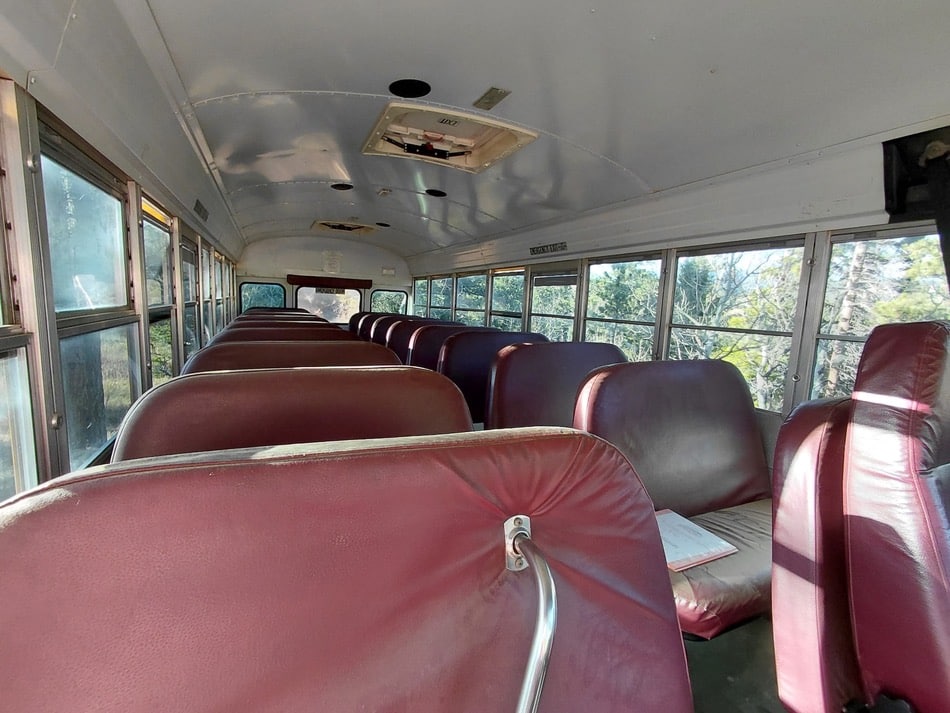
I remember looking at a short bus listing early on in my research and being confused by the V10 designation. Ten cylinders? In a bus? But that’s actually Ford’s answer to the diesel vs gas debate for medium-duty vehicles. Instead of using a diesel for moderate-weight applications, they threw more cylinders at the problem. It works, kind of. (See our guide on What Kind of Gas Mileage Does a Skoolie Get? for more on this.)
The V10 has plenty of power for a short bus or light full-size. Where it falls short is fuel economy and longevity. You’re looking at 6-9 MPG in a full-size and 8-12 MPG in a short bus. These engines can last 200,000+ miles, but they don’t have the 400,000-500,000 mile potential of the diesels.
The advantage is cost. Gas buses are cheaper to buy, cheaper to maintain, and any mechanic can work on them. Parts are at every AutoZone. If you’re building a weekend warrior or a short bus for occasional trips, the V10 is a perfectly reasonable choice.
Watch for spark plug blowout on some model years and broken exhaust manifold studs — both common Ford V10 problems. But the engine itself is reliable if maintained.
GM 8.1L Vortec (Gas)
The 8.1L Vortec is the biggest gas engine GM ever put in a light truck or bus chassis. It’s a 496 cubic inch V8 making around 340 horsepower and 455 lb-ft of torque. You’ll find it in some mid-2000s school buses on the Chevy/GMC platform, and also in some Blue Bird short and mid-size buses.

Kind of an oddball. GM only made it from 2001 to 2009 and it was never as popular as the Ford V10 in bus applications. But the people who have them tend to love them. Big, simple pushrod V8 that makes good torque without a lot of complicated electronics.
A guy I was chatting with online had an 8.1 Vortec in a short bus he’d been living in for three years. Said it drove like a truck, which was exactly what he wanted. Only complaint was fuel economy — 7 MPG highway, 5 in the city. Rough. But the engine had 180,000 miles and ran like new, so the tradeoff was worth it to him. No diesel mechanic needed, just show up at any shop.
If you find an 8.1 Vortec paired with an Allison 1000 transmission, that’s a solid package. The Allison is the same transmission family used in diesel buses and it’s nearly indestructible.
Downsides are the standard gas engine stuff — bad fuel economy, shorter lifespan (200,000-250,000 miles), and the engine working harder to move the same weight. Parts are getting slightly harder to find since GM discontinued the engine, but it shares components with the smaller Vortec engines so it’s manageable.
So Which Engine Do You Actually Pick?
After digging into all of this, here’s where I landed. If you’re doing a full-time build on a full-size bus and you want the engine to be the last thing you ever worry about, get a DT466 or a Cummins 5.9. Both are proven, both are cheap to maintain, and both will outlast every other component on the bus. The DT466 edges it out slightly on simplicity and parts cost. The Cummins edges it out on aftermarket support and power.

If you find a bus with a Cummins 8.3 or a T444E, don’t pass it up. Those are excellent engines with minor caveats. The Cat 3116/3126 is fine if the price is right and you budget for injectors.
For gas engines, the Ford V10 is the safer bet just because there are more of them out there and parts will always be available. The GM 8.1 is the better engine in my opinion, but the parts situation is something to keep in mind.
And honestly? Don’t let the engine be the only thing you look at. I made this mistake early on, getting tunnel vision on the powertrain and forgetting to check the body, frame, and transmission. A perfect engine bolted to a rusting frame doesn’t do you any good. Check the whole bus, not just what’s under the hood. That’s the advice I wish somebody had given me earlier.