

This is the article nobody wants to write, and honestly, I get why. Domicile law isn’t exactly riveting stuff. But I can tell you from experience that figuring out your domicile is the single most important piece of paperwork standing between you and actually living full-time in a bus. It touches everything — your driver’s license, your taxes, where you vote, how you get mail, what you pay for insurance, and a dozen other things you probably haven’t even thought about yet. (See our guide on How to Set Up a Domicile and Mailing Address for Full-Time Bus Life for more on this.)
Domicile is your legal home base — the one state that considers you a resident for tax, voting, and legal purposes. When you live in a bus and don’t have a traditional house, you still need one state to call home. Most full-time bus lifers establish domicile in South Dakota, Texas, or Florida because all three have zero state income tax and make it easy for nomads to set up residency. You’ll need a mailing address (through a mail forwarding service, not a PO Box), a driver’s license in that state, vehicle registration, voter registration, and updated banking and insurance info. This guide walks through every piece of it — what domicile actually means, which state to pick, how to set it up step by step, and how it affects everything from your taxes to jury duty.
What Does Domicile Actually Mean Legally?
I’ll be honest, I used the words “domicile” and “residence” interchangeably for way too long before somebody set me straight. They’re not the same thing, and the difference matters.
Your residence is wherever you’re physically staying. If you’re parked at an RV park in Arizona tonight, Arizona is your current residence. If you drive to New Mexico next week, now that’s your residence. It changes every time you move.
Domicile is different. Your domicile is the one state you consider your permanent legal home — the place you intend to return to, or at least the place that anchors your legal identity. You can only have one domicile at a time. It’s where you pay state taxes, where you’re registered to vote, where your driver’s license is issued, and where a court would say you “live” if it ever came down to a legal dispute. (See our guide on Can You Legally Live in a Converted School Bus? for more on this.)
For people in houses, domicile and residence are usually the same place. For bus lifers, they almost never are. Your domicile might be South Dakota, but you haven’t set foot in South Dakota in eight months. That’s fine. The legal system allows for that, and it’s been established through decades of case law around military families, traveling salespeople, and RV full-timers who came before us.
What makes domicile stick is intent. You need to demonstrate that you intend for that state to be your permanent home. Getting a driver’s license there, registering to vote, using a mailing address there — all of that establishes intent. I found this out when I was researching and one lawyer’s blog laid it out really cleanly. The two things that matter are physical presence (you need to actually visit the state at some point) and intent to remain (demonstrated through all your official paperwork pointing to that state). (See our guide on Do You Need a CDL to Drive a Skoolie? for more on this.)
Why Does Your Domicile State Even Matter?
So you might be wondering why this even matters if you’re just rolling around the country in a bus. Can’t you just… not pick a state?
No. And I learned this the hard way when I started looking into the practical side of things. Every system in America assumes you live somewhere. Your bank needs an address. Your insurance company needs a state of residence to calculate your rates. The IRS needs to know which state return you’re filing. Your driver’s license has to come from one specific state. If you don’t intentionally pick a domicile state, one will get assigned to you — usually the last state where you had a traditional address — and it might be one with high income taxes or expensive insurance. (See our guide on Can You Get Insurance for a Converted School Bus? for more on this.)
I talked to a guy at a campground once who hadn’t updated anything when he went full-time. He still had his California driver’s license, his bus was registered in California, and he was paying California state income tax — all while living in a bus parked in Texas. When I told him most full-timers establish domicile in a no-income-tax state, he just stared at me for a second. He’d been paying about $3,800 a year in state income tax he didn’t need to be paying.
That’s why this matters. The state you choose as your domicile determines your state income tax rate (or whether you pay any at all), your vehicle registration costs, your insurance premiums, your access to ACA healthcare plans, and which courts have jurisdiction over you. Pick the wrong state and you could be paying thousands more per year for the exact same lifestyle.
Popular Domicile States and Why Everyone Picks Them
Three states dominate the full-time nomad domicile conversation: South Dakota, Texas, and Florida. There are others that work, but these three have been the go-to choices for decades, going back to long before the skoolie movement even existed. RV full-timers figured this out in the 1980s and the playbook hasn’t changed much.
South Dakota
South Dakota is the king of nomad-friendly states and it’s not particularly close. I’d say at least half the full-timers I’ve talked to are domiciled there.
Here’s why. No state income tax. Vehicle registration is cheap — you’re looking at around $50-$150 depending on your vehicle’s weight and age, which is nothing compared to states like California or Massachusetts where you might pay $500+. There’s no vehicle safety inspection required. The process to establish domicile is stupid easy — you just need to spend one night in the state and you can walk into the DMV the next morning.
The mail forwarding services in Rapid City and other SD cities are set up specifically for nomads. Americas Mailbox is probably the most well-known one. You sign up, get a real street address, spend a night at a campground or hotel, go get your driver’s license, register your vehicle, and you’re done. The whole thing can happen in two or three days. (See our guide on How Do You Register a Converted School Bus as an RV? for more on this.)
One thing I didn’t know before I researched this — South Dakota doesn’t require you to maintain any ongoing physical presence in the state. Once you establish domicile, you don’t need to come back every year. Some states require you to spend a certain number of days there annually. South Dakota doesn’t care.
Insurance is generally affordable compared to coastal states, and the DMV offices in the Rapid City area are used to dealing with full-timers. They know exactly what you’re doing when you walk in with a mail forwarding address and an out-of-state bus. It’s not weird to them.
Texas
Texas is the other big one, and there are a few reasons you’d pick it over South Dakota.
No state income tax, same as South Dakota. Vehicle registration is in the ballpark of $50-$75 for most converted buses, which is competitive. The Escapees RV Club is headquartered in Livingston, Texas, and they’ve been providing mail forwarding and domicile support for full-timers since the 1970s. They literally invented this whole system for RV full-timers. If you’re going to use Escapees for your mail service, Texas makes natural sense as your domicile state.
Texas does require a vehicle safety inspection, which South Dakota does not. That’s the main downside. Your converted bus needs to pass inspection, and depending on what state it was previously registered in and how your conversion looks, that can be anything from simple to a minor headache. I heard from one guy who said his inspection took ten minutes and was no big deal. Another person told me she had to fix a cracked windshield and replace a turn signal bulb before hers would pass. Pretty normal car inspection stuff, nothing specific to the conversion itself.
Insurance rates in Texas can be a bit higher than South Dakota, especially if you’re in a metro area. But since you’re using a mailing address in a smaller city (like Livingston), it’s usually reasonable.
Florida
Florida rounds out the big three. No state income tax. Good insurance options. The homestead exemption can protect your assets if you ever end up in a lawsuit, which is something most people don’t think about but is actually a huge deal.
Florida’s downside is that vehicle registration tends to be more expensive than South Dakota or Texas. Depending on the weight of your bus, you could be looking at $200-$400+ annually. Insurance can also be pricier because Florida’s insurance market is just generally more expensive due to weather risk and the number of uninsured drivers.
I noticed that Florida seems more popular with full-timers who spend a significant amount of their year in the Southeast. If you’re going to be traveling through Florida regularly anyway, it makes sense. If you’re more of a West and Mountain states traveler, South Dakota makes more geographic sense, not that you have to visit your domicile state regularly.
What About Other No-Income-Tax States?
There are other states with no income tax — Nevada, Wyoming, Washington, New Hampshire, Alaska, Tennessee. They work too, technically. But they don’t have the same infrastructure for nomads. There aren’t well-established mail forwarding services set up in those states specifically for full-timers. The DMVs aren’t used to processing nomad domicile requests. It can be done, but you’d be reinventing the wheel when South Dakota, Texas, and Florida have already paved the road.
I did run across a handful of people using Wyoming because it has very low registration fees and no income tax, but they all said the mail forwarding situation was less convenient than what’s available in South Dakota.
“Do you have an address or do you have to keep a post office box for mail?”
This is one of the most common questions I see, and the answer trips people up because there’s an important distinction most people miss.
You need a real street address, not a PO Box. A PO Box won’t work for most of the things you need it for. You can’t get a driver’s license with a PO Box in most states. Many insurance companies won’t accept a PO Box. Banks sometimes reject them. And some government agencies flat out require a residential-style address.
What most full-timers use is a mail forwarding service that gives you what looks like a regular street address. It’s formatted like “123 Main Street, Suite 456, Rapid City, SD 57701.” The “Suite 456” is actually your box number, but to anyone looking at it — your bank, the DMV, your employer — it looks like a normal apartment address.
This isn’t some sneaky loophole either. It’s completely legal and the USPS has guidelines for exactly this type of address formatting (it’s called a Commercial Mail Receiving Agency, or CMRA). The forwarding services operate under USPS regulations and everything is above board. I was a little nervous about it at first, thinking it was some kind of gray area, but it’s not. These services have been operating for 40+ years.
You do NOT want to just use a PO Box. I can’t stress this enough. A PO Box is fine for receiving packages or magazine subscriptions, but it is not a residential address and it will cause problems with your driver’s license, insurance, and banking if that’s all you have.
“How do y’all get mail? Is it a PO Box?”
So here’s how the mail forwarding process actually works day to day, because when I first looked into it, I was confused about the mechanics.
You sign up with a mail forwarding service. They give you a street address. You file a USPS change of address form so all your mail gets redirected there. When mail arrives at the forwarding service, they do one of several things depending on what you’ve chosen.
Some services scan the outside of every envelope and email you a photo. You look at it on your phone and decide — forward it to me, open it and scan the contents, shred it, or just hold it. Other services automatically open and scan everything. The fancier ones have apps where you manage all of this from your phone, sitting in your bus wherever you happen to be parked.
When you want physical mail forwarded, they bundle it up and ship it to wherever you tell them. Some people have it sent to a campground they’ll be at next week. Others have it sent to a friend’s house. Some use General Delivery at a post office near where they’re traveling (that’s a free USPS service where they hold mail for you at a local post office and you pick it up at the counter).
Honestly, I get less mail now than I did when I had a house. Almost everything is digital — bank statements, tax documents, bills. The physical mail I do get is mostly junk that I tell the forwarding service to shred. Maybe once every two or three months I actually need something physically forwarded. The rest I just view as scans.
Mail Forwarding Services: Which One Should You Pick?
I spent way too long comparing these, so let me save you the trouble. There are three main players and a few smaller ones.
Escapees RV Club (Livingston, Texas)
Escapees has been doing this since the 1970s and they’re the OG of nomad mail services. You join the club ($50/year for membership), then the mail service itself is around $100/year on top of that. They give you a Texas street address. They hold your mail and forward it on your schedule, usually weekly or on-demand.
The nice thing about Escapees is that the membership comes with other perks beyond mail — discounts at campgrounds, a community of full-timers, and they even have a service that helps you get your driver’s license and vehicle registration in Texas. They’ll practically hold your hand through the whole domicile process. I talked to one couple who said the Escapees staff walked them through every form at the DMV. That kind of support is worth a lot when you’re doing this for the first time.
Downside: their mail scanning isn’t as slick as the more tech-forward services. It’s more of a traditional forwarding setup where they bundle and ship your mail, rather than scanning everything digitally.
Americas Mailbox (Box Elder, South Dakota)
This is the one most South Dakota domicilers use. They’re in Box Elder, right next to Rapid City, and they know exactly what full-timers need. Their service runs about $200-$300/year depending on the plan.
Americas Mailbox will scan your envelopes, open and scan contents on request, forward packages, and they also help with the domicile process. They have a checklist for everything you need to do when you arrive in South Dakota — which campgrounds to stay at, where the DMV is, what documents to bring. When I was looking into this, their FAQ section alone answered about 80% of my questions before I even signed up.
They also handle package receiving, which is important if you order things from Amazon regularly (and let’s be honest, who doesn’t while living in a bus). You can have packages sent to your Americas Mailbox address and they’ll hold them or forward them.
Traveling Mailbox (Various Locations)
Traveling Mailbox is the most tech-forward option. They’re not specific to one state — they have addresses in multiple states including some of the popular domicile states. Plans start around $15/month ($180/year).
Their whole system is app-based. Every piece of mail gets scanned automatically. You view it on the app, tap to open and scan, tap to forward, tap to shred. It’s very slick. If you’re the type of person who manages everything from your phone, this is probably the best user experience.
The trade-off is that they don’t offer the same hands-on domicile support that Escapees and Americas Mailbox do. They’re a mail service, not an RV club. You’re on your own for the DMV and registration stuff.
Other Options
There are smaller services too — St. Brendan’s Isle in Florida, Dakota Post in South Dakota, My RV Mail, Earth Class Mail. They all work. I don’t think you can go terribly wrong with any reputable mail forwarding service. The main decision is really which domicile state you want, and then you pick the service that operates there.
“I’m very curious about the legal logistics of living like this. Like I’d assume y’all don’t pay property taxes but where do they mail tax stuff to?”
This question comes up constantly, and I love it because it shows someone thinking through the practical reality of bus life instead of just the Instagram version.
You’re right — no property taxes on a bus. It’s a vehicle, not real estate. But you still have to deal with taxes in general, and where they “mail tax stuff” is your mail forwarding address. That’s the whole point of establishing domicile and having a mailing address. Your W-2s, 1099s, and any IRS correspondence goes to your forwarding address. You view it as a scan or have it physically forwarded.
Now let me dig into the tax picture a bit more because this is where choosing your domicile state really pays off — literally.
State Income Tax
If your domicile is in South Dakota, Texas, or Florida, you pay zero state income tax. That’s the biggest financial reason full-timers choose these states. If you’re earning $50,000 a year remotely, that’s a savings of anywhere from $2,000 to $6,000+ annually compared to being domiciled in a state like California (up to 13.3%), New York (up to 10.9%), or Oregon (up to 9.9%).
I did the math when I was figuring this out. If you earn $60,000 and you’re domiciled in California, you’re paying roughly $3,000+ in state income tax. Domiciled in South Dakota? Zero. That’s $3,000 a year, which covers your mail forwarding service for the next decade with money left over for diesel. It’s kind of a no-brainer.
There are some quirks though. If you earn income in a specific state — like you pick up a temporary job while parked in Colorado — you might owe Colorado income tax on those wages regardless of where you’re domiciled. This is called “source state” taxation. Most people who work remotely and get paid by an employer in another state don’t run into this, but it’s worth knowing about.
And yeah, I know taxes are boring. But I’ve seen people lose thousands of dollars because they didn’t change their domicile before going full-time. One woman in a Facebook group posted about owing $4,200 in California state income tax for her first year of bus life because she never bothered to change her driver’s license. California considered her a resident. Don’t be that person.
Federal Taxes
Federal taxes work the same whether you live in a house or a bus. You file with the IRS, you use your domicile address. Nothing changes there. The IRS doesn’t care that you live in a vehicle — they just want your money on time.
You might actually qualify for some deductions you didn’t have before, depending on your situation. If you work remotely from your bus and your bus is your primary workspace, there may be a home office deduction angle. I’d talk to a CPA about that one rather than guessing, because the rules around vehicle-based workspaces are fuzzy and I don’t want to give bad tax advice.
“How do you get a mailing address living in a bus?”
I’ve covered this above with the mail forwarding services, but let me address this specific question head-on because it usually comes with a layer of “is this even possible?” energy.

Yes, it’s possible. Hundreds of thousands of full-time RVers and bus lifers do it. The process is straightforward.
Step one: pick your domicile state. Step two: sign up for a mail forwarding service in that state. Step three: physically visit the state (South Dakota requires one night, Texas requires visiting the Escapees office, Florida requirements vary). Step four: go to the DMV and get your driver’s license with the forwarding address. Step five: update everything else to that address — bank, insurance, voter registration, vehicle registration.
That’s it. It sounds like a big deal, and the first time through it feels like one. But once you’ve done it, you’ve got a mailing address that works for everything, and you don’t have to think about it again unless you decide to change domicile states.
The address works for government mail, bank statements, Amazon deliveries, jury summons — all of it. It is, for all legal and practical purposes, your home address. The fact that your actual home is on wheels doesn’t matter.
Setting Up Domicile Step by Step
Alright, let me walk through the actual process from start to finish. I’m going to use South Dakota as the example since it’s the most popular, but the process for Texas and Florida is similar with some state-specific differences.
Before You Go
Get your documents together. You’ll need your current driver’s license, your vehicle title, proof of insurance, your Social Security card (or at least the number), and a passport or birth certificate as a secondary ID. South Dakota’s DMV requires two forms of identification.
Sign up for your mail forwarding service online before you arrive. Americas Mailbox can set up your account ahead of time so your address is active when you get there. This way you can use the address on your DMV paperwork on day one.
Day One: Arrive and Establish Presence
Drive to the Rapid City area. Stay at a campground or hotel for at least one night. Keep your receipt — this is your proof of overnight stay in South Dakota, which is all you need to establish physical presence.
If you’re using Americas Mailbox, stop by their office. They’ll walk you through everything you need for the DMV and will give you the specific documents showing your address at their location.
Day Two: DMV and Registration
Go to the Pennington County DMV (or whichever county your mail service is in). Bring everything — your IDs, your mail service documents, your overnight receipt. Surrender your old driver’s license and apply for a South Dakota license.
Same day or next day, register your vehicle in South Dakota. You’ll need your vehicle title, proof of insurance (update your insurance to the SD address first if possible, or at least call your insurance company and let them know you’re switching states), and payment for registration fees. For a converted bus registered as an RV, expect $50-$150 depending on weight.
If your bus is still titled as a school bus and not yet re-titled as an RV, you may need to handle that re-titling first. This process varies — South Dakota is pretty relaxed about it, but you’ll want to have your conversion documentation ready (photos of the interior showing it’s been converted into living space with sleeping, cooking, and bathroom facilities).
Day Three and Beyond: Update Everything Else
Once you have your new driver’s license and vehicle registration, it’s time to update the rest of your life. I made a checklist when I was going through this, and it was longer than I expected.
Bank accounts — update your address online or call customer service. Credit cards — same thing. Voter registration — you can register in South Dakota at the DMV or by mail. Insurance — call your provider and update your state of residence (this may change your rates, usually for the better if you’re coming from a high-cost state). Cell phone account — update your billing address. Any subscriptions, memberships, or services that have your old address — update them.
This trickle of address changes takes a couple weeks to fully work through. Every time you think you’ve caught everything, some random service sends something to your old address. I’d recommend setting up USPS mail forwarding from your old address to your new one as a safety net, so anything you miss still gets redirected.
Driver’s License Considerations
Your driver’s license is the anchor document for your domicile. It’s the one thing that definitively says “I’m a resident of this state.” Getting it switched to your domicile state should be priority number one.
Most states require you to surrender your old license when you get a new one. You can’t hold driver’s licenses in two states simultaneously — that’s actually illegal.
One thing I didn’t realize until I started digging into this: some states are slower than others to “release” you as a resident. If you’re leaving a state like New York or California, their tax authority might still consider you a resident for the tax year in which you moved, even after you’ve switched your license. The general rule is that you need to make a clean break — switch your license, register your vehicle, update your voter registration, and move your banking all in the same timeframe. Don’t leave loose threads in your old state.
For the actual license, South Dakota requires a written knowledge test if you’re over 18 and transferring from out of state. It’s the basic road rules test, not a driving test. Takes about 15 minutes. Texas doesn’t require any testing for out-of-state transfers. Florida requires a vision test.
Vehicle Registration Specifics
When you register your bus in your new domicile state, a few things to keep in mind.
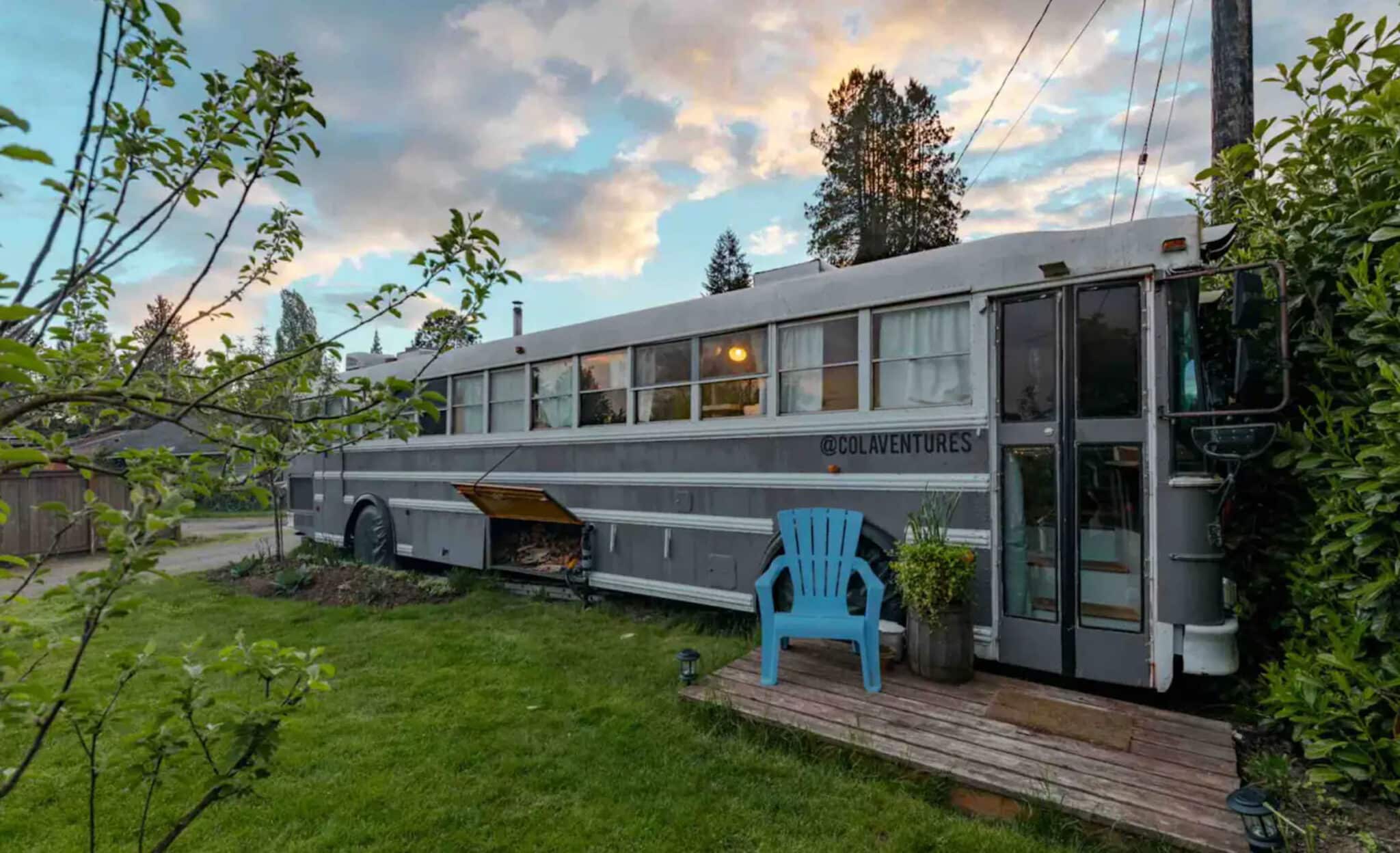
If your bus is already titled as an RV in another state, the transfer is usually straightforward. You’re just moving the registration. If it’s still titled as a school bus, you might need to go through the re-titling process in your new state, which can involve an inspection or at minimum some documentation showing the conversion.
South Dakota has no safety inspection requirement, which is one of the reasons it’s so popular. You bring your title, your insurance, and your money, and they register it. Texas requires an inspection. Florida requires a VIN verification.
Registration costs vary by state and by the weight/type of your vehicle. I put together a rough comparison based on what I found.
South Dakota: $50-$150 annually for an RV, depending on weight class. Texas: $50-$75 plus inspection fees. Florida: $200-$400+ depending on weight.
These numbers are approximate and change, so check with the specific state’s DMV website before you go. But they give you a ballpark.
Voting From Your Bus
You can absolutely vote as a full-time bus lifer, and you should. Register in your domicile state when you set up everything else.

Most domicile states offer absentee voting, which is how you’ll vote in most elections since you probably won’t be physically in South Dakota on election day. You request an absentee ballot, they mail it to your forwarding address (or in some states you can request it online), you fill it out, and mail it back.
South Dakota allows no-excuse absentee voting, meaning you don’t need a reason — you just request the ballot. Texas has some restrictions on who can vote absentee, which is one knock against it as a domicile state. Florida also offers no-excuse absentee voting.
When I was looking into this, I found that some bus lifers actually time their travel to be in their domicile state for major elections. Others have voted absentee for years without any issues. The system works — you just have to be proactive about requesting your ballot early enough that it arrives and you have time to send it back before the deadline.
Banking and Financial Accounts
Updating your bank to your new domicile address is important but usually painless. Most banks let you change your address online in about two minutes.
One thing to be aware of: if you use a regional bank or credit union that only operates in your old state, you might want to switch to a national bank. Being domiciled in South Dakota while banking with a credit union in Pennsylvania can create headaches. Not legal ones, just practical ones. Some credit unions require you to live in their service area.
I found that a lot of full-timers use online-only banks like Ally, Discover, or Capital One 360. No physical branches to worry about, they work everywhere, and they don’t care what state you’re in. If you need cash deposits, a national bank with ATMs everywhere like Chase or Bank of America works too.
For receiving checks — if someone sends you a physical check, which still happens more than you’d think — your mail forwarding service can scan it and many banks accept mobile deposit through their app. So you don’t even need the physical check in hand.
Insurance Implications
I covered insurance in detail in our full guide to insuring a converted bus, but here’s the domicile-specific piece.
Your insurance rates are based partly on where you’re domiciled. Insurance companies use your home address to calculate risk. South Dakota generally has lower premiums than coastal states. Texas is middle of the road. Florida can be expensive due to hurricane risk, even though you might not be anywhere near Florida most of the year.
When you switch your domicile, call your insurance company and update your address. Your rates may go up or down. Most people coming from high-cost states see their rates drop. One person I talked to said their annual premium dropped by almost $600 just by switching from New Jersey to South Dakota.
If your current insurance company won’t cover a bus conversion in your new state, you may need to switch carriers. National General, Good Sam, and Roamly are all familiar with converted buses and work in the popular domicile states. It’s one of those “call around and get quotes” situations.
Healthcare Marketplace and Your Domicile Address
This is a piece that catches people off guard and honestly, it almost caught me off guard too. Your ACA marketplace options are determined by your domicile state. When you go to healthcare.gov, you shop for plans in whatever state your legal address is in.
So if you’re domiciled in South Dakota, you’re shopping South Dakota marketplace plans. The available insurers, plan options, and costs are all specific to that state. Some states have better marketplace options than others.
Here’s where it gets tricky for bus lifers. If your plan has a narrow provider network, you might have excellent coverage in South Dakota and terrible coverage everywhere else you travel. PPO plans that work nationwide are available but they cost more.
I talked to a few full-timers who said they specifically chose their domicile state partly based on healthcare marketplace options. It’s not the top consideration for most people, but if you have ongoing medical needs, it’s worth looking at what plans are available in South Dakota vs. Texas vs. Florida before you commit. We covered this more in our healthcare guide for bus lifers.
One workaround some people use: telehealth. Many plans cover telehealth visits regardless of where you physically are. So even if your network is limited to South Dakota providers, you can do video visits from anywhere. For routine stuff — prescription refills, minor issues — this works great. For anything requiring hands-on care, you’ll need to find in-network providers wherever you happen to be, or pay out of network rates.
Jury Duty: Can They Find You?
Yes, they can find you. And yes, you might get called. When you register to vote and get a driver’s license in your domicile state, you go into the jury pool.
If you get a jury summons at your forwarding address, you have a few options. You can request a postponement, which most courts grant pretty easily, especially if you explain you’re hundreds of miles away. You can request an excusal due to distance, which many jurisdictions allow. Or, in rare cases, you can actually show up — some people plan a visit to their domicile state around jury duty.
I haven’t heard of anyone having serious problems with this. Most full-timers get a summons every few years, request a postponement or excusal, and that’s the end of it. The courts understand that people travel. You’re not going to get a warrant because you missed jury duty in South Dakota while parked in Oregon. But you do need to respond to the summons. Don’t just ignore it.
Using a Family Member’s Address vs. a Mail Forwarding Service
I see this question all the time — “why can’t I just use my parents’ address?” You can. It works. But there are trade-offs you should understand before going that route.
When I was weighing this decision, the biggest factor was tax implications. If your parents live in a state with income tax, using their address means you’re domiciled in that state. You’re filing state income tax there. If they’re in California, that could be a 9-13% state income tax rate on your income. If they’re in Tennessee or Florida, no problem — there’s no state income tax anyway.
Other considerations. Using a family member’s address ties your legal life to their location. If they move, you have to update everything. If they decide they don’t want to deal with your mail anymore, that’s a problem. There’s also the issue of it not being “your” address — some government agencies ask if you actually live at the address on your license, and while plenty of people fudge this, a mail forwarding service is a cleaner legal arrangement.
On the plus side, using family is free. No $200/year mail service fee. They can text you a photo of your mail. They can forward packages easily. If your family lives in a tax-friendly state and you trust them to handle your mail reliably, it’s a legitimate option.
Here’s my take on it after looking at everything. If your family is in a no-income-tax state and they’re happy to handle your mail, go for it. If they’re in a state with income tax, the mail forwarding service pays for itself in tax savings within the first month or two. I’ve seen people save enough in the first year to cover the forwarding service for the next five years. It’s really not a hard decision when you run the numbers.
The Order of Operations — Getting It All Done
When I was putting this all together, I realized that the order you do things in actually matters. You can’t register your vehicle in a new state without insurance in that state. You can’t get insurance without an address. You can’t get a driver’s license without an address. Everything is interconnected, and if you do it in the wrong order, you end up going back to the DMV twice.
Here’s the order that works.
First, sign up for your mail forwarding service and get your address established. This can be done online from wherever you are.
Second, call your insurance company and update your address to the new state, or get a new policy in the new domicile state. You need active insurance before you can register your vehicle. Some people get a new policy and cancel the old one once the new one is active.
Third, physically go to the domicile state. Stay overnight (keep the receipt).
Fourth, go to the DMV. Get your driver’s license first. Then register your vehicle. Bring everything — you don’t want to make two trips.
Fifth, register to vote while you’re at the DMV or do it by mail afterward.
Sixth, update everything else over the following weeks — bank, credit cards, subscriptions, employer, cell phone, anything that has your address on file.
The whole in-state portion takes two to three days if you plan it right. I know people who’ve done it in one very long day, but why rush it? Make it part of a trip. Spend a few days in South Dakota, see Mount Rushmore, eat a steak, and get your paperwork handled.
Common Mistakes to Avoid
After reading through dozens of forum threads and talking to people who’ve been through this, I put together a list of the mistakes that come up over and over.
Not cutting ties with your old state. If you leave your old driver’s license active, keep a PO Box there, or stay registered to vote there, your old state may still consider you a resident and try to tax you. Make a clean break.
Using a PO Box instead of a mail forwarding service. I keep coming back to this because people keep making this mistake. A PO Box is not a residential address. It won’t work for your driver’s license, and it creates problems with insurance and banking.
Not updating insurance before going to the DMV. The DMV needs proof of insurance in the new state. If you show up with insurance from your old state, some DMVs will send you away.
Forgetting about your old state’s tax filing. Even if you switch domicile mid-year, you may owe your old state income tax for the portion of the year you were a resident there. File a part-year return in both states.
Choosing a domicile state based only on taxes. Taxes are the biggest factor, sure. But also consider insurance costs, registration requirements, healthcare marketplace options, and how easy the state makes the whole process. South Dakota wins on almost all of these, which is why it’s so popular. But your situation might be different.
Wrapping Up
So that’s the whole picture. I know it’s a lot. When I first started digging into domicile stuff, my eyes glazed over about halfway through and I had to come back to it a couple times before everything clicked. But once you actually do it, you realize it’s not that complicated — it’s just a bunch of paperwork that you knock out in a long weekend.
The people who struggle with this are the ones who try to skip it or half-do it. They keep their old state’s license, use their mom’s address in California, and then wonder why they’re still paying state income tax. Or they get a PO Box and then can’t figure out why their insurance application keeps getting rejected.
Do it right the first time. Pick your domicile state, sign up for a mail forwarding service, take the trip, knock out the DMV in a day, and then spend the next couple weeks updating your accounts from whatever campground you end up at. After that, you don’t think about it again. Your mail shows up as scans on your phone, your taxes are simpler than they’ve ever been, and you’ve got one less thing to worry about while you’re out enjoying bus life.
It’s the least exciting part of going full-time, I’ll give you that. Nobody’s making YouTube videos about their trip to the South Dakota DMV. But it’s the foundation everything else sits on, and getting it right from the start saves you money and headaches down the road. Do the boring stuff first, then go have your adventure.