

Weight is the thing that can quietly ruin an otherwise great bus build, and most people don’t think about it until it’s too late. I learned this the hard way when I started digging into what actually goes into a conversion and realized just how fast the pounds add up.
Every bus has a Gross Vehicle Weight Rating (GVWR), which is the absolute maximum the whole thing — chassis, passengers, cargo, water, build materials, everything — is supposed to weigh. A typical full-size school bus has a GVWR between 29,000 and 36,000 lbs, and the empty bus itself weighs roughly 17,000 to 24,000 lbs. That leaves you somewhere between 8,000 and 15,000 lbs for your entire conversion. Sounds like plenty until you start adding wood framing, water tanks, appliances, tile, and batteries. The only way to know for sure where you stand is to weigh your bus on a certified scale, and you should be doing that more than once during your build.
What Is GVWR and Why Does It Matter?
So GVWR stands for Gross Vehicle Weight Rating. It’s a number set by the manufacturer that represents the maximum safe operating weight for that specific vehicle. This isn’t a suggestion — it’s the number that the frame, axles, suspension, brakes, and tires were engineered to handle.
I didn’t really grasp why this mattered until I started reading about what happens when you exceed it. Your brakes are designed to stop a certain amount of weight. Your tires are rated for a certain load. Go over that number and you’re asking every system to do more than it was built for. It’s a safety issue, not just a technicality.
And here’s the part that catches people off guard. The GVWR isn’t just about the bus and the build. It includes the driver, every passenger, all your personal stuff, full water tanks, full fuel tank, food, tools, that cast iron Dutch oven you swore you’d use every week. All of it. So that gap between your empty bus weight and the GVWR? It shrinks faster than you’d think.
How to Find Your Bus’s GVWR
This part is actually pretty straightforward, which is nice because nothing else about bus conversions is.
There’s a sticker on your bus, usually on the driver’s side doorframe or on the dash, that has the GVWR printed right on it. It’s the federal certification label and every vehicle manufactured for the US market has one. It’ll list the GVWR (total vehicle), the GAWR front (front axle weight rating), and the GAWR rear (rear axle weight rating). Write all three numbers down. You’ll need them.
If the sticker is gone or faded, you can look up the VIN with the manufacturer — Blue Bird, Thomas, IC Bus, they all have records. Or call a dealer that services that brand of bus and give them the VIN. They can pull it up. The original title or registration paperwork sometimes lists it too.
One thing I want to mention because it tripped me up at first. Don’t confuse GVWR with GCWR. GVWR is the rating for the vehicle alone. GCWR is the Gross Combined Weight Rating, which includes the vehicle plus anything you’re towing. If you’re planning to tow a car behind your skoolie, you need both numbers.
Here are the rough GVWR ranges I found for common bus types:
- Short bus (Type A): 10,000 to 14,500 lbs
- Mid-size school bus: 19,500 to 25,000 lbs
- Full-size school bus (Type C): 25,500 to 33,000 lbs
- Full-size flat nose (Type D): 29,000 to 36,000 lbs
- Transit bus: 25,000 to 42,000 lbs
The bigger the bus, the more GVWR you generally have to work with. But bigger buses also weigh more empty, so don’t assume a bigger bus means more room for build weight.
How Much Does a Typical Build Add?
This is where people start getting nervous, and honestly, they should be.
I spent a while going through build logs and forum posts where people had actually weighed their finished buses. A basic, no-frills conversion on a full-size bus — vinyl plank floors, minimal cabinets, composting toilet, basic plumbing, solar setup — tends to add 3,000 to 5,000 lbs. A mid-range build with real cabinets, some tile, a decent kitchen, washer/dryer, and full water system? You’re looking at 5,000 to 8,000 lbs. The full residential builds with granite countertops, hardwood floors, and a bathtub for some reason can hit 8,000 to 12,000 lbs.
Let me break down where the weight actually comes from, because some of these surprised me:
- Water: 8.34 lbs per gallon. A 100-gallon fresh water tank full weighs 834 lbs. Add a 40-gallon gray water tank and you’re over 1,100 lbs in water alone.
- Batteries: A single Battle Born 100Ah lithium battery is about 31 lbs. Lead-acid? A 6V golf cart battery is around 60-65 lbs each.
- Appliances: A residential fridge runs 150 to 250 lbs. A washer/dryer combo is 130 to 180 lbs.
- Fuel: Diesel weighs about 7 lbs per gallon. A full 60-gallon tank is 420 lbs, and that counts toward your GVWR.
- People: A family of four with clothes, laptops, books, and miscellaneous stuff can easily be 700 to 900 lbs.
When I added all this up for a hypothetical mid-range build, it came out to something like 7,500 lbs before people even got on the bus. On a full-size school bus with a 33,000 lb GVWR and a curb weight of 23,000 lbs, that leaves you 10,000 lbs to play with, and 7,500 is already spoken for. Add a family of four and you’ve got less than 2,000 lbs of margin.
Wood Framing vs Metal Framing: Weight Comparison
I see this debate come up constantly. The question is simple — is metal framing lighter than wood? Yes, usually. But it’s more complicated than just swapping one for the other.
A standard 2×4 stud at eight feet weighs about 10 to 13 lbs depending on species and moisture content. A comparable steel stud, 3-5/8″ 25-gauge at eight feet, weighs about 5 to 6 lbs. So you’re cutting your framing weight roughly in half by switching to metal.
Multiply that across an entire bus. A full-size build might use 80 pieces of lumber between walls, ceiling joists, and blocking. At 11 lbs average, that’s 880 lbs in framing lumber. The same build in metal studs? Around 400 to 480 lbs. You’re saving 400+ lbs.
But metal studs are thermal bridges — they conduct heat and cold straight through your wall, which can mess with your insulation strategy. Wood is a natural insulator, metal is the opposite. If you’re in a cold climate and you frame with metal, you need to account for that thermal bridging or you’ll end up with cold spots.
There’s also a skill difference. Most people are comfortable with a circular saw and a box of screws. Metal framing needs tin snips or an angle grinder and self-tapping screws. It’s not harder exactly, just different. And running screws into metal studs for cabinets requires planning ahead, you can’t just sink a lag bolt wherever you want like you would with wood.
A builder I was chatting with online went metal specifically because of the weight savings. He had a shorter bus with a tight GVWR margin and said those 400 lbs made the difference between being safe and being right at the limit.
Heavy Materials to Avoid (And Lightweight Alternatives)
Some materials look great in a build video but add an absurd amount of weight. I started keeping a running list of the worst offenders after I saw a forum thread where a guy realized his dream build was going to put him 3,000 lbs over his GVWR before he even added water.
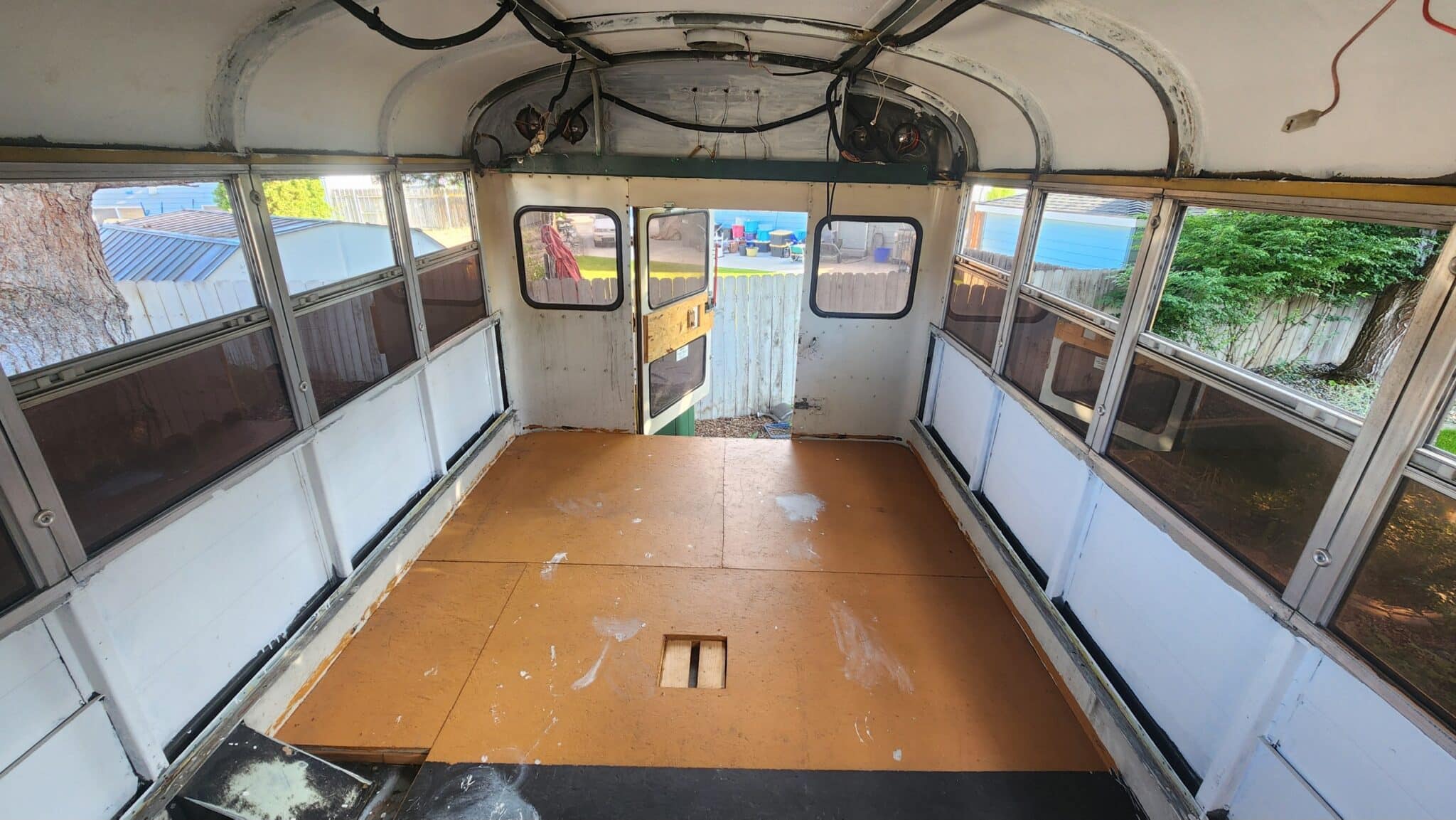
Ceramic and porcelain tile. Probably the biggest offender. A full bathroom tiled in porcelain can add 400 to 600 lbs with thinset, grout, and cement backer board. The alternative? Luxury vinyl tile or PVC wall panels that look like tile. Way lighter, won’t crack on the road.
Granite countertops. A six-foot granite countertop can weigh 200+ lbs. Butcher block is lighter at 80 to 100 lbs. Laminate over plywood even lighter. Epoxy-coated plywood looks great and weighs almost nothing compared to stone.
Solid hardwood flooring. Oak or hickory across a full-size bus can run 600 to 800 lbs. Luxury vinyl plank does the same job at maybe 200 to 250 lbs. I’ve seen side-by-side comparisons where I genuinely couldn’t tell which was the real wood until I touched it.
Residential water heaters. A 40-gallon tank water heater is over 100 lbs empty and 430+ lbs full. Tankless water heaters weigh 15 to 25 lbs and heat on demand. No contest.
The general rule I came away with: whenever you’re picking a material, check the weight per square foot, multiply it across your build, and ask if there’s something that does the same job at half the weight. Nine times out of ten, there is.
How to Weigh Your Bus (CAT Scales and More)
So you’ve been tracking weight on a spreadsheet and you think you’re fine. Great. Now go actually weigh it, because I can almost guarantee your spreadsheet is wrong.

CAT Scales are the go-to. There are over 2,300 locations across the US, mostly at truck stops like Pilot, Flying J, Love’s, and TA. You pull onto the scale, they weigh you, and you get a ticket with three numbers: steer axle weight, drive axle weight, and gross weight. Costs about $13 to $16 and takes five minutes.
I remember reading a post from a builder who’d been meticulous about his spreadsheet, had every board and every screw accounted for, and was confident he was 2,000 lbs under. First trip to a CAT Scale? He was 800 lbs OVER. All the stuff he hadn’t tracked — hardware, adhesives, caulk, wiring, paint, the toolbox under the bed, personal items — added up to nearly 3,000 lbs more than his spreadsheet showed. That’s not uncommon.
You can download the CAT Scale app (Weigh My Truck) and find locations near you. The approach that makes the most sense to me is weighing before you start the build to get an accurate curb weight, then at major milestones, and once more when you’re fully loaded for travel.
Other options: gravel yards and junkyards sometimes have scales and will weigh you for a few bucks. Recycling centers too. For precise weight distribution, portable wheel scales can show the weight on each individual wheel, though they’re $200 to $400 for a set.
The axle weights matter just as much as the total. You could be under your total GVWR but over on one axle if your build is heavier in the front or back. A lot of people put the heavy stuff — water tanks, batteries, kitchen — toward the rear, and that rear axle can be overloaded even when the total looks fine.
What Happens If You Go Over
Alright, so what actually happens if you’re over your GVWR? This is where it goes from inconvenient to genuinely serious.

First, the mechanical stuff. Your tires are load-rated, and when you exceed that rating, they run hotter, wear faster, and become significantly more likely to blow out at highway speed. Your brakes are the same deal — add a few thousand extra pounds and your stopping distance increases, brake fade happens sooner. Overloaded leaf springs sag, which changes your ride height, headlight aim, and how the bus handles turns. I’ve seen photos of buses where the rear end was sagging so badly the tires were rubbing on the wheel wells.
Then there’s the legal side. Converted buses do get pulled into weigh stations sometimes, and being over your GVWR is a violation. Fines vary by state but they can run from a couple hundred dollars up to thousands. Some states fine per pound over the limit. And in some cases, they won’t let you drive away until you offload enough weight to be legal. Imagine being told at a weigh station in Nevada that you need to leave 2,000 lbs on the side of the road.
The insurance angle is the scariest part honestly. If you’re in an accident and the investigation shows you were over your GVWR, your insurance company has grounds to deny the claim. A guy on a bus life forum told me he knew someone who rear-ended a car because the brakes couldn’t stop his overloaded bus in time, and the insurance company denied everything. The guy was personally liable for medical bills. That is not a position you want to be in.
So what do you do if you’re over? The obvious answer is remove weight — swap heavy materials for lighter ones, downsize your water tanks, ditch stuff you don’t need. The less obvious option is upgrading suspension, tires, and brakes. Airbags, higher load-rated tires, better brake components. But here’s the important thing — none of that changes your GVWR. The GVWR is set by the manufacturer and stays what it is regardless of what you bolt on. You might be physically more capable of handling the weight, but you’re still legally over. It’s a gray area that a lot of people drive around in, and I’m not going to tell anyone what to do, but you should know the risks.
So Where Does That Leave You
After all the research I did on this, the thing that stuck with me is that weight management isn’t something you deal with at the end of a build. It’s something you plan for from day one. Know your GVWR before you design anything. Weigh the bus empty before you start. Pick materials with weight in mind.
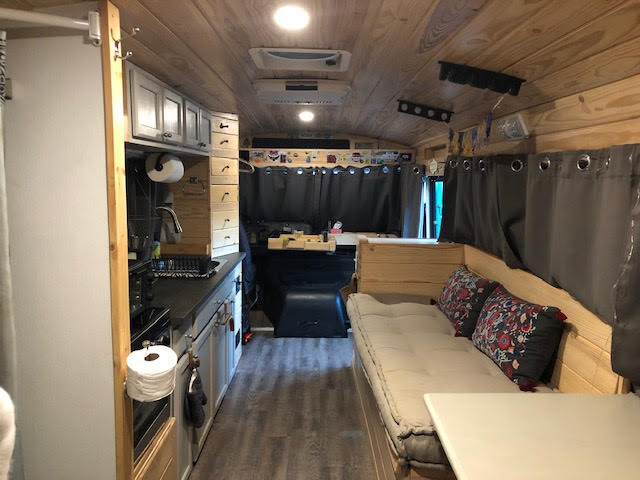
The builders who run into trouble are the ones who design first and check the numbers later. They fall in love with a material choice and find out three months in that they’ve used up their weight budget on framing and flooring, and they haven’t even added water tanks yet. By then you’re either ripping stuff out or accepting the risk. Neither feels great.
The good news is lightweight alternatives exist for almost everything now. You don’t have to sacrifice the look or feel of your build to stay under your GVWR. You just have to make those choices intentionally. A CAT Scale costs less than $16 and takes five minutes. There’s really no excuse not to know where you stand.