
Owning a skoolie means owning a commercial vehicle, and commercial vehicles need a real maintenance schedule. Not a vague “change the oil when the light comes on” kind of schedule — an actual plan with actual intervals.
Keeping a skoolie running well isn’t complicated, but it does require consistency. These are diesel engines built for hundreds of thousands of miles, and they’ll happily get there if you take care of them. The problem is that most people coming into bus life have only ever maintained a car, and a school bus has systems a car doesn’t — air brakes, air dryers, coolant filters, wheel seals, and a whole lot more rubber exposed to the elements. The maintenance isn’t hard. It’s just different. Follow a basic schedule and you’ll avoid 90% of the horror stories people post about online.
Daily Checks (Before You Drive)
I know, I know. Nobody wants to hear that there’s stuff to do every single day before you drive. But hear me out, because this takes about five minutes and it’s the single best habit you can build as a bus owner.
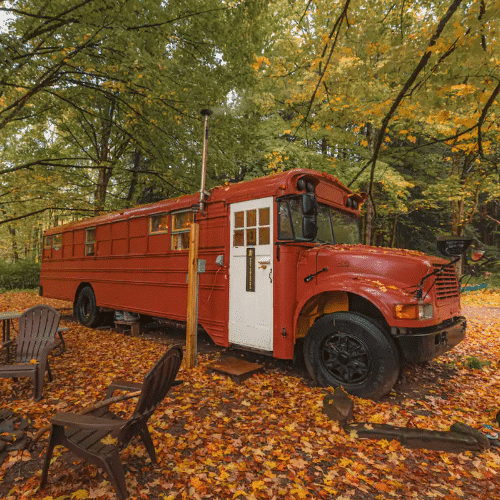
Walk around the bus. That’s it, that’s the first step. Do a literal lap around the outside. You’re looking for anything that changed overnight — a new puddle underneath, a tire that looks low, something hanging down that wasn’t hanging down before. I started doing this after I read about a guy who drove 30 miles before realizing his rear driveshaft was dragging on the pavement. A walk-around would have caught that in about four seconds.
Pop the hood and check your oil level. Takes thirty seconds. Check your coolant overflow tank while you’re there. If you’re losing coolant between checks, that’s a problem you want to catch early, not after the engine overheats on a mountain pass in July. Give your belts a quick look too — fraying or cracking means replace them now, not later.
And then start it up and just listen. You live in this thing, so you know what it sounds like. Any new noise — a tick, a whine, a knock, a squeal — that’s your bus trying to tell you something. I’ve talked to enough people in the community to know that almost every major repair started as a minor noise somebody ignored for two weeks.
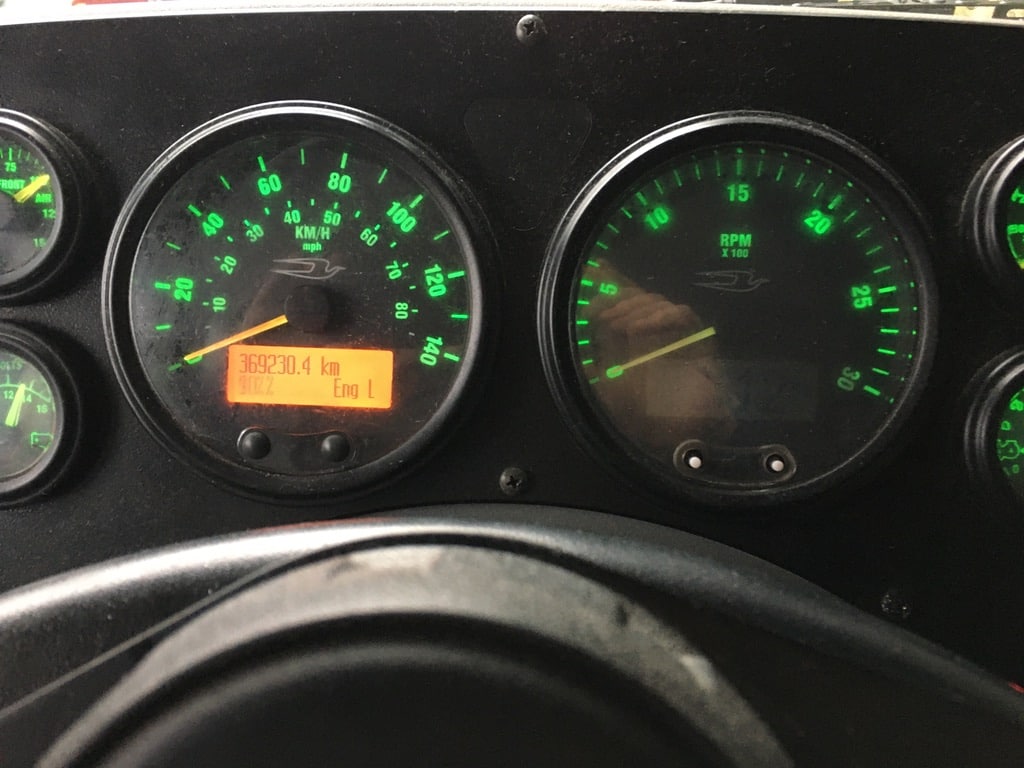
Air pressure is the last one. If your bus has air brakes, watch your air pressure gauge. It should build to operating pressure within a couple minutes. If it’s slow to build or you can hear air leaking, you’re not driving anywhere until that’s sorted out. Low air pressure means your brakes are going to lock up, which is exactly as fun as it sounds.
Monthly Maintenance
Monthly stuff is where you go a little deeper than the daily walk-around. Set a day each month — first Saturday, whatever works — and just knock it out.
Check all your fluid levels properly. Not just oil and coolant, but transmission fluid, power steering fluid, brake fluid if you have hydraulic brakes, and windshield washer fluid. Transmission fluid on an Allison should be checked warm and at idle, by the way. The procedure is different than a car, and checking it wrong will give you a bad reading. Your Allison manual will spell out exactly how to do it.
Inspect your air filter. Pull it out and look at it. Hold it up to light — if you can see light through the pleats, it’s still good. If it’s solid brown and caked, swap it out. How fast your air filter gets dirty depends entirely on where you’re driving. Desert? Dusty roads? You might go through filters faster than someone who sticks to highways. I was surprised to learn how much of a performance difference a clogged air filter makes on a diesel. It’s not subtle.
Battery terminals. Check them for corrosion. Clean them if they’re getting fuzzy. This is one of those things that costs you nothing to maintain but will leave you stranded if you ignore it. A wire brush and some dielectric grease is all you need.
Grease your chassis. School buses have grease fittings — zerks — on the steering components, suspension, and sometimes the driveshaft. A grease gun costs maybe $30 and a tube of grease is a few bucks. Hit every fitting until you see fresh grease squeeze out. This prevents metal-on-metal wear on joints that are really expensive to replace. Look up a diagram for your specific chassis because the number and location of zerks varies.
Check your lights. All of them. Headlights, taillights, brake lights, turn signals, clearance lights. States absolutely will pull you over for a busted clearance light on something that looks like a converted bus. I’ve heard that story enough times from people in the community that I believe it.
Take a look under the bus while you’re at it. New leaks, loose exhaust hangers, anything that shifted or came loose. Buses vibrate. Things work themselves free over time.
Every 3,000-5,000 Miles (Oil and Fluids)
This is the big one that people obsess over, and honestly it’s also the simplest one. Change your oil and filter.
The exact interval depends on your engine and who you ask. I landed somewhere in the middle — 5,000 miles for normal driving, shorter if you’re doing a lot of idling or dusty conditions. The DT466, Cummins 5.9, Cummins 8.3, and Cat 3126 all have slightly different manufacturer recommendations, so check your specific engine manual.
An oil change on a bus is more oil than you’re used to. Most school bus diesels take somewhere between 10-15 quarts depending on the engine and filter. That’s roughly three to four times what a car takes. Budget maybe $60-$100 in oil and filter if you’re doing it yourself, more like $100-$150 at a shop. Not outrageous for a vehicle this size.
While you’re doing oil, change your fuel filters too. Diesel fuel filters are cheap — $15-$30 depending on the engine — and they’re doing a lot of work keeping junk out of your injectors. Injectors are expensive. Fuel filters are cheap. The math works itself out pretty quick. Most diesel engines have a primary and secondary fuel filter, so make sure you’re getting both.
Check your coolant condition while you’re at it. Diesel coolant needs supplemental coolant additives — SCAs — to prevent cavitation of the cylinder liners. This is something people coming from the car world don’t know about, and if you skip it long enough, it’ll eat pinholes through your cylinder walls. Some engines use a coolant filter with SCAs built in, so changing the filter automatically replenishes them. Check what your engine uses.
Transmission fluid and filter changes happen on a longer interval — typically every 25,000-50,000 miles for an Allison. But check the level and condition at every oil change. It should be red or pink. If it’s brown or smells burnt, you’ve got problems.
Seasonal Checks (Spring and Fall)
So I actually think of skoolie maintenance in two big seasonal chunks, and they roughly line up with when the weather changes dramatically. Spring prep and fall prep.
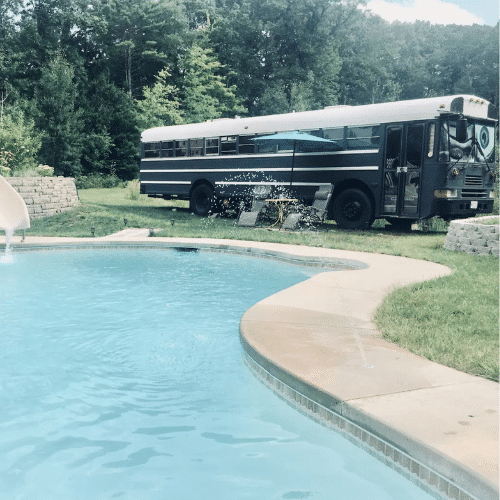
In the spring, you’re transitioning from cold weather to warm. Check your AC system if you have one — the compressor, the hoses, and make sure the condenser isn’t clogged with bugs and road grime. Clean it out with a garden hose. Bus AC systems have more potential leak points than a car, especially if you’ve modified things during your build.
Spring is also when you deal with anything that winter may have damaged. Road salt is murder on the underside of a bus. Get under there and look at your frame, brake lines, fuel lines. If you see heavy rust or scaling, treat it now. I talked to a skoolie owner once who lost a brake line to corrosion, and he told me the scariest moment of his life was pressing the brake pedal and feeling it go straight to the floor. Spring is when you prevent that from being your story.
Check your tires carefully in spring too. Look for sidewall cracking and check the date codes — those four digits that tell you the week and year of manufacture. Tires older than 7 years should be replaced regardless of tread depth.
Fall prep is about getting ready for cold. Check your block heater if you have one. Test your glow plugs or intake heater. Make sure your batteries are strong — a battery that’s marginal in September will leave you stranded in December. And check your antifreeze protection level. A refractometer costs about $15 online and is way more accurate than the cheap ball-float testers.
Here’s one I didn’t think about until someone mentioned it to me — your fuel. Diesel gels in cold weather. You need either winterized diesel or a fuel additive to prevent gelling. If your bus sat all summer running on summer diesel and you suddenly drive it into a cold snap, you can wake up to a bus that won’t start because the fuel turned to jelly in the lines.
Annual Maintenance
Once a year, you go through everything more thoroughly. Think of it like an annual physical for your bus. Some of this you can do yourself, some of it you might want a shop to handle.
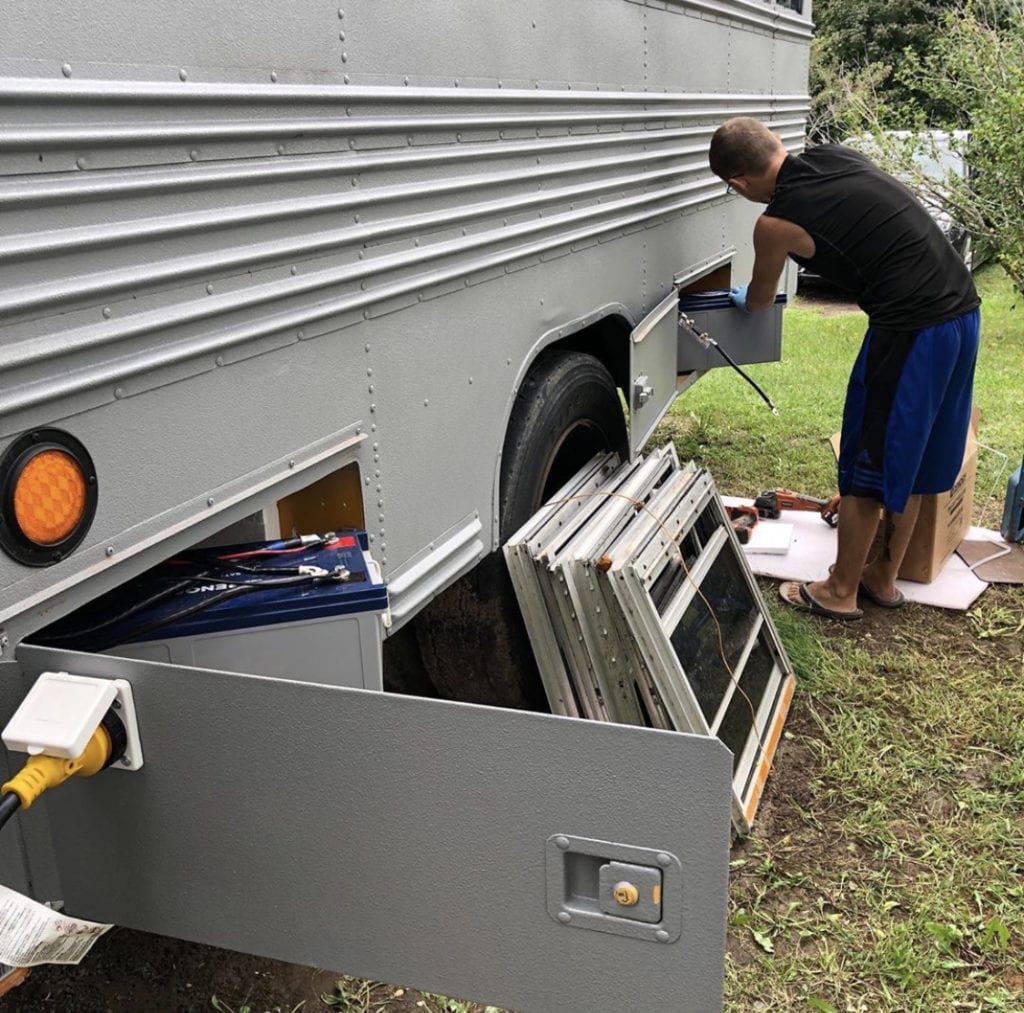
Brake inspection is the big annual item. If you have air brakes, check the brake shoe thickness, the drums for scoring or cracking, the slack adjusters for proper adjustment, and the air chambers for leaks. If you have disc brakes, check pad thickness and rotor condition. Brakes are not the place to cheap out or procrastinate. A full brake inspection at a commercial vehicle shop runs maybe $100-$200 and it’s money well spent.
Get your coolant tested properly, and if it’s been two years or more, flush and replace it. The SCAs deplete over time even if the coolant looks fine. The system holds 6-10 gallons depending on the bus, so it’s a bigger job than a car, but still straightforward.
Check your suspension. Leaf springs crack. U-bolts loosen. Bushings wear out. Shocks lose their effectiveness. Get under the bus and look at everything. If the bus is sagging on one side or bouncing more than it used to, something in the suspension needs attention.
Steering components deserve a close look annually too. Tie rod ends, drag link, pitman arm, steering gear box. Have someone turn the wheel while you watch from underneath. Any play or looseness is a safety issue, and worn steering parts can fail suddenly at highway speed.
I’d also recommend pulling the valve covers once a year and adjusting your valves if your engine requires it. The DT466 and some Cummins engines need periodic valve adjustment. Out-of-spec valves cause hard starting, rough idle, and eventually valve damage. A diesel shop will charge maybe $150-$300 for this, or you can learn to do it yourself with a YouTube video and an afternoon.
And inspect your exhaust system from manifold to tail pipe. Exhaust leaks on a bus you live in are not just a noise issue — they’re a carbon monoxide issue. Make sure your CO detector is working too while you’re thinking about it.
The Stuff People Forget (Roof Seals, Wheel Bearings, Air Dryer)
Alright, this is the section that might save you the most money in the long run because these are the items that don’t show up on most basic maintenance lists but will absolutely wreck your day if you neglect them.

Roof seals. If you’ve done any roof modification — solar panels, a roof raise, vent fans, AC units — you’ve got sealant up there exposed to UV, rain, heat, cold, and everything else. Dicor, lap sealant, whatever you used, it degrades. Check every six months at minimum, reapply at least once a year. Water intrusion from a failed roof seal will destroy your build from the inside out, and you won’t know it’s happening until the ceiling is soft and the mold smell hits you. I’ve read enough forum posts about people tearing open walls to find black mold to know this is not an exaggeration. Get up on the roof, look at every penetration, poke at the sealant. If it’s cracked or pulling away, redo it.
Wheel bearings. Most people never think about them until one fails, and a wheel bearing failure at speed can mean losing a wheel. Front wheel bearings should be repacked or inspected every 25,000-30,000 miles or annually, whichever comes first. When you or your shop does a brake inspection, that’s the time to check bearing play. Any roughness or looseness means it’s time.
The air dryer. If your bus has air brakes, it has an air dryer with a desiccant cartridge that absorbs moisture from compressed air before it hits your brake system. When that cartridge is spent, moisture gets into your air lines. In cold weather, that moisture freezes. Frozen air lines mean no air pressure, which means your brakes lock up. Replace the cartridge annually. It’s a $30-$60 part and takes fifteen minutes to swap. For what it prevents, it’s probably the best value maintenance item on the entire bus.
Fuel tank is another one. Diesel fuel grows stuff in it — algae, bacteria, fungus, whatever you want to call it. Especially in tanks that sit with fuel in them for a while. A fuel biocide additive every few tanks helps prevent this. If your bus sat for a long time before you bought it, consider having the tank cleaned or at minimum draining the old fuel.
And crankcase ventilation. Whether it’s a simple breather tube or a more complex PCV system, it gets gunked up with oil vapor residue over time. If it clogs, pressure builds in the crankcase and you get oil leaks from every gasket and seal on the engine. Check it once a year, clean it or replace it.
After digging into all of this, here’s what I keep coming back to. The people who have major mechanical problems with their skoolies are almost always the people who skipped the boring routine stuff. They drove 15,000 miles without an oil change. They never greased the chassis. They didn’t check their coolant chemistry. And then when something big fails, they post online about how buses are unreliable money pits, and the cycle continues.
The reality is these buses were maintained by professional fleet mechanics on strict schedules when they were in service, and they ran fine for 15-20 years. Your bus doesn’t need less maintenance now that it’s a home — it needs more, because there’s no fleet shop keeping an eye on it. You’re the fleet mechanic now. Keep a notebook, write down what you did and when, stick to the schedule. That’s the whole secret.