
If you’ve got kids and you’re thinking about bus life, this is probably the question that keeps you up at night. I know it was for me. You can figure out plumbing and solar later, but your kids being safe while a 30,000-pound bus is rolling down the highway? That needs to be answered first. (See our guide on Is It Safe to Live in a Bus During a Storm? for more on this.)
The short answer is you install proper passenger seats with three-point seatbelts, bolt them through the floor into the steel frame, and secure car seats using LATCH anchors or the seatbelt system just like you would in any other vehicle. You don’t strap car seats to couches. You don’t let kids roam free while driving. You treat the cab area of your skoolie the same way you’d treat a car or truck when it comes to child safety, because the physics of a crash don’t care that you live in a cool bus.
“How do you keep the kids safe while driving? Do you have car seats that can be secured into the couches?”
I kept seeing this exact question come up in forums and comment sections, and I think it comes from a really understandable place. People see these beautiful skoolie builds with custom couches and dinettes, and they naturally wonder if you can just strap a car seat to that. The answer is no. Not safely, and not legally in most states. (See our guide on Can You Legally Live in a Converted School Bus? for more on this.)
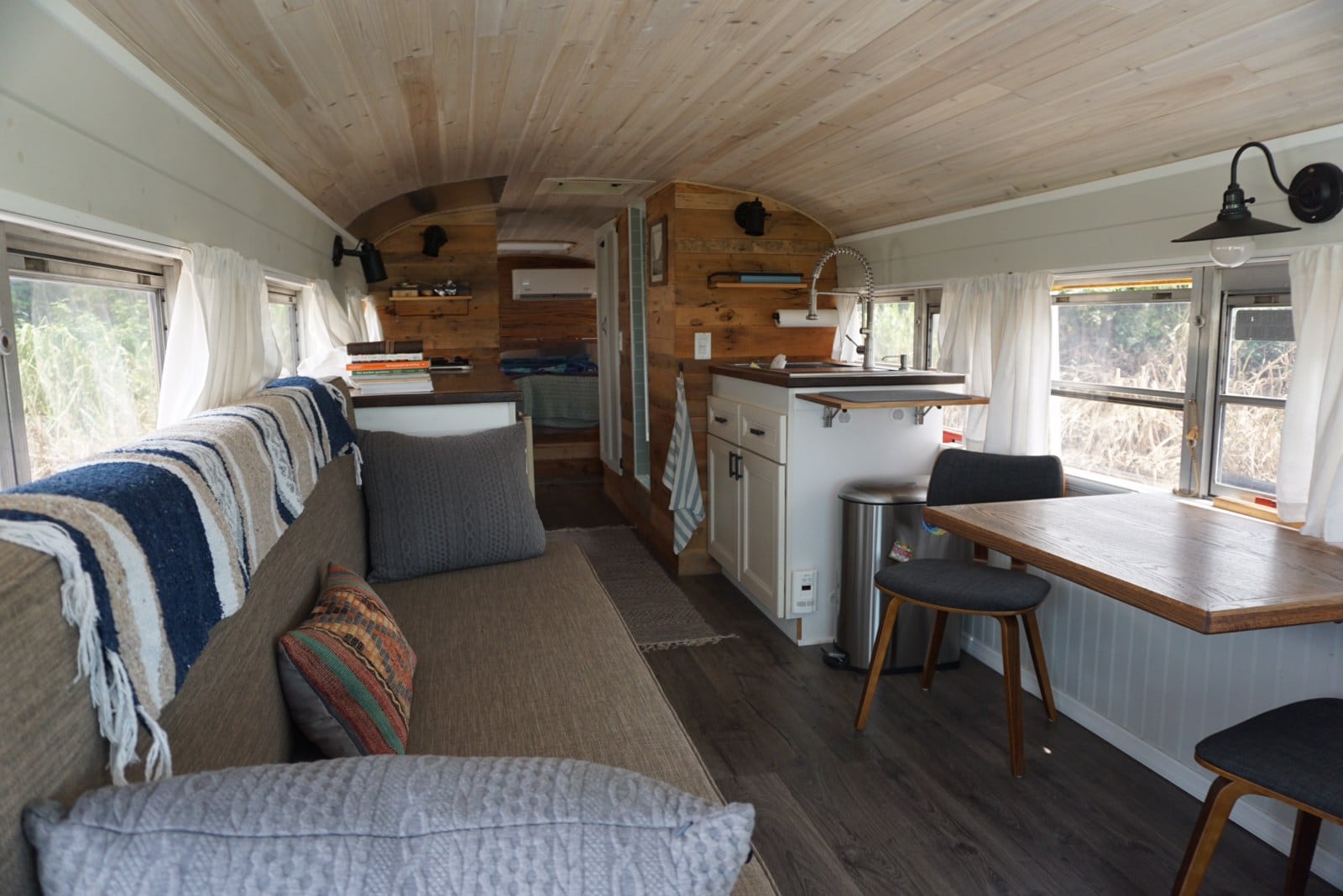
Here’s the thing about couches in a skoolie. Even a really well-built couch is furniture. It’s not crash-tested. It’s not anchored to the frame the way a proper seat is. The mounting points aren’t designed to withstand the forces of a collision. I found one forum post from a guy who tested this with a sudden stop in a parking lot, not even a crash, and the couch slid forward on its mounts. A car seat attached to that couch would have gone right with it.
What you actually need is a dedicated passenger seat, either an original bus seat you kept during the conversion or an aftermarket seat designed for vehicle use. These get bolted through the floor and into the steel frame of the bus. Not into plywood. Not into the subfloor you built for your nice flooring. Into the actual structural steel.
I talked to a welder at a shop outside of Tulsa who does a lot of work for bus families. He told me the most common job he gets is welding LATCH anchor points onto the bus frame so families can click car seats in properly. He charges around $150-200 per anchor point, and he said it takes maybe an hour each. For the peace of mind? That’s nothing.
Once you’ve got proper seats with proper anchors, the car seat installation is identical to what you’d do in a minivan or SUV. Follow the car seat manufacturer’s instructions, use the LATCH system or thread the seatbelt through, and check for movement. The car seat shouldn’t move more than an inch in any direction at the belt path. Same rules apply.
“Where do the kids ride when you’re on the road?”
This varies from family to family, but the setup I’ve seen work best is keeping the first two or three rows of original bus seats directly behind the driver. That puts the kids right up front where you can see them, talk to them, hand them snacks, and keep an eye on what’s going on without craning your neck around.
Some families rip out all the original seats and install aftermarket options instead. Van seats from a Ford Transit or Sprinter are popular because they’re narrower, more comfortable, and already come with three-point seatbelts and LATCH anchors built in. You can usually find them at salvage yards for $100-300 per seat. I spent a whole afternoon one time browsing salvage yard listings online and was surprised how many options there were.
Now, the part that trips people up is this. When the bus is moving, every single person needs to be in a seat with a seatbelt on. Period. No exceptions. I don’t care if the kid is crying and wants to lay down in the bunk. I don’t care if it’s only a five-minute drive to the next campsite. The bus does not move unless everyone is buckled. This is the rule that experienced bus families told me matters more than anything else, and honestly it’s the same rule you’d follow in your car. (See our guide on What Happens If Your Skoolie Breaks Down? for more on this.)
Some families with older kids (teenagers mostly) put their seats further back in the bus, closer to the living area. That works fine as long as the seats are properly mounted and belted. But for younger kids, especially ones still in car seats, keeping them close to the front just makes practical sense. You can reach them. You can see them in a mirror. And if something happens, you’re right there. (See our guide on How Do You Get a Mailing Address Living in a Bus? for more on this.)
One thing I noticed talking to families is that the driving days become their own kind of routine. Kids know where their seat is. They’ve got their books or tablets or whatever loaded up. Some families have a little cubby or pouch attached to the seat back for each kid’s stuff. It’s not that different from a long road trip in a regular car, honestly. It just looks different because the vehicle is bigger.
“What about seatbelts for the family in case of an accident while traveling?”
So this is where it gets into some legal territory that I found really interesting when I was digging into it.
Here’s a fact that surprises a lot of people. Original school buses don’t have seatbelts. Those bench seats in a yellow school bus rely on something called “compartmentalization,” which is basically the idea that the high-backed, closely spaced seats act as a protective cage during a crash. The NHTSA has studied this for decades and it works well for buses full of school-age kids sitting in forward-facing bench seats.
But here’s the problem. Once you convert the bus, you’ve removed most of those seats. The compartmentalization concept goes out the window. Your custom couch, your dinette bench, your bed — none of that is providing crash protection. So you absolutely need proper seatbelts for everyone who’s riding in the bus while it’s moving.
Most states require seatbelts for all passengers in a motor vehicle, and once your bus is re-titled as a motorhome or RV, those laws apply to you. Some states are stricter than others. I found that a few states still have older laws on the books that technically exempt buses from seatbelt requirements, but relying on a legal technicality for your kids’ safety is not something I’d recommend to anyone.
The setup most families go with is three-point lap-and-shoulder belts. These are the same seatbelts you’ve got in your car. They bolt to the seat frame and the floor, and they need to be rated for the weight they’re going to hold. You can buy retrofit seatbelt kits for around $40-80 per belt, and installation isn’t too bad if you’re handy with a wrench and a drill. The important part is that the mounting points go into structural steel.
I read about a family in Colorado who got rear-ended on I-70 while driving their skoolie. Their two kids were in proper car seats bolted to original bus seats with three-point belts. The impact crumpled the rear bumper and pushed the back wall in about eight inches. Nobody in the family was hurt. The car seats did exactly what they were supposed to do. That story stuck with me because it proved this stuff works when you do it right.
Also worth mentioning, you need to check the seatbelt laws for every state you’re driving through, not just your home state. What’s legal in Texas might not be legal in California. I keep a note in my phone with the basic requirements for each state, and I update it before any big trip. There are websites that compile state-by-state car seat and seatbelt laws, and I’d recommend bookmarking one of those.
“Would love to start doing this but how do you do it with 5 kids who still need car seats?”
Five car seats is no joke. I’m not going to pretend that’s easy because it’s genuinely one of the hardest configurations to plan for. But families are doing it, and I’ve talked to a couple who made it work really well.
The first thing you need to accept is that the car seat situation drives the entire build. Not the kitchen. Not the bathroom. Not the cool Instagram-worthy living room. The car seats come first, and everything else gets designed around whatever space is left. I know that sounds limiting, but honestly it’s just good prioritization. (See our guide on How Do You Get Internet and WiFi Living in a Bus? for more on this.)
On a full-size 40-foot bus, five car seats take up roughly two to three rows depending on the width of the seats you’re using. Narrower car seats like the Diono Radian (about 17 inches wide) let you fit three across in a single row. So two rows could handle six car seats if you needed them to. Three wider seats might need three rows, which eats up about 6-8 feet of your floor plan.
One family I connected with online had five kids ages 1 through 7. They kept three rows of original bus seats, added three-point seatbelts and LATCH anchors to each one, and managed to fit all five car seats across those three rows. The oldest two were in booster seats, which take up less room. The youngest three were in convertible seats. They planned it on paper first, literally cutting out cardboard templates the size of each car seat and laying them on the bus seats to make sure everything fit before buying a single thing.
That’s actually a tip I’d pass along to anyone in this situation. Before you spend a dime, measure everything. Measure your bus seats or whatever passenger seats you’re planning to install. Measure the car seats. Account for the width of the buckles and the angle of the seat when it’s reclined for an infant. These things matter when you’re trying to fit three across.
The other thing that helps with five kids is understanding that this changes over time. A 1-year-old needs a rear-facing infant seat that takes up a ton of space. By the time they’re 4 or 5, they’re in a forward-facing seat that’s much more compact. By 7 or 8, depending on the state, they might be in just a booster or even just a seatbelt. So the tightest years are when you’ve got multiple kids under 4. After that, it starts opening up.
Some families also stagger their approach. They use a tow vehicle or a follow car for the first few years when the car seat situation is at its worst. One parent drives the bus, the other drives the car with a couple of the kids. It’s not ideal, but it solves the space problem until the older kids age out of car seats. I wouldn’t personally love this solution, but I’ve heard from families who say it worked well for them during a transitional period.
The cost for all this isn’t crazy either. Five car seats run anywhere from $200 to $1,500 depending on what you buy. The seatbelt and LATCH installation for five positions is maybe $500-800 if you’re having someone else do the welding. Under $300 if you do it yourself and already have the tools. Compared to what you’re spending on the overall bus build, it’s a small fraction for arguably the most important part.
So yeah, five kids in car seats on a skoolie. It’s doable. It takes more planning upfront than most other parts of the build, and you’ll probably redesign your floor plan at least twice before you get it right. But the families who commit to figuring it out seem to come through the other side just fine. The bus is big enough. You just have to be smart about how you use the space.
If you’re planning a family bus build and want the full picture on what life looks like with kids on board, check out our complete guide to bus life with kids. And if you want more on the general safety side of things, our skoolie safety and security guide covers everything from road safety to campsite security.
e71fc8