
If you’re thinking about moving your family into a converted bus, you’ve probably already gotten the look from at least one person. That mix of curiosity and judgment. I get it. The idea of raising kids in 250 square feet sounds either incredible or insane depending on who you ask, and honestly, some days it’s both.
Families of all sizes live full-time in converted buses, and they make it work. The biggest concerns, car seat safety, education, privacy, growing kids, and healthcare, all have real solutions that thousands of families are already using. This guide covers every major question parents ask before, during, and after making the switch to bus life with children.
“How do you keep the kids safe while driving? Do you have car seats that can be secured into the couches?”
This is always the first thing parents want to know, and it should be. Let me be direct about this one because safety isn’t the place to get creative or cut corners.
You cannot legally or safely strap a car seat to a couch. Doesn’t matter how sturdy the couch looks. Couches aren’t crash-tested, and the mounting points aren’t rated for the forces involved in a collision. A car seat needs to be secured to a proper seat with either a LATCH system or a seatbelt, same as it would in any vehicle. (See our guide on Can You Legally Live in a Converted School Bus? for more on this.)
So what do families actually do? Most install dedicated passenger seats with three-point seatbelts specifically for the kids. Some families keep the original bus seats in the front rows and add seatbelts to those. Others install aftermarket van seats or truck bench seats with LATCH anchors welded or bolted to the bus frame. The key is that whatever you install needs to be bolted through the floor into the steel frame, not just screwed into plywood subfloor.
I talked to a guy at a bus meetup in Arkansas last year who had five kids, three still in car seats. He kept four of the original bus seats behind the driver, added lap-and-shoulder belts to each one, and had the welds inspected by a local shop. Cost him about $600 total. His kids sat in those seats every single time the bus moved, no exceptions. That’s the standard.
Now, the rules vary by state. Some states require car seats up to age 8 or a certain height and weight. Some require booster seats up to age 12. You need to know the laws for your home state AND any state you’re driving through. This is not optional, it’s the law, and highway patrol doesn’t care that you live in a bus.
“Where do 8 people sit while driving?”
Well, here’s where it gets real for bigger families. A full-size school bus has a GVWR that supports a lot of passengers, but once you rip out all those bench seats to build your home, you’ve got a problem. Where does everyone sit?

The most common solution I’ve seen is keeping 2-4 rows of original seats right behind the driver and converting the rest. That gives you 4-8 passenger spots depending on the seat configuration. Some families install forward-facing bench seats along the wall behind the cab area, with belts anchored to the frame.
Here’s the thing nobody tells you though. The more seats you keep, the less living space you have. A family of 8 keeping four rows of seats is giving up roughly 8-10 feet of floor plan. On a 40-foot bus that’s manageable. On a short bus? That’s basically your whole kitchen. (See our guide on How Do You Get a Mailing Address Living in a Bus? for more on this.)
So bigger families almost always need a full-size bus. That’s just the math. I’ve seen families try to fit 6 people in a short bus and the build always felt cramped. The ones in a 40-footer with proper seat planning? Totally different experience.
“Would love to start doing this but how do you do it with 5 kids who still need car seats?”
Five car seats. Yeah, this is a real scenario and it comes up more than you’d think.
The reality is that you need five proper mounting points, which means keeping enough original seating or installing enough aftermarket seats to handle it. Some families run two rows of three-across seating using narrow car seats (like the Diono Radian which is only 17 inches wide). Others install a dedicated “passenger section” with a bench seat that has five LATCH positions.
I’ll be honest, this is one of those situations where the build gets designed around the car seats first and everything else second. You figure out how much space five car seats need, lock that in, and then plan your kitchen, bathroom, and sleeping area with whatever’s left.
Is it tight? Sure. But people with five kids in a three-bedroom apartment are tight too. At least in the bus, the backyard changes every week.
One thing that helps is that kids outgrow car seats at different rates. A family with a 1-year-old and a 7-year-old doesn’t need five full car seats, they need a mix of infant seats, convertible seats, and booster seats. As the older kids age out, you free up space and can swap to smaller booster seats or just seatbelts.
“The question is: children go through growth spurts, and these bunk beds will not fit the growing kids. What will happen to the small beds when the kids have grown?”
This is one of those questions where you can tell the person has actually thought about long-term bus life, not just the Instagram version.
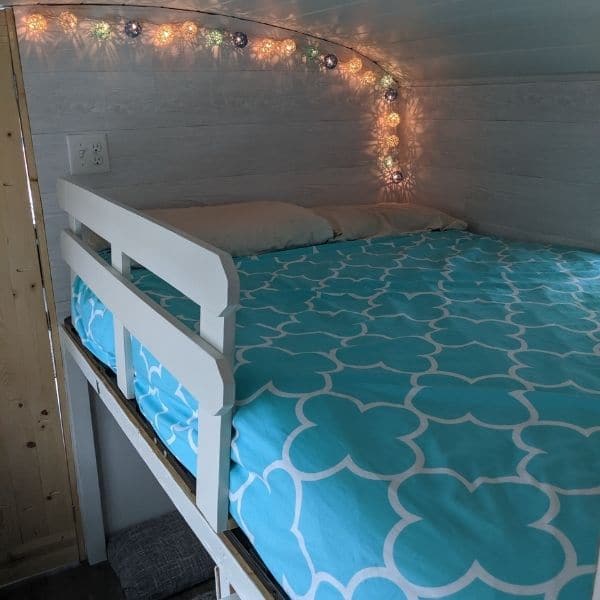
The short answer is you build modular. The families who plan ahead build bunk frames that can be adjusted or reconfigured as kids grow. Some use slotted rails (like a loft bed from IKEA) where you can raise or lower the sleeping platform. Others build bunks with removable side rails so a toddler bunk can become a teen bunk by just pulling the rails off and adding length.
But here’s what actually happens with most families over time. As kids grow, the whole bus layout evolves. What started as four small bunks might become two larger bunks and a fold-down couch bed. Some families have told me they basically do a mini-renovation every 18-24 months as the kids hit growth spurts. It sounds like a lot of work, and it is, but it’s also way cheaper and faster than remodeling a room in a house.
The standard twin mattress is 75 inches long. That works for most kids up through their mid-teens. The real issue isn’t usually length, it’s width and headroom. A 6-year-old doesn’t care about a 24-inch-wide bunk. A 14-year-old absolutely does.
So the families who make this work long-term tend to start with bunks that are at least 28-30 inches wide and have 24-30 inches of headroom. That gives you runway. Not forever, but enough years to figure out what comes next. (See our guide on 11 Ways to Make Money While Living in a Bus for more on this.)
“What about the kids’ education? How does that work? Are they home schooled or doing online classes?”
Education is probably the second biggest question after safety, and I’ve found there’s way more options than most people realize.
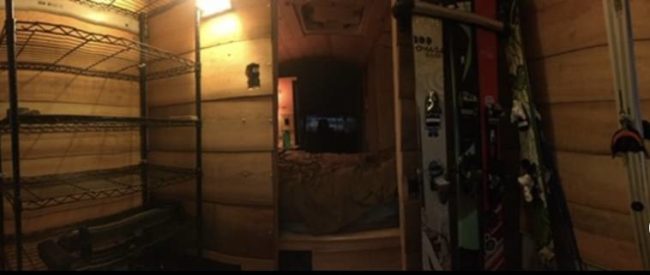
The majority of bus life families homeschool, and that’s a broad term now. Homeschooling in 2026 looks nothing like what it looked like even ten years ago. You’ve got full curriculum programs like Abeka, Saxon, and Classical Conversations that ship you everything. You’ve got online platforms like Khan Academy, Outschool, and Time4Learning where kids attend live classes with teachers and other students. Some families use a hybrid approach, doing core subjects themselves and outsourcing things like foreign language or advanced math to online tutors. (See our guide on 15 Things Nobody Tells You About Living in a School Bus for more on this.)
Then there are the families who unschool, which basically means the travel IS the education. Your kids are visiting national parks, meeting people from different backgrounds, learning geography by actually being there. I’ve met families whose kids can tell you more about geology from visiting the Grand Canyon than most adults learned in a textbook.
Now, before anyone gets worried, homeschooling is legal in all 50 states. The requirements vary. Some states want you to register and submit test scores. Others basically leave you alone. You’ll want to establish your homeschool in a state with reasonable regulations. Many bus families use their domicile state (the same one they use for mail and vehicle registration) as their homeschool state.
What about socialization?
This comes up every single time, and I think it’s worth addressing because it’s a legitimate concern. Kids need other kids. Period.
So how do bus life families handle it? Co-ops are huge. Homeschool co-ops exist in basically every region of the country, and they meet weekly for group classes, field trips, and social activities. Some bus families join multiple co-ops as they travel. Others connect through bus life and RV community groups where families caravan together and the kids basically grow up as a pack.
Sports are trickier but not impossible. Community rec leagues, YMCA programs, and some states allow homeschooled students to participate in public school sports. It takes more effort than just signing your kid up at the neighborhood school, but it’s doable.
I’ve been looking into this topic a lot, and honestly the socialization argument falls apart when you look at the data. Most homeschooled kids, bus life or not, have as many or more social interactions as traditionally schooled kids. They’re just different interactions.
“Can you inform how a family of 5 can do a realistic build?”
Alright, let’s get into the practical side. A family of five means two adults and three kids (or one adult and four kids, which I’ve also seen). You need sleeping space for five, seating for five, and a layout that doesn’t make everyone want to scream by day three.
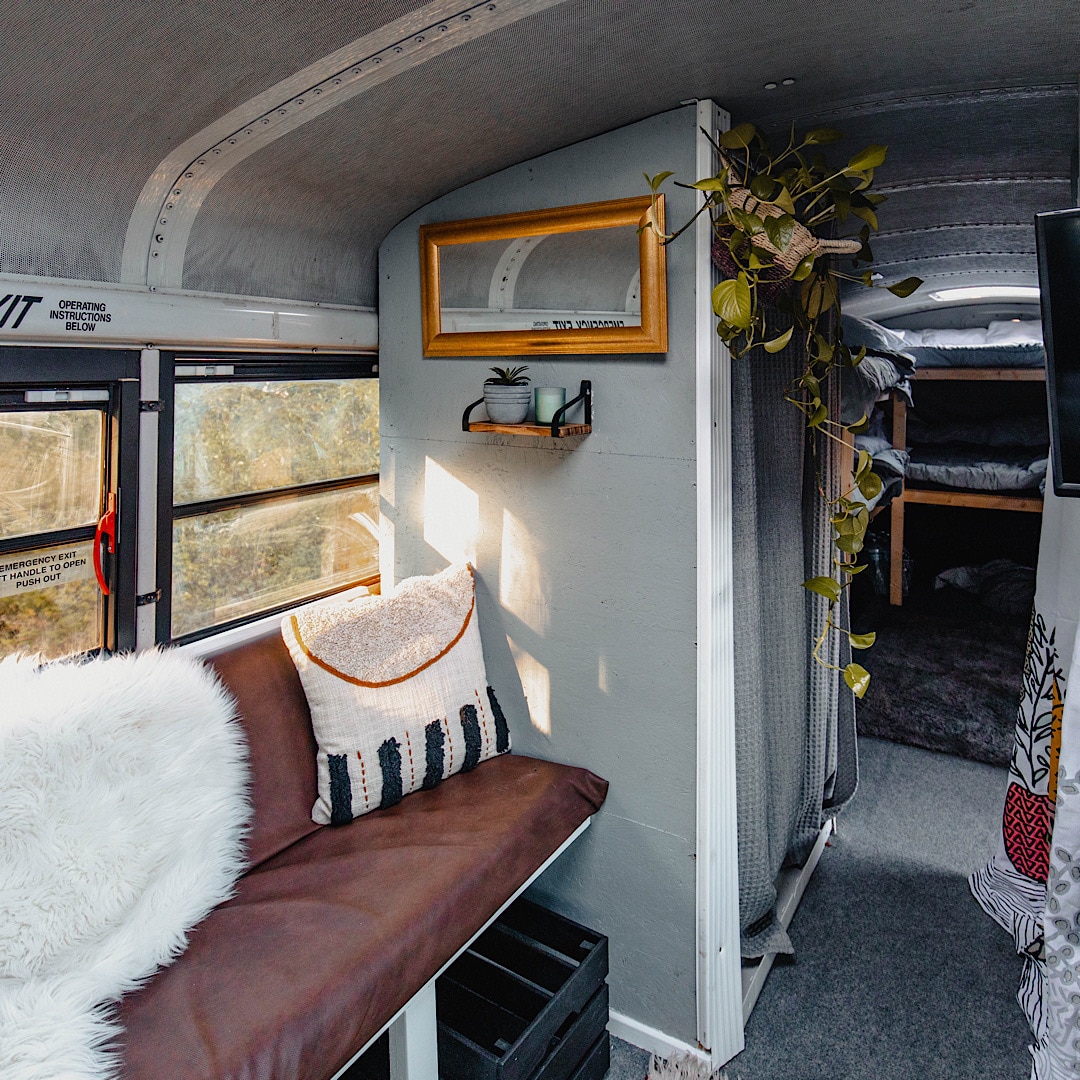
Here’s what a realistic build looks like for a family this size on a full-size 40-foot bus:
Sleeping: Master bedroom in the rear with a queen or full-size bed. Two to three bunks in the midsection. Some families stack three bunks vertically (tight but it works for younger kids) and others do two bunks plus a convertible dinette that becomes a third bed at night.
Kitchen: Standard galley kitchen with a two-burner cooktop, a small oven, a 12V fridge, and counter space. This doesn’t need to be huge. Most bus families cook simpler meals than they did in a house, and that’s honestly fine.
Bathroom: A composting toilet and a small shower stall. With five people, you’ll want at least a 40-gallon fresh water tank, probably closer to 60 if you can fit it. Showers get rationed. Military-style showers (wet, soap, rinse) become the norm, and the kids learn fast.
Living area: A dinette that doubles as school workspace. Maybe a small couch. This is where homeschooling happens, where board games happen, where the family actually lives during waking hours.
Storage: Under-bunk storage, overhead cabinets, and usually some kind of garage or bumper cargo box on the back for outdoor gear, bikes, and seasonal stuff.
Budget-wise? A family of five can do a functional build for $15,000-$25,000 DIY if you’re smart about materials. That’s on top of the bus purchase ($3,000-$7,000). So you’re looking at roughly $20,000-$32,000 all-in for something livable. Not fancy, but livable and safe.
For a deeper breakdown of build costs, check out our School Bus Conversion Cost Breakdown where we go through every system line by line.
“What do yall do for privacy?”
I’m not going to pretend this isn’t a real challenge, because it is. When you’ve got kids in the bus, privacy basically becomes a scheduled event rather than a default state.
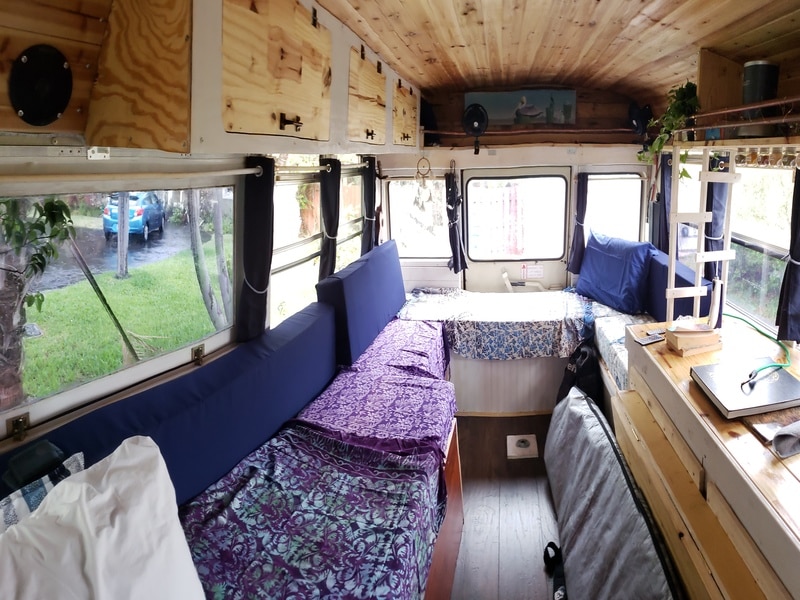
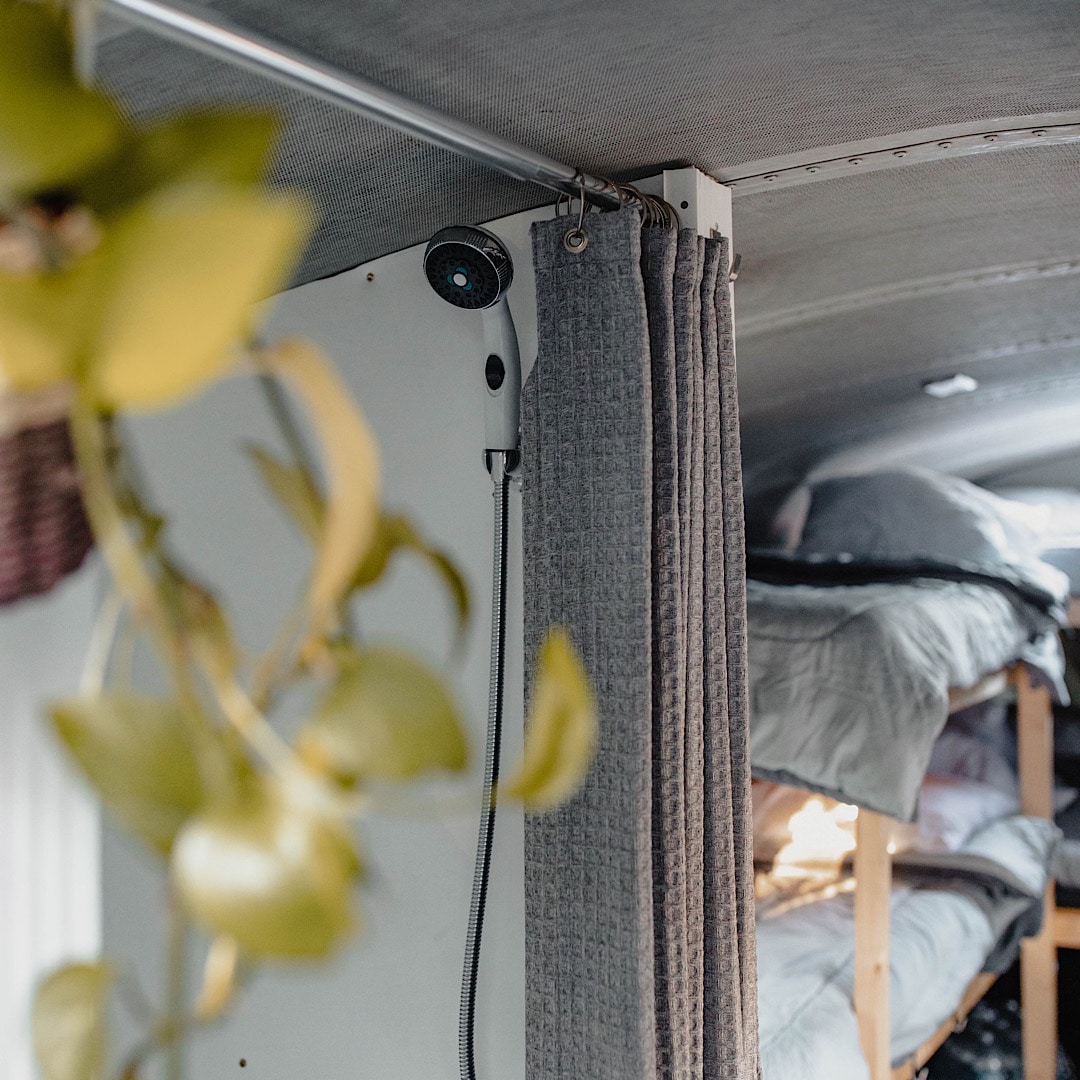
Here’s what families actually do. Curtains are the most common solution, and I don’t mean flimsy ones. Heavy fabric curtains on ceiling-mounted tracks can divide the bus into zones. Master bedroom gets a curtain. Bunk area gets a curtain. Some families even give each bunk its own individual curtain so each kid has a little cocoon.
Beyond curtains, a lot of families I’ve talked to rely on routine. Kids go to bed at 8:30. Adults have from 8:30 to whenever for their own time. During the day, privacy happens when the kids are outside playing. Parked at a campground with a playground? That’s your window.
For couples, the honest answer is you get creative and you plan around the kids’ schedules. Nap time, bedtime, and “go play outside for an hour” time. It’s awkward to talk about but every bus family figures it out. This isn’t unique to buses either, people in small apartments deal with the same thing, they just don’t have to talk about it on YouTube.
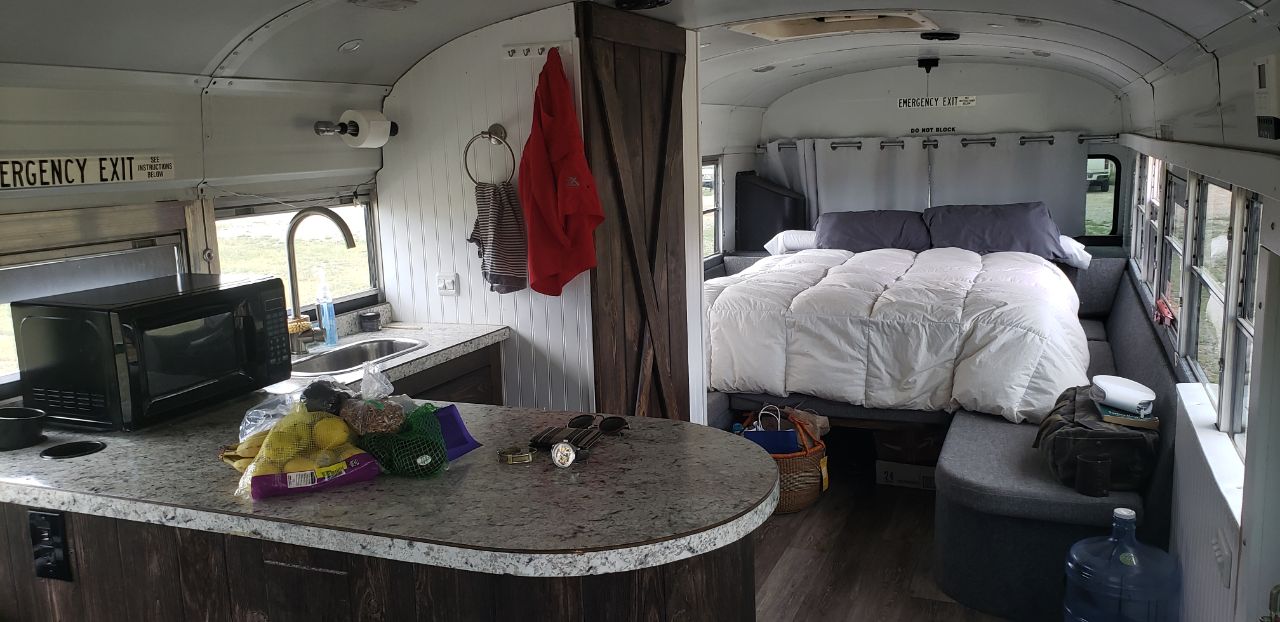
Some families build actual doors for the master bedroom. A pocket door or a barn-style sliding door doesn’t take up much space and gives you a real separation that curtains can’t. If privacy is a major concern (and for most families it is), I’d spend the extra $100-$200 on a solid door instead of a curtain for the master area. Worth every penny.
“How do you care for a sick child in a bunk bed where you can’t access him/her?”
This is the kind of question that only a parent would think to ask, and it’s a good one.
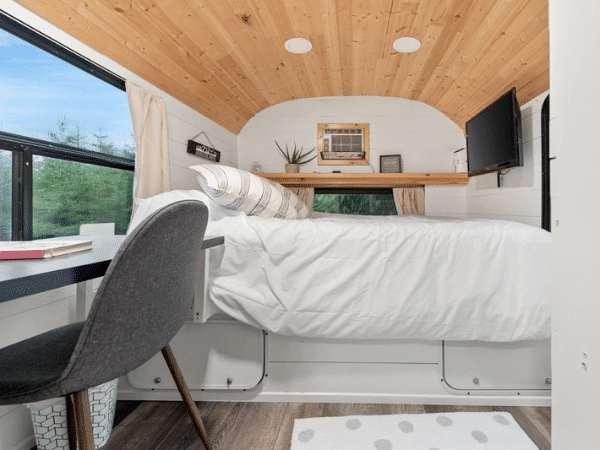
First off, if a bunk is built so tight that an adult can’t reach a sick child, the bunk is built wrong. Even top bunks should have enough access for a parent to lean in, feel a forehead, hand over medicine, or in a worst-case scenario, lift the child out. That means the bunk opening needs to be large enough for an adult’s upper body, not just a kid-sized slot.
Some families handle this by designing bunks with removable or fold-down safety rails, so you can open up the side of the bunk when you need full access. Others build step-and-access combos where the stairs to the top bunk also serve as a platform for a parent to stand on and lean in.
But here’s what most families actually do when a kid is really sick. The sick kid comes down to the couch or the parents’ bed. The bunks are for sleeping, not for being a hospital bed. If your child has a fever and you need to be checking on them through the night, they’re sleeping next to you. That’s just how it works in a small space, and honestly it’s probably better for the kid anyway.
For basic illnesses, you keep a well-stocked medicine kit and you know where the nearest urgent care is. I talked to one family who keeps a laminated card on their fridge with the number for the nurse hotline in their insurance network. Smart move.
Serious illness or injury? You go to the hospital. Same as you would from a house. The bus doesn’t change that equation. You just need to be aware of your proximity to medical facilities, especially if you’re boondocking in remote areas with young kids.
“I wonder how they will adjust to the kids growing older and ultimately needing more space of their own?”
So this is the big long-term question, and anyone who tells you they have a perfect answer is probably selling something.
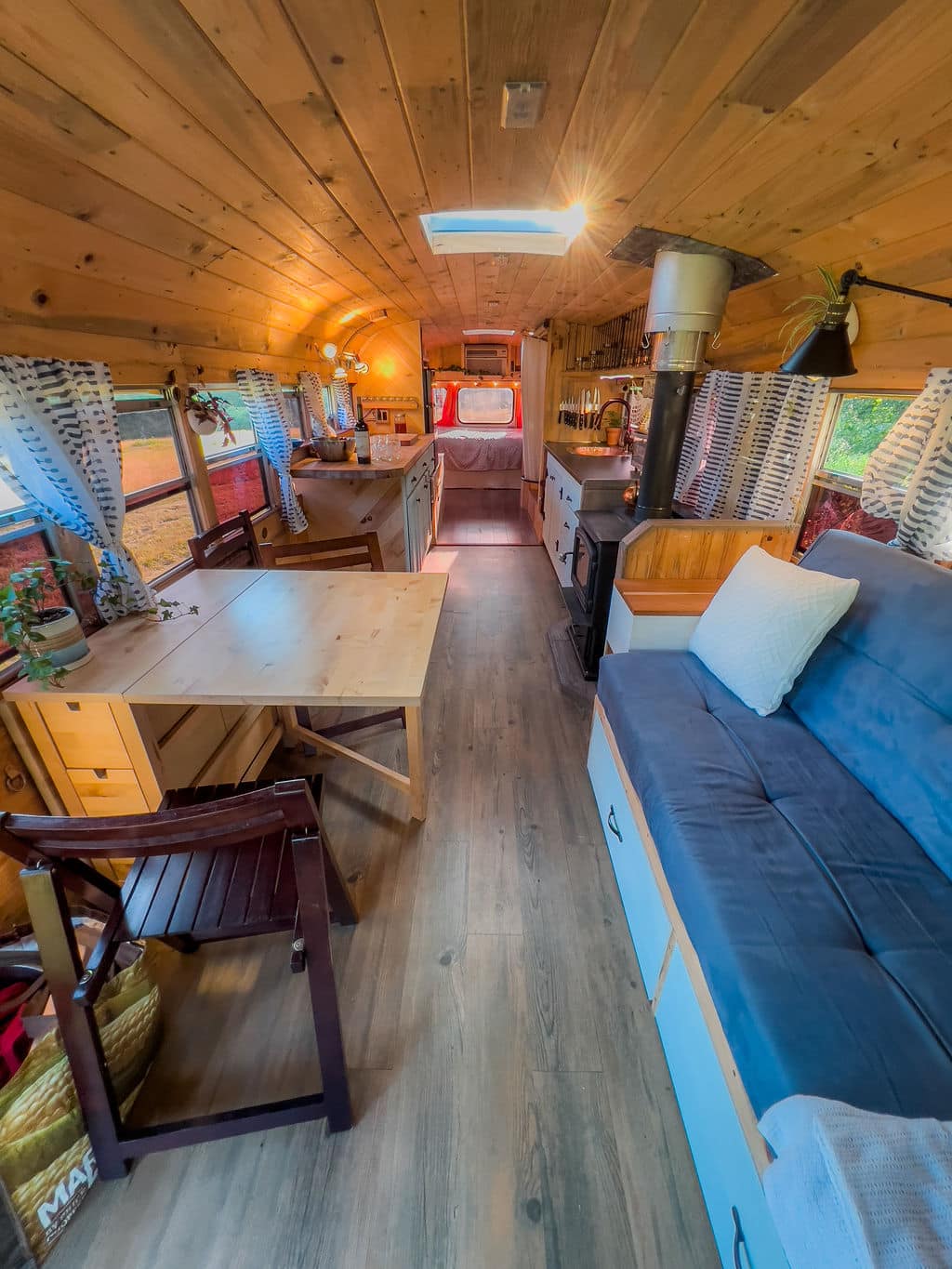
Here’s what I’ve seen happen with families who started bus life when their kids were small. Around ages 10-13, kids start wanting more of their own space. That’s true in a house and it’s especially true in 250 square feet. Some families respond by doing a mid-life renovation of the bus, reconfiguring the layout to give older kids a semi-private area with their own curtained-off section, their own shelf, maybe a reading light and a place to put headphones on and zone out.
Other families accept that bus life has a natural expiration date. They planned to do it for 5-7 years while the kids were young and then transition to something else, maybe land, maybe a house, maybe a bigger rig. That’s not a failure. That’s just planning.
I’ve also met a few families who went the opposite direction. When the oldest hit 15, they bought a second small vehicle, a cargo trailer or a van, and the teenager basically got their own space. Connected to the family but with some breathing room. Is it unconventional? Obviously. But so is living in a bus. (See our guide on How Do You Get Internet and WiFi Living in a Bus? for more on this.)
The truth is that kids growing up changes everything about your space needs, no matter where you live. A three-bedroom house that was perfect for two toddlers feels small with two teenagers too. The bus just compresses that timeline and makes it more visible.
What I keep hearing from long-term bus families is that the key isn’t having a perfect plan for every stage. It’s being willing to adapt. The families who last are the ones who treat the bus as a living thing that changes with them, not a fixed structure they’re trapped in.
Healthcare on the Road with Kids
I wanted to add a section on this because it comes up in almost every conversation about families in buses, even though nobody asked about it as a standalone question. Kids get sick. Kids need checkups. Kids need vaccinations (or you need to navigate exemptions depending on your homeschool state). This stuff doesn’t stop just because you’re on wheels.
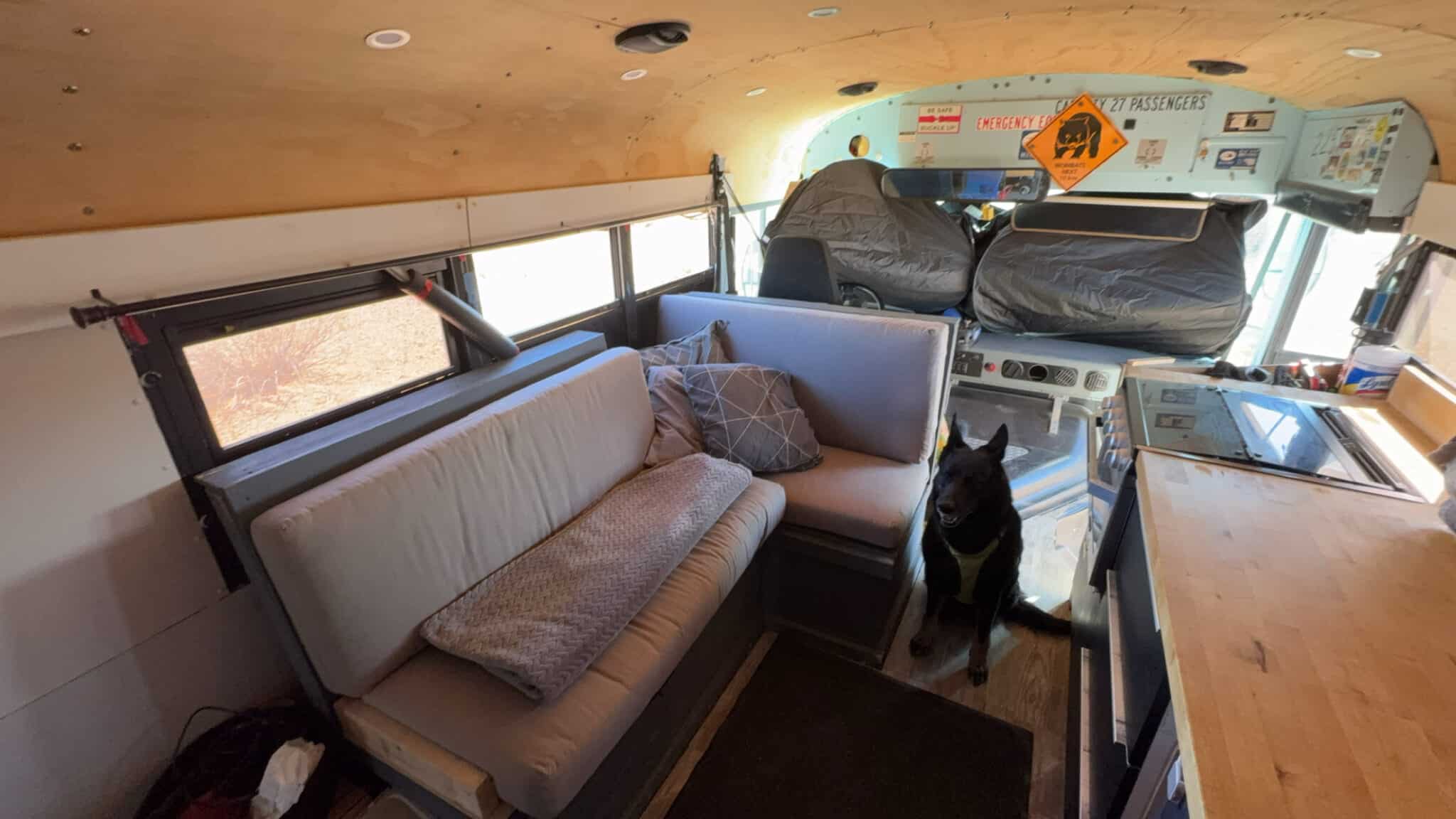
Most bus families use ACA marketplace insurance through their domicile state. For kids specifically, many states offer CHIP (Children’s Health Insurance Program) which is low-cost or free depending on your income. If you’re self-employed or freelancing from the road, you likely qualify.
Dental and vision you schedule when you’re near a city. Some families plan their travel routes around annual checkup schedules. Pull into a town for a week, do all the appointments, stock up on groceries, do laundry, and then head back out.
Prescriptions are handled through mail-order pharmacies or national chains like CVS and Walgreens that you can find almost anywhere. If your kid has a chronic condition that needs regular medication, this works fine as long as you plan refills in advance.
For emergencies, you keep a serious first aid kit (not the $15 one from Walmart) and you know basic first aid. If you’re frequently boondocking in remote areas with kids, an emergency satellite communicator like a Garmin inReach is worth the investment. They run about $300-$400 for the device plus a monthly plan. Cheap insurance when you’re 40 miles from the nearest cell tower with a kid who just broke an arm falling off a rock.
The Emotional Side Nobody Talks About
Let me just say this because I think it matters. Raising kids in a bus is emotionally different from raising them in a house, and not all of it is sunshine and national parks.
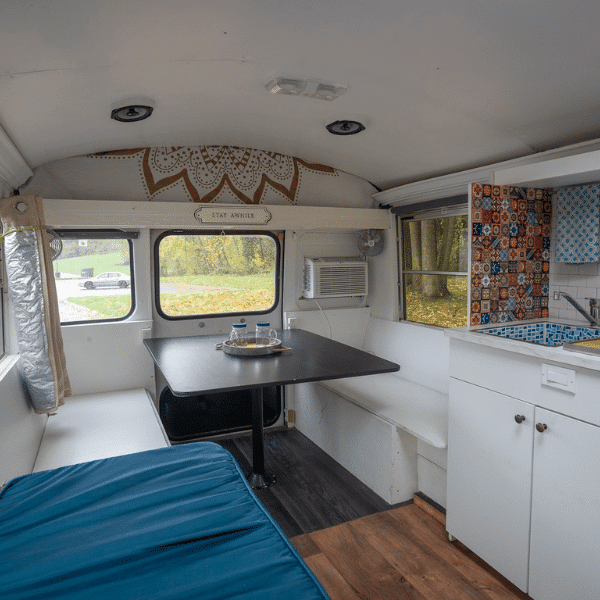
There are days when the rain doesn’t stop and the kids are bouncing off the walls, literally, because the walls are three feet apart and you’re going to lose your mind if someone asks for a snack one more time. There are nights when you wonder if you’re giving your kids a magical childhood or just a weird one.
And then there are the mornings when your 6-year-old wakes up, looks out the windshield at a mountain range they’ve never seen before, and says something that stops you in your tracks. Those moments aren’t manufactured. They happen because you put your family in a position to experience things most kids only see on screens.
I’ve talked to enough bus families to know that the ones who thrive have a few things in common. They communicate constantly, they build routines that give structure to an unstructured life, and they give each other grace on the hard days. The bus isn’t the hard part. The close quarters just amplify whatever’s already going on in the family dynamic, good and bad.
So Is It Worth It?
That’s not a question I can answer for you, and I wouldn’t try. What I can tell you is that thousands of families are doing this right now, and the vast majority of them wouldn’t trade it. Not because it’s easy, but because the hard parts are worth what you get in return.
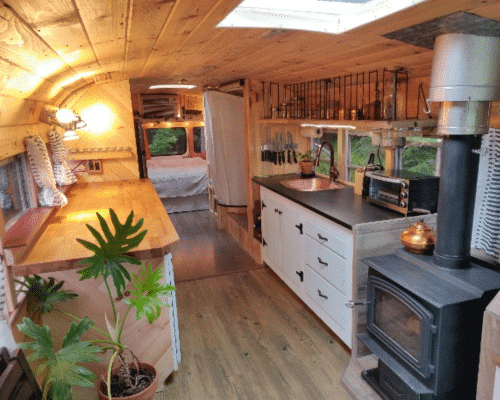
Here’s what you need to figure out before you commit:
- Safety first. Proper seating with seatbelts for every child, every single time. No exceptions, no shortcuts.
- Education has more options than you think. Online programs, co-ops, curriculum kits, unschooling. You’ll find what works for your family.
- Build for growth. Modular bunks, adjustable layouts, and a willingness to renovate as kids age.
- Privacy takes planning. Curtains, doors, routines, and scheduling. It works, but it doesn’t happen by accident.
- Healthcare is solvable. ACA, CHIP, mail-order prescriptions, and planned travel routes around appointment schedules.
- The emotional stuff is real. Talk about it. With your partner, with your kids, with other bus families. Don’t pretend the hard days don’t exist.
You’ll figure it out. Every family does. The fact that you’re reading this and asking these questions means you’re already thinking about it the right way.
y8cwsy
dc2rq5
26jv4l
2wkz6k
rakuf8
wl1vu4
m4e6lh